Showing posts with label 3 star. Show all posts

Thursday, June 26, 2014

The Great O'Malley (1937)

Seems like Pat O'Brien spent his career playing cops or priests, and in The Great O'Malley nothing is anything different for him.  From 1937, this touching, 71-minute, William Dieterle drama features Humphrey Bogart, Ann Sheridan, and child star Sybil Jason in supporting roles.


James O'Malley (O'Brien) is a New York City police officer with a penchant for handing out tickets.  For Officer O'Malley there are absolutely no gray areas---black is always black.  With his overzealous, no-room-for-discussion ways, he hands out tickets left and right.  Continually citing people for old-fashioned ordinances that no one even remembers anymore, such as too many bells on a wagon or a storefront awning being the wrong length, Officer O'Malley has become a pain in the neck to the people on his beat.  His superior warns him that justice needs to be tempered with mercy, but O'Malley just doesn't get it.

One day, he pulls John Phillips (Humphrey Bogart) over for having a loud muffler on his car.  Although Mr. Phillips asks O'Malley to quickly write the ticket because he is on his way to the first job he's had in years, the officer takes his time about things.  By the time Phillips arrives at his job, he's late, and the job has been given to someone else.  With a wife and lame daughter at home, Phillips is desperate and tries to pawn his gun; however, when the pawnshop owner won't pay the amount of money Phillips wants, Phillips clobbers the man on the head and then robs the store, a crime for which he ends up being sentenced 2-10 years.

Officer O'Malley's superior believes that O'Malley's focusing on minor infractions drove John Phillips to crime...had O'Malley not stopped Phillips for something as petty as a noisy muffler, he wouldn't have missed out on the job and wouldn't have been driven to the breaking point.  The police chief believes that O'Malley needs to get a heart and stop harassing people, and in an effort to either make or break the officer, the police captain demotes O'Malley to the position of school-crossing guard.  And it just happens to be the school which John Phillips' daughter, Barbara (Sybil Jason), attends.

Barbara, who walks with a limp, is a kind and loving child, and she soon has stolen the heart of the gruff crossing guard.  She tells him her father is working in Canada, but when Officer O'Malley escorts Barbara home one day, he sees a photo of her father and realizes that he is none other than John Phillips.  At this point, Officer O'Malley is a changed man, and he seeks to undo the damage he caused the little girl's family.  How everything works out is the balance of the film.


Though not spectacular, this really is a gem of a film.  It's tender and touching and even gets me mildly misty-eyed.  It affords the opportunity to catch Humphrey Bogart before he became the huge star that he did (this film came just after The Petrified Forest); plus, the little girl, Sybil Jason, is adorable.  Also, the message of tempering justice with mercy is a good one. I actually came close to giving this 4 stars, but in the end, I went with 3, simply because in films this short, I don't feel the characters or the story are developed enough.  So, this really is a "could have been 4 stars if it was a bit longer" kind of movie.

TCM will be airing The Great O'Malley on Tuesday, July 15th, at 1:30 p.m. (ET).  Plus, the film is out on DVD as part of the Humphrey Bogart Essential Collection.  I do hope you get a chance to see this, as I think it's worth it.

Happy viewing!!

Sunday, February 16, 2014

Golden Boy (1939)

Another of the films highlighted in Majestic Hollywood, The Greatest Films of 1939 is Golden Boy, a boxing drama starring Barbara Stanwyck, Adolphe Menjou, and---in one of his earliest film appearances---William Holden. Based on Clifford Odets' 1937 play, this Reuben Mamoulian film, which features Lee J. Cobb, Joseph Calleia, and Sam Levene in support, garnered a Best Music Academy Award nomination.


Joe Bonaparte (William Holden) is a sensitive young violinist, who lives with his father (Lee J. Cobb), sister, and brother-in-law above the family's grocery store.  Although Joe plays the violin beautifully and could possibly have a future in music, he wants to make money quickly and, therefore, begins boxing for Tom Moody (Adolphe Menjou).


Joe becomes an overnight sensation in the boxing ring, but since a violinist needs his hands and he could possibly injure his hands boxing, he talks about backing out.  Moody knows that he has a money-maker in Joe, though, so he's not about to let him walk away and, therefore, instructs his secretary/mistress, Lorna Moon (Barbara Stanwyck), to change Joe's mind. Joe has fallen in love with Lorna, and after she leads him to believe she loves him too and that there can be a future for them, Joe returns to the boxing world, much to the disappointment of his father.


Because Joe is such a sensation, he quickly attracts the attention of another promoter, one who promises him bigger and better things.  Joe jumps at the opportunity and leaves Moody's organization, which infuriates Moody and sends Lorna, once again, to Joe's side in an attempt to change his mind.


Joe soon becomes disillusioned with boxing....but does he quit?  Does he return to the violin?  Does he really love Lorna?  Does she really love him?  Those are the questions which play out in the balance of the film.


Though Golden Boy is not one of my favorite Bill Holden films (or even one of my favorite boxing films), it is a solid, interesting, well-acted drama, and it gives an opportunity to catch Mr. Holden before his star had begun to rise.  Although it's easy to see why he went on to become the star that he did, at the outset, it would have appeared that Holden's career was over even before it began. The seemingly-endless boxing lessons, violin lessons, and dramatic coaching were exhausting to Holden; according to Majestic Hollywood, "It was a dreadful period for the young actor, and he expected to be replaced at any time. However, Barbara Stanwyck believed in Holden and went to bat for him.  Telling Columbia boss Harry Cohn that he hadn't given the young man a chance, she promised to work with him. With Miss Stanwyck coaching him, Holden regained his confidence and was able to take direction from Mamoulian; after Golden Boy, Holden was suddenly in demand and on his way to a successful, Academy Award-winning career.  He never forgot Barbara Stanwyck's support and help; in years to come, he would always send her flowers on April 1, the anniversary of Golden Boy's first shooting day."  [1]


Beyond Bill Holden's performance, is that of Lee J. Cobb.  He is absolutely terrific!  He would reprise his role in 1952, when Golden Boy, again, played on Broadway.  Interestingly, in that production, one of my other great loves---John Garfield---would take on the Joe Bonaparte role.

Barbara Stanwyck is my #3 gal (sometimes even #2), and William Holden is one of my "terrific 10," so even though Golden Boy isn't a favorite, I do enjoy their pairing here.  They have great chemistry together.  I'm calling this 3 stars, but it's more like 3.5

Out on DVD, Golden Boy should be quite easy to track down.

Happy viewing!!

[1]  Majestic Hollywood, The Greatest Films of 1939, by Mark A. Vieira, Running Press, 2013.

Tuesday, September 17, 2013

Sleep, My Love (1948)

Though Douglas Sirk is mostly known for romantic melodramas, he did venture into other genre...including film noir.  One such example is 1948's Sleep, My Love, which stars Claudette Colbert, Robert Cummings, and Don Ameche.  Another of those "wife being driven to madness" films, Sleep, My Love features Queenie Smith, Hazel Brooks, Rita Johnson, and George Coulouris in supporting roles.

                                                                    image source


Wealthy Allison Courtland (Claudette Colbert) awakens in the sleeper car of a New York-to-Boston train, hysterical because she has no recollection of how she got there. Despite the fact that witnesses claim to have seen her in Grand Central Station before departure, Allison insists that she did not board the train and had, in fact, gone to bed in her own home.  After phoning her husband, Richard (Don Ameche), to tell him where she is, Allison boards a plane for the flight back to New York. Although panicked by the situation in which she finds herself, Allison does manage to strike up a friendship with her seat-mate, Bruce Elcott (Robert Cummings).

Richard Courtland is relieved to have his wife back home; however, after informing her that she shot him the previous evening and reminding her that she has disappeared on other occasions, he convinces her that it's time to see a psychiatrist.  Allison reluctantly agrees, and Dr. Rinehart (George Coulouris) is called in---but Dr. Rinehart isn't a doctor at all. He is actually a man in cahoots with Richard Courtland, and the plan is to drive Allison to suicide and then cash in on her wealth.  Allison's only hope lies in new friend Bruce.  Will he figure things out in time to rescue her?  How it all plays out is the balance of the film.

While solid and interesting, Sleep, My Love fell a bit short for me. Although all the leads are fine in their roles, since I had been expecting something the caliber of Gaslight, I was letdown by this.  I found Miss Colbert and Mr. Cummings to be a rather strange pairing, plus the storyline was a bit too farfetched for me.  Also, the scene with the Chinese wedding seemed rather pointless.  Still, though, I enjoyed the film and deem it a solid 3-stars.  Another 3-star Claudette Colbert "woman being driven insane" film is The Secret Fury, which pairs Miss Colbert with (the wonderful and under-rated) Robert Ryan  (reviewed HERE).

To my knowledge, Sleep, My Love is not out on DVD; however, it is available on YouTube (HERE), plus, through instant streaming on Amazon.

Happy viewing!

Thursday, September 12, 2013

Torch Singer (1933)

While I'm very familiar with Claudette Colbert's "code" work, with the exception of Imitation of Life and It Happened One Night---both of which were from the year the code went into effect---I've not seen any of her pre-code films.  I decided that during her reign as star of the month here at They Don't Make 'Em Like They Used To, I would make it a point to expose myself to some of her pre-code works.  The first of those is Torch Singer, a 1933 drama also starring Ricardo Cortez, with David Manners, Lyda Roberti, and Charley Grapewin also making appearances.


                                                                      image source

After giving birth to a baby girl, unmarried, unemployed Sally Trent (Claudette Colbert) tries to make it on her own.  When the friend she is living with loses her job and moves away, Sally finds herself in dire straits---she's behind on her rent, locked out of her apartment, and unable to find a job.  With no ability to support herself, let alone a child, Sally approaches the wealthy aunt of her former boyfriend, Michael Gardner (David Manners, though you won't see him until 45 minutes into the film), hoping that the woman will take her little girl. Although Sally promises to give up all claim to the child, the older woman will have no part of it; in fact, she's not even sure the child is that of her nephew

                                                                   image source


With nowhere else to turn, Sally returns to the hospital where she gave birth, putting her child into the hands of the kindly nun who had helped her months earlier.  Although warned by the sister that things will be permanent, that she'll be giving up her daughter forever, Sally knows she has no choice.


                                                                image source

Now without a child, Sally changes her image and takes on the name Mimi Benton, finding success as a nightclub singer and garnering an unsavory reputation.


                                                                 image source


A few years later, Sally/Mimi helps a friend out of a bind by stepping up to the mike when the storyteller of his children's radio program bails on him.  Although she is Mimi Benton---torch singer---and not the wholesome Aunt Jenny she is slated to be, children all over the country love her.  With ratings soaring, Sally is given the role permanently.

By now, Michael has returned from his trip to China, and he sets out to track down the woman he left behind and whom he still loves.  Upon locating Sally, he is disconcerted by both her attitude towards him and the change in her demeanor. Gone is Sally Trent, he says, and in her place is a selfish, hard woman. Michael vows to do what it takes to win his love back.  Sally, too, desires to do some winning back---she intends to use her radio show to track down the little girl she gave away.  How it all plays out is the balance of the film.


This film is the youngest I have ever seen Miss Colbert, and I think she is beautiful. Her performance in this role is terrific.  She is one of those stars who shines as readily in drama as she does in comedy.  Oh, and she gets an opportunity to belt out a few tunes here.  Who knew she could sing? The other stars, as well, do a great job in their roles.  In fact, this film had the potential for being a 4-star gem; in the end, though, because  the ending is lame, rushed, unrealistic, and leaves a lot of unanswered questions, I downgraded to 3 stars---but it's more like 3.5. Definitely, Torch Singer is a solid, very enjoyable film.

Out on DVD as part of a Pre-code Hollywood collection, Torch Singer should be fairly easy to track down.  It is also available on YouTube, in parts.  HERE is the link to the first part. If you enjoy pre-code films, or if you'd like to catch Claudette Colbert in her very young years, you'll definitely want to see this.

Happy viewing!

Friday, August 09, 2013

Spencer's Mountain (1963)

The inspiration for the long-running, award-winning television series The Waltons came in the form of 1963's heartwarming drama, Spencer's Mountain.  Starring Henry Fonda, Maureen O'Hara, and James MacArthur, with Donald Crisp (in his final film), Wally Cox, and Mimsy Farmer taking on supporting roles, this Delmer Daves Technicolor film is based on the novel by Earl Hamner, Jr. While Mr. Hamner's novel and The Waltons have an Appalachian Mountain setting, for this film, the locale was changed to the more rugged mountains of Wyoming's Grand Teton National Park.


For three generations, the Spencer family has been living in the Snake River area of Wyoming. Old Hannibal Spencer, who is now buried in the family plot, was the first of the family to arrive there, and his son (Donald Crisp) stayed on and raised a family of ten sons.  Each of those sons has remained in the area and is now raising a family of his own.  The film focuses on the life of son Clay (Henry Fonda), his wife, Livvy (Maureen O'Hara), and their nine children.


Rich in love, but poor in cash, the Spencer family has dreams.  Father Clay yearns to build a grand home for his large brood.  Whenever possible, he steals time away to work a bit on the dream house. Mother Livvy wants a graduation ring for son Clayboy (James MacArthur), and Clayboy yearns to attend college, a dream that seems as far away as the moon, even with the partial scholarship he has received.  For any or all of the family's dreams to be accomplished, much sacrifice will have to be made.  How it all plays out---in ways which will sometimes remind you vividly of The Waltons---is the balance of the film.


Filmed on location in the Grand Tetons and the surrounding area, the movie's scenery is incredibly gorgeous.  It is also very familiar (and beloved) to me.  Living within a day's drive from Grand Teton National Park, our family has vacationed there on four different occasions. The beautiful mountain peaks in the film are ones we have enjoyed photographing ourselves; and the little church in the film is the Chapel of the Transfiguration, which sits at the south end of the park, and which our family has visited on every trip.  (With a view like this, can you imagine the difficulty of keeping your mind on the preacher's sermon?!  My photo, taken on a 2006 family vacation.)


At times, I thought Spencer's Mountain was a 4-star "like it a lot" film, while at others it was a 3-star "good, enjoyable, like it okay" film.  So, while I'm going with 3 stars, it's more like 3.5. The overzealous girlfriend scenes grew a bit tedious, as did some of the hymn-singing.  The story is sweet, sentimental, and morally appealing, and the performances of all are solid.  Miss O'Hara is her usual beautiful self, and although I'm not much of a Henry Fonda fan, I have to admit, he is terrific in this role.  Donald Crisp, in his final film appearance, doesn't have much to do, but he does it well.  I think he ended his career on a high note.  One of the youngest children is played by Kym Karath, who portrayed the youngest Von Trapp daughter, Gretel, in The Sound of Music.  She is a bit precocious here in Spencer's Mountain, but she's also adorable and sweet.  I was completely charmed by her.

Out on DVD, Spencer's Mountain should be fairly easy to track down.  Additionally, it is on the TCM schedule for this coming, Sunday, August 11th, at 9:30 a.m. ET (as part of Henry Fonda's day in Summer Under the Stars).  If you are a fan of The Waltons, you will definitely want to see the film which inspired it.

Happy viewing!!

Sunday, July 28, 2013

The Proud Rebel (1958)

The Proud Rebel, from 1958, is a heart-tugging (to me) Western starring Alan Ladd and Olivia deHavilland.  Directed by Michael Curtiz, this Technicolor film features Dean Jagger and Cecil Kellaway in supporting roles and introduces Mr. Ladd’s youngest child, David. 


When the Union Army blazed a path of destruction through Georgia, young David Chandler (David Ladd), witnessed the death of his mother during the burning of Atlanta.  He was then shipped off to an orphanage in the North, where he remained until his soldier father, Johnny (Alan Ladd), found him after the end of the war.  The trauma of seeing his mother killed and the city burned, so shocked the young boy that he was left unable to speak.  As the film begins, Johnny is intent upon finding a doctor who can treat his son, and the two of them, along with David’s beloved dog, Lance, make their way to Aberdeen, Illinois, where they meet with a local doctor (Cecil Kellaway).  Although Dr. Davis can’t help, he is acquainted with a physician who works with Dr. Mayo in Rochester, Minnesota, and he suggests he might be of help.


While the Chandlers are in the general store buying supplies for their trek to Minnesota, dog Lance is tied outside, where local bullies, the Burley brothers, attempt to steal him.  After Johnny is mocked for his Southernness and the boy for his inability to speak, a brawl ensues.  Frightened, David runs away and straight into the path of a wagon driven by local farmer, Linnett Moore (Olivia deHavilland).

Charged with assault and battery because of the brawl, Johnny is taken to court, where a Confederate-hating judge finds him guilty and sentences him to 30 days or $30.  Linnett pays Johnny's fine, saying he can work it off.  Though working for Linnette will delay him getting to Minnesota, Johnny intends to pay his debts and raise the necessary funds for the trip.    

The Burley patriarch, Harry (Dean Jagger), is determined to force Linnett to sell her farm, even approaching Johnny about working for him.  On top of that, a local man is interested in purchasing Lance and he makes an offer to Johnny for him.  With his desperate need for funds for the trip to Minnesota, Johnny finds himself considering the sale of David's beloved dog. Will he go through with the sale?  Will he assist Harry Burley in convincing Linnett to sell her farm?  And what about David?  Will he have the operation?  Will it be successful and enable him to speak again?  These are the questions which play out in the balance of the film.


While not a spectacular film, The Proud Rebel is an interesting, exciting, enjoyable viewing experience, with believable performances by all.  The characters created by Alan Ladd, Olivia deHavilland, and David Ladd are ones I really cared about and rooted for.  I found myself teary-eyed on more than one occasion. While I'm calling this a 3-star film, it's more like 3.5.

This film ought to be fairly easy to track down, as it is out on DVD and also available in its entirety on YouTube.  Fans of Alan Ladd and Olivia deHavilland ought to quite enjoy it.

Happy viewing!! 

Tuesday, July 09, 2013

Princess O'Rourke (1943)

Princess O'Rourke, from 1943, is a sweet little romantic comedy starring Olivia deHavilland and Robert Cummings, with Jack Carson, Jane Wyman, and Charles Coburn taking on supporting roles.  Garnering an Academy Award win for Norman Krasna's screenplay, Princess O'Rourke is somewhat like Roman Holiday, in that it is the story of a royal-blooded heroine falling in love with a common man.


Having been run out of her European country due to Nazi activity, Princess Maria (Olivia deHavilland), along with her uncle/guardian (Charles Coburn), is living in a New York hotel. Because Maria is of an age where she is expected to fulfill her duty to marry and have children---boys preferably---eligible men are continually calling on her.  Not attracted to any of the "acceptable" men, Maria is rather bored and unhappy; deciding that a change of scenery might do wonders for Maria's state of mind, Uncle arranges for her to visit a ranch in California.

Flying under the name of Mary Williams, our lovely heroine, in the hopes of catching a few z's and sleeping through the flight, downs far too many sleeping pills.  With bad weather keeping the plane in New York, Maria/Mary has no opportunity to sleep off the effects of the pills, thus, as everyone deplanes, she is out cold.  Feeling responsible for the woman, yet unable to determine where she belongs, pilot Eddie O'Rourke (Robert Cummings) takes her for coffee at a local diner.  Thinking that the slightly-dazed lady before him is simply in need of a good night's sleep, the waiter slips a sleeping pill into her coffee, causing her to pass out completely. Not knowing what else to do, Eddie takes the sleeping beauty to his apartment, where she spends the night.

Eddie and Maria begin seeing each other, but she doesn't tell him the truth about herself.  In fact, she invents a story which has Eddie believing she is a refugee, bound for a housemaid job in California. He asks her to marry him, but much as Maria loves Eddie and wants to marry him, she is pretty sure her uncle would not approve of a marriage between them, so she attempts to break things off.  Unbeknownst to Maria, however, her bodyguard has been following her and reporting back to Uncle, and when Uncle discovers that Eddie is one of nine boys and that his father was one of eleven boys, he embraces such a union.  Only thing is, the couple now has to run their romance according to the rules and regulations of Uncle and royal proclamation...and that poses a problem.  How it all plays out is the balance of the film.


While not a spectacular film, Princess O'Rourke is definitely cute, enjoyable, and loads of fun. Olivia deHavilland is sweet and well-suited to this role---and she's stunningly beautiful! Robert Cummings is delightful.  Jack Carson, who is absolutely not a favorite, is out of character here---and for that reason, he doesn't bug me like he usually does.  Jane Wyman, also not a favorite, is enjoyable in her role as well.  And Charles Coburn is terrific.  I got a huge kick out of him, especially as he reveled in the number of male offspring in O'Rourke's family, calling it a "veritable goldmine of boys." Again, this isn't a great movie...it's just a sweet, solid, 3-star film, well worth viewing.

The film is out on DVD, so it should be fairly easy to track down.  Additionally, it is on the TCM schedule for Saturday, August 24th, at 9:45 a.m. (ET).

Happy viewing!!

Wednesday, July 03, 2013

Light in the Piazza (1962)

First up for Olivia deHavilland month is Light in the Piazza, a touching romantic drama from 1962. Shot on location in Italy, this Guy Green-directed film also stars Rossano Brazzi, Yvette Mimieux, and George Hamilton, with Barry Sullivan taking on a supporting (and very pivotal) role.


Vacationing in Florence, Italy, are Americans Meg Johnson (Olivia deHavilland) and her 26-year old daughter, Clara (Yvette Mimieux).  Years earlier, Clara had been kicked in the head by a pony, resulting in a brain injury which left her with the mental capabilities of a 10-year old. As Clara grew to adulthood, she began being attracted to boys---and they to her; feeling that such relationships could never work given Clara's limited mental state, Meg and her husband Noel (Barry Sullivan) determined that their daughter should be taken abroad and, thus, removed from potential love situations.


Obviously, if one is trying to avoid love, Italy is not the place to visit, for, Clara soon makes the acquaintance of Fabrizio Naccarelli (George Hamilton).  Never suspecting that Clara's childlike innocence is because she really is a child, Fabrizio finds her charming and delightful.  Clara adores him too---which greatly unsettles her mother.  Hoping to nip the relationship in the bud, Meg attempts to explain the situation to Fabrizio's father (Rossano Brazzi), but when she is unable to do so, she determines that the only way out is to leave Florence---and Fabrizio.


After meeting up with husband, Noel, in Rome, and learning that he wants to send Clara to a special school, Meg begins to see the whole situation differently. Although Noel insists that Clara's condition is the same and has not improved, Meg, who has been living with the dream that Clara will one day be able to live a normal life, is convinced that the trip has done Clara good and that she has begun to get well.  Further, knowing that Fabrizio adores Clara just as she is, Meg begins to believe that a marriage between them would not only work, but that it would be good for both of them.  Despite her husband's instructions to the contrary, Meg is determined to do whatever it takes to see to it that Clara and Fabrizio are joined together in marriage.  How it all plays out is the balance of the film.


A lovely, charming story, Light in the Piazza is definitely a "discussion piece" kind of film. Would we really deem a 10-year old capable of handling all the aspects of marriage?  Do we think it's right to withhold information from those whom it affects?  Each of us will have to wrestle with those questions as we watch this.

The Italian backdrop to the film is gorgeous!  If I didn't already want to visit Italy, I certainly would be wanting to after my viewing of this.  Olivia deHavilland is gorgeous here---stunning, really!  She's 46 and even more beautiful (I think) than she was in her 1940's films!  She gives a terrific, heart-tugging performance. What mom doesn't want a normal life for her child?!  What mom wouldn't do everything in her power to see her child happy?!  I could really identify with her heart, even if not her actions.

Rossano Brazzi is incredibly handsome and dashing---very much the stereotypical Italian gentleman.  And his lovely accent only adds to his charm!  George Hamilton is very good in his role.  While there are moments when his character seems a bit too immature to be a 23-year old man, the bulk of the time, he is kind, caring, loving, and sincere.  Mr. Hamilton brings Fabrizio beautifully to life.

Yvette Mimieux---in one of her earliest films---is really terrific. She's incredibly beautiful here, and she plays the part of the innocent, childlike Clara perfectly. She was 20-years old at the time, portraying a character who was supposed to be 26.  I never took her for 26...and not just because her character's brain injury had left her with a mental capacity of a 10-year old.  Had the film not given the age she was supposed to be, because she is so youthful-looking, I would have taken her for about 18, 20 at the most.

Filled with wonderful, gracious characters you can't help but care about, Light in the Piazza is a lovely, charming, heart-tugging film, well worth viewing.  I'm calling it 3 stars, but it's more like 3.5, and very close to 4.  Out on DVD, it should be fairly easy to track down.

Happy viewing!!


NOTE:  This article has also been published at Olivia & Joan: Sisters of the Silver Screen  (HERE)

Sunday, June 16, 2013

Bad Boy (1949)


Awhile back, I caught the TCM premiere of Bad Boy, the 1949 film which features Audie Murphy in his very first leading role.  Starring alongside Audie in this somewhat-touching drama are Lloyd Nolan and Jane Wyatt, with James Gleason, Martha Vickers, and Rhys Williams in support.  According to Robert Osborne, who always provides the viewer with a wealth of interesting information, the producer of this film insisted that Audie be cast in this role, otherwise he would not finance it.


Bad Boy is Audie's third movie, but it's the first one in which he has a starring role.  In fact, the credits read, "And in his first starring role, Audie Murphy."  Audie portrays Danny Lester, a violent and angry young man who has been running from the law since leaving home at age 13.  Now 17, Danny is brought before the juvenile court on armed robbery and assault charges.  The judge (Selena Royle) believes that Danny's hardened, unrepentant attitude warrants the severest punishment she can give him---the juvenile reformatory until adulthood, and then 20 years in the state prison.


However, Marshall Brown (Lloyd Nolan), of the Variety Clubs Boys' Ranch, who believes there are no hopeless cases, petitions the judge to release Danny into his custody.  He feels sure that just as the Ranch has been successful at rehabilitating other young juvenile delinquents, it will do the same for Danny.


Against her better judgment, the judge agrees to Mr. Brown's request, and Danny is sent to the Ranch, where, Brown soon discovers, the troubled young man proves to be much more difficult to rehabilitate than the other boys entrusted to his care.


Will Danny ever turn from his rebellious, lawbreaking ways?  Will he ever become a productive, giving member of society?  Or is he destined to be one of the boys the Ranch is unable to reach?  These are the questions which play out in the balance of the film.


Bad Boy is an extremely solid 3-star movie to me.  It's a great "message" movie, about investing in the lives of others and about not giving up when the going gets tough.  Audie Murphy is very good in this role. He is believable, and he brings to life a character I really cared about and rooted for. Audie's performance here in Bad Boy resulted in a 7-year contract with Universal, thus, establishing his career as an actor.

In this film, Audie is 24-years old, but I must say, he looks much younger.  When you realize that this film was made a full four years after the end of the war, you really begin to understand that when he received all his many military awards, he was hardly more than a boy.  It's kind of breathtaking to realize he was so young when he was in combat.  (This is one of the publicity photos for Bad Boy.  Wow!  Does Audie look young!)


This film is definitely worth watching. I don't believe it's out on DVD; however, it is available through Amazon's instant video.  If you are an Audie Murphy fan, you'll definitely want to catch him in his first starring role.

Happy viewing!!!


NOTE:   All photos used in this article were obtained from the Audie L. Murphy Memorial Website (HERE)

Friday, June 14, 2013

Cast a Long Shadow (1959)


From 1959, comes Cast a Long Shadow, a Western starring Audie Murphy, Terry Moore, and John Dehner.  Based on Wayne Overholser's novel of the same name, this film features James Best, Rita Lynn, and Denver Pyle in supporting roles.


Wealthy Jake Keenan has died, leaving his ranch to Matt Brown (Audie Murphy), an illegitimately-born young man, who has always believed that Keenan was his father.  Having been gone from New Mexico a long time, and uninterested in the ranch of a man who treated his mother so badly, Matt jumps at the chance to sell his new inheritance to the very men who had worked it for years.  He'll return only long enough to finalize the sale, then be on the road again.


Matt's return to the ranch brings former flame, Janet (Terry Moore), back into his life.  Though they had been in love, Janet broke things off. Older now, she vows that she knows what she wants, and it's Matt.  Because of Matt's "no name" status, though, Janet's brother declares that he's not good enough, which only serves to fill Matt with the desire to prove himself.


Before the sale can take place, Chip Donohue (John Dehner) discovers that the ranch is heavily in debt, and unless payment is made within days, the bank will foreclose. The only way to make payment is to get the cattle to market immediately.


Determined to prove himself to the town naysayers, Matt changes his mind about selling; instead, he'll run the ranch, and he'll lead the drive to market. More than that, he'll do it his way...with no input from anyone and a policy of zero tolerance for those who disobey him.


Though Janet insists that being a big man doesn't mean Matt has to throw away his good qualities or rule with an iron hand, Matt is determined to do things his way...even if he is killed in the process.  How everything plays out is the balance of the film.


Though Cast a Long Shadow is not a spectacular film---nor one of my favorite Murphy Westerns---I still found it to be interesting and exciting.  The action got underway immediately, and things never dragged.  Unlike the majority (if not all) of Audie's Westerns, this one is not in color, but that only serves to give the feeling that it's an early 1950's film, rather than late '50's.

Out on DVD, this should be fairly easy to track down. For me, it's a 3-star, "like it" film---nothing outstanding, but definitely watchable.

Happy viewing!


NOTE:  All photos used in this article were obtained from the Audie L. Murphy Memorial Website (HERE)

Tuesday, June 11, 2013

Battle at Bloody Beach (1961)

Perhaps in an attempt to get away from the Western roles into which he had been typecast, Audie Murphy starred in the little-known, low-budget 1961 World War II flick, Battle at Bloody Beach.  Set in the Philippines during the time of the Japanese occupation, this Herbert Coleman film also stars Gary Crosby and Dolores Michaels and introduces Alejandro Rey.


Having been in the Philippines at the time of the Japanese invasion, American civilian, Craig Benson (Audie Murphy), and his new bride, Ruth (Dolores Michaels), were separated in the resulting chaos. Craig was evacuated with other Americans to Australia, and now, two years later, feeling sure that his wife was not killed or taken prisoner but is hiding out somewhere, he has returned to the islands to search for her.  With Craig's knowledge of the islands, the U.S. Army has given him authority to arm Filipino resistance leaders, one of whom is Julio Fontana (Alejandro Rey).

Before providing Julio with the guns and ammunition, Craig insists that Julio bring to him any Americans he has been hiding, so that they may be evacuated to Australia.  Seven people are brought forth, one of whom is Ruth, who had been rescued and taken in by some kindly Filipinos.  Since her rescue, she has been working for the resistance efforts, and also, believing Craig to have been killed in the air raid, she became romantically involved with Julio. Although Craig's plan is to gather his wife and the other Americans and return to the States, Ruth isn't ready to leave the resistance fighting...and maybe not Julio either.


While at the beach where they will meet up with the U.S. sub which will carry them to safety, the Japanese Army approaches.  Will any of the Americans survive the onslaught?  And if they do, will Ruth choose to stay behind with Julio and the resistance?  Or will she choose to travel home with her husband?  These are the questions which play out in the balance of the film.


This film has many horrible reviews, yet I am actually going to recommend it---but not without a caveat and an explanation of my movie-viewing habits.  When it comes to movies, I often march to the beat of my own drum.  Many films that critics (and movie viewers) love do nothing for me; similarly, many films trashed by others are quite acceptable to me.  I suppose that's because I'm just a (classic) film enthusiast, not a film critic, and, therefore, I don't put on a critic's hat when I sit down to watch a movie.  I'm not looking to pick it apart or to point out all that's wrong with it; in fact, if the film's storyline interests me, I may not even notice its imperfections, and even if I do, I can easily overlook them and focus, instead, on the positive. Thus, while Battle at Bloody Beach is a flawed film and has many horrible reviews on IMDB, I was able to look past the flaws and enjoy it (unlike most of the reviewers).

Some pluses:  Interesting storyline---and one not covered a great deal in WWII films.  Also, Mr. Murphy gives a good performance and is very believable in his role.  His character is extremely likable---you can't help caring about him.


Another plus (for me) is how Audie looks in this film.  He's 36 here...and gorgeous!  Although he still looks young, gone is the cute little babyface.  Instead, there's a mature, very handsome, man, with a few light lines on his face and a tiny touch of gray in his hair.


Other pluses are Alejandro Rey and Dolores Michaels, both of whom are believable in their roles.  I liked them both.  This is a low-budget film, though, and that is very apparent in some of the scenes. Also, because the film was fairly short (83 minutes), the characters weren't fully developed.  In addition to Ruth, there were 6 other Americans to be evacuated. There was a mother and a young son, a bickering married couple, and an older married couple.  The film's short length precluded an opportunity to get to know enough about those characters to really care about them. Even the love triangle between Ruth, Craig, and Julio wasn't all that intense or passionate.  Still, Battle at Bloody Beach is what it is---an interesting, watchable, low-budget film.

Although nowhere near the caliber of earlier war films, this one may pique the curiosity of those who have interest in WWII's Pacific theatre, especially the occupation of the Philippines.  Also, Murphy completists will undoubtedly want to watch this.  If, however, you're looking for a cinematic masterpiece and can find no enjoyment in a somewhat-flawed, low-budget effort, you will probably want to skip this.  I, though, enjoyed it enough to rate it 3 stars ("good, enjoyable, like it okay")...and to record it to disc, so I can watch it again.


This film is not out on DVD, but, thanks to the Audie L. Murphy Memorial Website's "rerun" page, I discovered that it was being shown on Fox Movie Channel yesterday.  They will be airing it again this Thursday, June 13th, at 10:00 a.m. (ET), so set your DVRs if you'd like to catch it. If, however, you'd like to see it and don't get FMC, shoot me an email.  I still have it in my DVR and would be happy to record you a copy and toss it in the mail.  (After all, we Audie fans have to help each other out when possible!)

Happy viewing!!

All photos used in this post were obtained from the Audie L. Murphy Memorial Website (HERE).

NOTE:  I was born during the production of this film (filming was January 16, 1961 through February 15, 1961).  Maybe that is another reason I have a soft spot for it.

Sunday, June 09, 2013

Posse from Hell (1961)

Posse from Hell, from 1961, is a Western starring Audie Murphy and John Saxon, with Zohra Lampert, Vic Morrow, Royal Dano, Rudolph Acosta, and Robert Keith in supporting roles. Directed by Herbert Coleman, the film is based on Clair Huffaker's novel of the same name.


After breaking out of the death cell, four cruel outlaws (among them Vic Morrow and Lee Van Cleef) descend upon the sleepy little town of Paradise. Shooting the marshall and four other men and then robbing the local bank, they ride out of town, taking a young woman hostage with them.


With his dying breath, the marshall deputizes his friend Banner Cole (Audie Murphy), a loner who has lost faith in people.  Though Banner would really prefer to track the outlaws himself, he puts together a posse of seven men.


The hodgepodge of a posse includes Jeremiah Brown (Robert Keith), who, based on his Civil War career, thinks he ought to be in charge and, thus, often bucks Banner's authority; the kidnapped girl's weak-willed, drunken uncle (Royal Dano); a local Indian (Rudolph Acosta), looking for acceptance by the townspeople; and city slicker, Seymour Kern (John Saxon), a banker in town on business.  Goaded by the local bank president into joining the posse, his manhood grows while on the trail of the killers.  For once, he feels like a man at a man's game.


The men's relentless search for the outlaws first leads them to the woman hostage (Zohra Lampert), left---raped and abandoned---on the trail. Although her despair over the treatment she received at the hands of the outlaws has left her with little desire to live, she warns Banner that the gang is vicious and that with a posse of his size, he won't be able to stop them.  More determined than ever, however, Cole spurs his posse onward. Little by little, the posse grows smaller, as men are either killed or desert.  In the end, two men remain. Which two and how it all plays out is the balance of the film.


Posse from Hell is a very solid 3-star film for me...3.5 stars really.  On my rating scale, it falls somewhere between "like it" and "really like it."  It's interesting and exciting and even sports a couple very touching moments.  There's terrific character development, particularly in Audie's and John Saxon's characters.  Both men bring their characters to life beautifully, and it is interesting watching them change.  Zohra Lampert, as the kidnapped/raped young woman, is fantastic!

This film is not on the TCM schedule anytime soon; nor, to my knowledge, is it out on DVD.  It is, however, available in its entirety on YouTube.  I think it is definitely worth watching.

Happy viewing!!


NOTE:  All photos in this post were obtained through the Audie L. Murphy Memorial Website (HERE).

Wednesday, June 05, 2013

The Wild and the Innocent (1959)

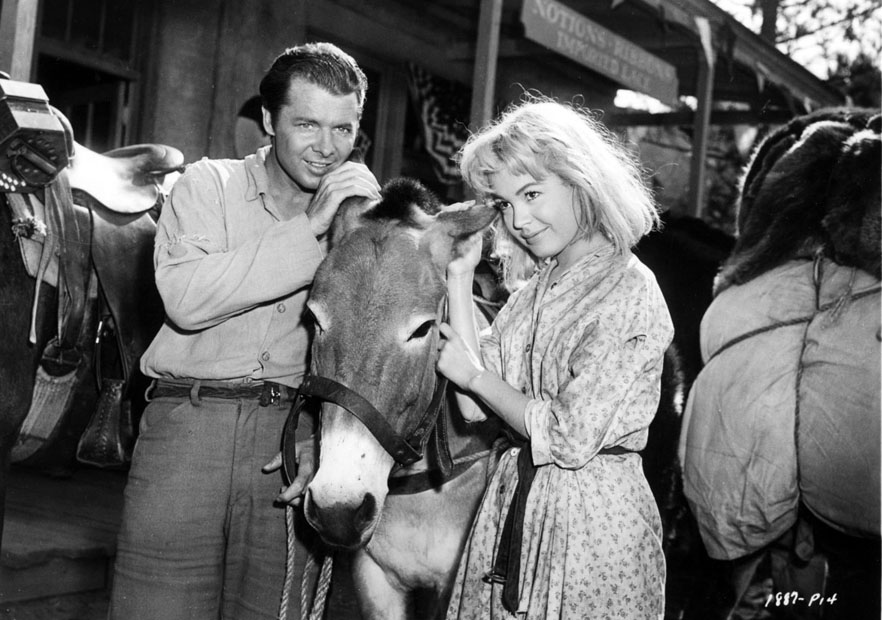
What do you get when you cross Audie Murphy with Sandra Dee?  An unlikely pairing, right? Maybe...but you also get the fun and sweet The Wild and the Innocent.  From 1959, this romantic comedy Western also features Joanne Dru, Gilbert Roland, and Jim Backus in supporting roles.  Strother Martin and Peter Breck (of Big Valley fame) also have parts in this charming little film.


Somewhere in the mountains of Wyoming, Yancy Hawks (Audie Murphy) lives with his uncle and his uncle's wife.  Trappers, the two men have been in the mountains for years; in fact, Yancy's never been out of them and in a town before.  After his uncle is mauled by a bear and needs to be still in order to recuperate, Yancy is sent on to the trading post to get needed supplies.  To his dismay, he discovers that the trading post has been closed and in order to sell his pelts and purchase what he needs, he will have to go into the big city---to the general store in Casper.


Enroute to the "big city," Yancy comes across a man (Strother Martin) traveling westward with a whole passel of kids.  Saying she would make a good wife, the man offers to trade his daughter, Rosalie (Sandra Dee), for half of Yancy's furs. Insisting that he would have to love a woman in order to marry her, Yancy declines the man's offer and continues on his way.


Not long afterwards, the dirty, unkempt Rosalie, who has run away from her pa, re-enters Yancy's life.  Sure that her father would have traded her to the first man who would take her, she chose to strike out on her own.  Since she figures she'll be able to find a job in the big city, and since that is Yancy's destination, Rosalie requests that he take her with him.  Although he doesn't really want the responsibility of the girl, Yancy agrees, and two very innocent, naive souls soon have their first-ever taste of city life.


The city's 4th of July celebration is in full-swing, so after cleaning up and getting some new clothes, both Yancy and Rosalie enjoy a night on the town.  Not knowing exactly what a dance hall girl is, Yancy is soon quite smitten with one of them (Joanne Dru).  Meanwhile, Rosalie, who is in love with Yancy and yearns for him to notice her, is romanced by the town's sheriff (Gilbert Roland) and offered a job at the dance hall.  She's unsettled about the type of gown she must wear and the kind of work she's expected to do, but since she has to support herself, what choice does she have?


Both Yancy and Rosalie are so innocent that the sheriff makes the comment that one doesn't know the kind of world he's in and the other doesn't even know she's pretty.  Will these two innocents get taken for a ride in the big city?  Will Yancy realize Rosalie loves him?  Or will he keep his attentions on the dance hall girl?  And what will Yancy do when he discovers Rosalie will soon be part of the dance hall establishment? How it all plays out is the balance of this very delightful film.


Although I'm calling this 3-stars, it's more like 3.5---it's cute, fun, sweet, totally charming, and somewhere between "like it" and "really like it" for me. There are a few parts which caused me to giggle like crazy.  First, when new clothes are bought for Rosalie---one of the items is a corset, and she has no idea what it is, nor does Yancy.  She tells him that she was informed it was to "hold her up."  Yancy's response, "Hold you up where?"  was quite comical.  Later, after she had donned her new gown over the corset, Yancy told her to take the corset off, that it made her bulge in places.  (Yes, the innocence of those statements is laughable to us today, but that is part of the film's charm.)


Besides the delightfully winsome storyline, it's fun seeing Sandra Dee in this change-of-pace role.  I think she did a great job.  The Big Valley's Peter Breck portrays one of the rowdy, drunken cowpokes who wants to bully the ill-equipped-for-city-life mountain man. Breck seemed totally in character, as on The Big Valley, he is usually the first one of the Barkley brothers to get into a scuffle.  Audie Murphy is perfect in this role; in fact, his character is much how I think of him in real life---an unsophisticated, small-town guy, able to stand right there with the best of them. Oh, and it must be mentioned that Audie is incredibly handsome at this point in his career!  While he was in his mid-30's here, his naturally youthful looks allowed him to believably portray a character who was probably supposed to be in his late teens.  (Audie was 17 years older than Sandra Dee, and, quite honestly, that fact didn't even occur to me until I was doing this post and realized her birth year---she actually could have passed for early 20's here.  And since Audie looked younger than his years, their pairing worked.)

The movie is corny, predictable, and (of course) very dated, but it's also charming, sweet, and unpretentious.  Put on your 1950's lenses, sit back, and enjoy a trip back to a more innocent time.

While not out on DVD or on the TCM schedule anytime soon, The Wild and the Innocent is available in its entirety on YouTube.  It's in four 20-minute parts, and although it's always a bit of a pain to watch in parts, it's definitely better than nothing.  I do hope you get a chance to see this.

Happy viewing!

NOTE:  All photos in this post were obtained from the Audie L. Murphy Memorial Website (HERE)