Showing posts with label Stewart Granger. Show all posts

Friday, May 31, 2013

After a Month of Stewart Granger Viewing...

The month of May found me being incredibly faithful to Stewart Granger.  While I did enjoy the occasional film of another---including a "new to me" Gary Cooper flick---far and away, Stewart Granger's films have been the only ones I have watched for the past 30 days.  I've re-watched old favorites, discovered some new faves, and, in the case of King Solomon's Mines, developed an appreciation for a film I didn't like the first time I saw it.

In all, I've watched (or attempted to watch) 20 Granger films in the past month.  (Sadly, time precluded me from reviewing all of them.) While the very top of my "favorite Granger films" list hasn't changed in the 3 weeks since the birthday post where they were unveiled, the lower half has; therefore, to cap off the centennial birthday celebration month, I thought I would provide a list of how I rank all the Stewart Granger films I've seen.  


5 star films:

1.  The Prisoner of Zenda  (reviewed HERE)


4 star films:

2.  Moonfleet  (almost 5 stars---reviewed HERE)
3.  Scaramouche
4.  Saraband for Dead Lovers  (reviewed HERE)
5.  Salome (I called this 3 stars in my review, but it's very close to 4---reviewed HERE)

3 star films:  (in about this order)

All the Brothers Were Valiant  (reviewed HERE)
King Solomon’s Mines
Adam and Evalyne  (reviewed HERE)
Harry Black and the Tiger  (reviewed HERE)
Footsteps in the Fog  (reviewed HERE)
Blanche Fury  (reviewed HERE)
Love Story (aka A Lady Surrenders)  (reviewed HERE)
Swordsman of Siena


2 star films:  (made it through these, but was pretty bored)

Green Fire  (even with Grace Kelly as the co-star, this one didn't do it for me)
The Crooked Road  (this one also stars Robert Ryan, so it's shocking that I didn't like it)
The Wild North 


1 star films:  (didn't make it through any of these films)

Fanny by Gaslight
The Hound of the Baskervilles
The Secret Invasion
Waterloo Road


There are many more of Mr. Granger's films on my "want to watch" list, including these titles: Bhowani Junction (which TCM will be airing in June), The Whole Truth (on the TCM schedule for July 15th), The Secret Partner (have been unable to track down), North to Alaska (have had on hold at the library, but it hasn't come in yet), Madonna of the Seven Moons (available on YouTube, but I just haven't had time to watch it).  Even though Mr. Granger's centennial birthday celebration will be over, I'll post reviews of these films after I get around to watching them.

I hope you, my dear blog readers, have enjoyed the opportunity of getting to know Stewart Granger a bit more this past month.  I hope you've discovered some "must watch" films.

Thursday, May 30, 2013

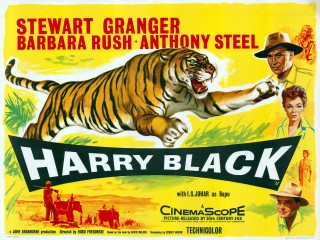
Harry Black and the Tiger (1958)

Another of Stewart Granger's action/adventure films is 1958's Harry Black and the Tiger. Shot on location in India, this film, which also stars Barbara Rush, Anthony Steel, and I. S. Johar, is based on David Walker's novel Harry Black.  Taking on such themes as lost love, courage, fear, and contentment, this Hugo Fregonese film tackles far more than just a tiger.


With a man-eating tiger on the loose and terrorizing the residents of a small Indian village, big-game hunter, Harry Black (Stewart Granger), is brought in to kill the animal.  Accompanied by a native guide, Pabu (I. S. Johar), tin-legged Harry tracks the animal, narrowly missing him on a couple occasions. One time, due to the misfiring of an accompanying man's rifle, the big cat jumps Harry, severely injuring him.


People from Harry's past live in the area, and his arrival has brought them back into his life. Desmond Tanner (Anthony Steel), is an old Army buddy, now overseeing a local plantation. As he spends time with Desmond while recovering from the tiger attack, Harry finds himself reliving the scene in which Desmond's cowardice resulted in the loss of his (Harry's) leg and the need for a prosthesis. Attempting an escape from a German POW camp, Desmond's fear paralyzed him, causing Harry to hesitate and lose precious moments. While he did manage to escape, the few-seconds' delay enabled the enemy to get a shot off, shattering Harry's leg, leaving him with no choice but amputation.

Upon being released from the hospital, Harry called upon Desmond's family, and he and Desmond's wife, Christian (Barbara Rush), ended up falling in love.  Knowing the futility and heartbreak of such a relationship, Harry said goodbye to Christian and moved into a life without her. Seeing each other once more, though, has brought their feelings for one another back to the surface. When Harry wonders if she has been happy, Christian responds that while there have been no flashes of lightning, she has been content. 


Unsettled by Christian's nearness and the realization that his love for her has never died, Harry's ability to capture the tiger is hampered, so hampered, in fact, that after his own moment of cowardice, he determines to give up the quest.  Yet when Desmond and Christian's young son, Michael, is thrown from his horse and is stranded alone in the jungle where the man-eating beast lurks, Harry will have to put his feelings aside.  How it all plays out is the balance of the film.


While Harry Black and the Tiger is not one of my most favorite Granger films, the character of Harry Black is one I like a lot. He is a very likable man...one you can't help rooting for.  His rapport with young Michael is very sweet, as is his rapport with the guide Pabu.  Obviously, the on-screen chemistry with Mr. Johar was felt off-screen as well, for about him, Granger wrote, "His lilting accent and marvellous (sic) hand gestures were a joy, and our obvious affection for each other played a big part in the success of the film."  The scenery is beautiful, as is the tiger...and so is Stewart Granger.  The man looks fantastic with the touch of gray in his hair!

Having worked so well with Deborah Kerr in other films, Mr. Granger had really hoped to have her as his co-star/love interest once more.  However, "to his bitter disappointment, Twentieth Century wouldn't release her," so Barbara Rush was given the nod.  Even if Miss Rush wasn't to Granger's liking, though, the sexual tension between the star-crossed lovers seemed very believable to me.


In Sparks Fly Upward, Mr. Granger shares some fun facts about the making of Harry Black. During the early part of the filming, the star tiger (a tigress, not the male they had thought) was in season and loudly called to the males each night.  Besides being kept awake by all the racket, in the morning, they always discovered evidence that cats had been wandering through their camp the night before.  Eventually, "the star" went out of season, and things settled down. Also adding to the excitement of filming in India was the fact that there had recently been a cholera outbreak, resulting in water so "cleaned up" that they felt they were drinking pure chlorine.  Coupling that with having curry for every meal, he writes that his "memories of that enchanting camp were smells of curry and chlorine."  (The things people go through to bring a movie to us!!)


Although Leonard Maltin gave Harry Black and the Tiger 0 out of 4 stars, I'm going with 3 out of 5.  I found it to be an interesting, enjoyable, solid film.  For me, it's right up there with King Solomon's Mines as an exciting trek through the jungle (albeit on two different continents).  Both films feature a brave adventurer, native guides, superstition, danger, and a woman in love with a man other than her husband.  While there were times the film dragged, I found that to be true with King Solomon's Mines as well.  In the end, I was interested enough in the story to persevere through the slow parts, and even though I will probably never watch Harry Black and the Tiger again, I, nevertheless enjoyed it.  It even touched me a bit and got me lightly misty-eyed at one point.

While not on the TCM schedule in the near future and not out on DVD here in the U.S. (though a Region 2 disc has been released) the film is available in its entirety on YouTube.

Happy viewing!!

NOTE:  All quoted material derived from Sparks Fly Upward, by Stewart Granger, G. P. Putnam's Sons, 1981

Wednesday, May 29, 2013

Roles Stewart Granger Might Have Had

Through my reading of Stewart Granger's autobiography, Sparks Fly Upward, I discovered some high-profile film roles which could possibly have gone to him.  As in the careers of George Raft and John Garfield (HERE), taking on a particular role might have made a monumental difference in Mr. Granger's career.  Of course, it's useless to play the "what if" game, and, in the end, things generally work out the way they are supposed to.  Even so, it's interesting to learn what other roles might have come a star's way.  In Mr. Granger's case, here are a few of the big ones:


Ben-Hur---Originally, according to Sparks Fly Upward, Marlon Brando was wanted for the role of Judah Ben-Hur. When he wouldn't or couldn't, do it, the role was offered to Kirk Douglas, with the Messala role offered to Granger and the Esther role offered to Jean (Simmons).  By the time, Mr. and Mrs. Stewart Granger agreed to the roles, they had already been given to others (and the title role had gone to Charlton Heston). His agent railed at him, "Why didn't you say you'd do it last week?  Metro has fixed Stephen Boyd and Haya Harareet."  Even though Mr. Boyd had been loaned out from another studio, the deal couldn't be broken, so Boyd played the part.  "And very good he was too," wrote Mr. Granger.  About the loss of this role, Mr. Granger wrote, "That one week (in getting back to his agent) made so much different to so many lives.  It caused an unnecessary death and I think an unnecessary divorce (his and Jean Simmons'), among other things."


I would have to add a hearty Amen Mr. Granger's words about Mr. Boyd's performance in Ben-Hur.  He was completely and totally brilliant in the role of Messala. (Truly, he ought to have been nominated for and won an Academy Award!)  I can see Stewart Granger in the role, and I think he would have done a great job, but loving that movie as I do, I love it as it is.  Stephen Boyd is Messala to me.


From Here to Eternity---When Harry Cohn (Columbia Pictures boss) tossed the script at him, saying "There you are, you Limey bastard, there's a part for you," Stewart Granger's first response was "Which part?"  When Cohn responded that it was the Marine sergeant lead, Granger was incredulous.  "I can't play an American Marine sergeant. I'm English."  Cohn's response was that Granger was an actor and could, of course, take on such a role.  To Mr. Cohn's amazement, though, Mr. Granger turned the role down, an action about which he wrote, "What an idiot I was.  If I'd played it, nobody would have known how marvellous (sic) Burt Lancaster was going to be and it was such a great part I'd probably have got away with it."


Can you see Stewart Granger in Burt Lancaster's From Here to Eternity role?  Though I love that movie and think Burt Lancaster was absolutely super in the role, I really can see Stewart Granger doing a terrific job as well.  (Portraying an American would not have been a problem for him, I know, as in The Wild North, he put his English roots aside in order to portray a Frenchman.)  Knowing how great the chemistry was between Mr. Granger and Deborah Kerr in The Prisoner of Zenda and King Solomon's Mines and remembering that Mr. Granger said the two of them had once been intimately involved (though Miss Kerr denied that), they may well have had even greater chemistry than that which was between Kerr and Lancaster.


Quo Vadis---Because  Mr. Granger had originally told his agent that he wasn't going to do the film, Robert Taylor had been cast.  By the time Granger said he'd take on the role, the studio refused to replace Mr. Taylor.  Mr. Granger's agent was irritated.  "You told me you weren't going to sign, Jim (Friends and family always referred to Granger as Jim or Jimmy).  If you had, it would have been easy, as you were the first choice."


Given how terrific Mr. Granger was in action/adventure films and Biblical epics, I can easily see him in the role of Quo Vadis' Marcus Vinicius.  He would have looked incredible in the Roman garb (he did in Salome), and the film would have paired him, once more, with Deborah Kerr, with whom he had such terrific chemistry.  I do adore Robert Taylor in this role, though. (Actually, I adore Robert Taylor period---he's among my top 10 faves; however, after a month of watching Granger films, I'm quite high on him too.)  Quo Vadis is the film which brought Mr. Taylor into my life, and it's my 2nd favorite of his films, so imagining anyone but him in the role is a bit of a hardship.


A Star Is Born---This was a film Granger very much wanted to do.  The 1937 Janet Gaynor/Fredric March version of the film had been one of his favorites, and he knew it would be a film which would boost his career.  He was thrilled to learn that he was under consideration to "try and repeat the magnificent performance of Mr. March."  He was thrilled, also, for the opportunity to appear opposite "the legendary Judy Garland."  During rehearsals, though, he found working with director George Cukor to be an exasperating experience.  In the end, he told Mr. Cukor to "take the script and shove it."   "What a shame," he wrote in his autobiography.  "I could have played that part on my head."


I really don't care for the '54 version of A Star Is Born, and it has nothing to do with the male lead.  It has to do with Judy Garland.  I'm not a fan at all, so it matters little whether it was Stewart Granger or James Mason in the Norman Maine role.  Because of Judy Garland, the film wouldn't work for me no matter who the co-star was.


Tell me, can you see Stewart Granger in any of these roles?  Would you even want to?


NOTE:  All information and quoted material derived from Sparks Fly Upward, by Stewart Granger, G. P. Putnam's Sons, 1981.


Thursday, May 23, 2013

Saraband for Dead Lovers (1948)

For years, I have been fascinated by the British monarchy---and I'm not just talking about the current Mountbatten-Windsors.  I've been enthralled by the Tudors, the Stuarts, the Hanovers, and the Windsors.  In fact, my passionate interest in the monarchy extends back to the Lancasters and the Yorks and their War of the Roses.  So, upon looking through Stewart Granger's filmography and discovering a film based on an actual incident in the life of one who would become a British monarch, I knew it was a must-see for me.  That film---1948's Saraband for Dead Lovers---is about the real-life wife of the man who would become England's King George I.  Also starring Joan Greenwood and featuring Peter Bull, Michael Gough, and Flora Robson in supporting roles, this British film, which received an Academy Award nomination for Best Art Direction, is easily a 4-star film for me.


As the story begins in 1700's Germany, a dying woman pleads to be allowed to write a letter to her son.  Knowing that he was brought up believing that his mother had brought dishonor to the House of Hanover, she longs for him to know the truth, and as she writes the letter, her story is brought to life.


For political gain, 16-year old Sophie Dorothea of Celle (Joan Greenwood) is wed to George Louis, Prince of Hanover (Peter Bull).  It's a marriage neither party wants, but because they must live their lives for politics, marry for politics, and bear children for politics, they do their duty.  First a son, then a daughter are born, and for Sophie Dorothea, the children are the only bright spot in her lonely life, as her husband has his share of mistresses and virtually ignores her.  All too soon, the children are taken from her to begin training for their futures.


In the summer of 1689, Count Phillip Konigsmarkk of Sweden (Stewart Granger) makes a visit to Hanover.  There is an immediate connection between him and Princess Sophie, and they soon fall in love.  Though their love may never have been consummated (according to history, there is some doubt as to whether it was), the Count's feelings for Sophie are not lost on the powerful, hateful Countess Clara Platen (Flora Robson).  Attracted to Konigsmarkk herself, Clara throws herself at him, but when he fails to respond to her, she is furious.  Of course, there is no fury like that of a woman scorned, and the Countess puts in motion a plan to separate the lovers forever.


This movie is fascinating, and it appears that it hasn't greatly altered any historical facts. Sophie Dorothea and Count Konigsmarkk really did fall in love (though they may or may not have been lovers).  He did, in fact, die under mysterious circumstances, presumably at the bidding of George Louis or his henchmen, and the Princess Sophie really did spend the final thirty years of her life imprisoned, while her husband took his place on the British throne.

Stewart Granger said the Saraband "script fascinated him, as he had no idea that love affair was the reason why the wife of George I of England, the mother of George II, spent the last thirty years of her life as a prisoner in the castle at Ahlden."  Further, he said, he loved the story and the character he was to portray.  In the end, according to his autobiography, Sparks Fly Upward, Saraband for Dead Lovers "is one of the few films he'd always been proud of."


Mr. Granger is so incredibly handsome here, and he is terrific in the role.  Also, he gets a chance to wield his sword a bit...which is always fun to watch.  Joan Greenwood is exquisitely beautiful and plays her tragic part to perfection.  Flora Robson, though, takes the prize for her performance.  She is evil and nasty in a way I have never seen her before.  Finally, the film's costumes are stunning---Oscar-worthy, in my opinion.  All these things, plus my interest in the subject matter, combine to make this a 4-star, "like it a lot" film for me, quite shaking things up on the bottom half of my "top-5 Stewart Granger films" list.

Though the film is not currently on the TCM schedule, nor to my knowledge is it out on DVD, it is available in its entirety on YouTube (in parts.)  I think it's well worth viewing, especially for those who like British drama, Stewart Granger, Joan Greenwood, Flora Robson, or British monarchs.

Happy viewing!!

NOTE:  For more information about Sophie Dorothea, her alleged affair with Phillip Konigsmarkk, and her imprisonment, go HERE.

Monday, May 20, 2013

Love Story (aka A Lady Surrenders) 1944

From Britain's Gainsborough Pictures, Ltd., comes Love Story, a wartime romantic drama from 1944. Starring Margaret Lockwood and Stewart Granger, this film bore the title A Lady Surrenders upon its release in the United States.  It's a film I had never even heard of until I went on the prowl for some of Mr. Granger's earlier works.


Wanting to do more for the war effort, concert pianist, Felicity Crichton (Margaret Lockwood), purposes to leave her career behind and take a position with the RAF WAC's.  In the physical exam required for admission to the corp, it is discovered that the fainting spells she had been having are not due to nerves as she had thought; rather, they are indicative of a fatal heart condition, resulting from her childhood battle with scarlet fever.  According to her doctor, death is inevitable...and not far off. Wanting to enjoy every single minute of the few months she has left to live, Felicity journeys to the English coast, taking on the name Lissa Campbell for anonymity.

Also visiting the English coast is Kit Firth (Stewart Granger), a former RAF pilot no longer able to serve, due to an optic nerve injury which has left him with a prognosis of blindness. Although a surgical procedure could repair the damage, the odds aren't in Kit's favor, so he has refused the operation, a decision reinforced by his childhood friend, Judy (Patricia Roc).  One of the few people aware of his condition, Judy is secretly in love with Kit and for that reason, views his impending blindness as a good thing, as it will keep him dependent upon her.

Though Lissa and Kit fall in love, in typical melodramatic fashion, neither will reveal their condition to the other.  Not wanting to burden one another, they vow a "no strings attached" kind of relationship, which means their love may not even survive the short time they could have together.


Though not spectacular, this film is well worth watching.  It is a bit on the slow side, but the story is sweet, Stewart Granger is incredibly handsome, Margaret Lockwood is lovely, and the music is beautiful.  Definitely, for me, an enjoyable, 3-star viewing experience.

Love Story is out on DVD and available through Classic Flix.  It is also available in its entirety on YouTube.

Happy viewing!!


Sunday, May 19, 2013

Blanche Fury (1948)

Blanche Fury, from 1948, is a suspenseful period drama starring Stewart Granger and Valerie Hobson.  It's a film which had been in my Net Flix instant queue for many months, and I'm glad I used Mr. Granger's centennial month as an excuse to buckle down and watch it.  While not a favorite film, it is definitely an enjoyable and interesting viewing experience.


In 1860's England, proud but poor Blanche Fuller has had her fill of being a companion to rich, crochety old ladies.  Ambitious and very strong-willed, Blanche doesn't have the personality to be a successful long-term employee to those who patronize her, so she has left a whole host of positions prior to the one which begins the film.  A way out of the despised situation arrives in the form of a letter from her wealthy uncle, Simon Fury.  Due to differences of opinion between her father and her uncle, the families have long been estranged; however, Simon is in need of a governess for his motherless granddaughter, Lavinia, and Blanche is offered the position. Accepting immediately, Blanche takes up residence at Clare---the ancestral estate her uncle has recently acquired from the Fury family.  (At the time of the property acquisition, Simon Fuller chose to take on the Fury name as well.)


The estate's steward, Phillip Thorn (Stewart Granger), believes he is Clare's rightful owner, as his father was Adam Fury.  However, since documentation proving the marriage between his mother and Adam Fury has never been found, his legitimacy is denied, as is his claim to the property.  Unwilling to accept such circumstances, Thorn has become obsessed with finding a way to make Clare his own.


Simon's son, Lawrence, asks Blanche to marry him, and through her acceptance, she becomes mistress of the estate.  Though Blanche and Phillip Thorn had gotten off on a bad note, they soon become lovers; with Thorn obsessed with obtaining what he believes to belong to him, and Blanche, ambitious and having no love for her husband, the two put in plan a motion to murder those standing in the way of what they want. Whether their plan is successful or not will play out in the balance of the film.


While not a spectacular film, Blanche Fury is, nevertheless, solid and interesting...a definite 3 stars for me.  I had never heard of Valerie Hobson prior to seeing her here, but that doesn't matter.  She was quite believable as Blanche.  I really liked Stewart Granger in his role. Though his Phillip was an obsessed, driven, mostly unlikable man, I enjoyed the way Mr. Granger brought him to life.  Plus, he's always great to look at!  I might have rated the film higher had there not been some plot developments which I found totally inconsistent with the times.  Since I don't want to provide spoilers, I will just say that with the information which came out at the trial, I didn't find the townspeople's response to be in keeping with the era being portrayed.  For that reason, I decided to downgrade to 3 stars.

While not out on DVD, the film is available through Net Flix instant viewing and on YouTube.

Happy viewing!


Monday, May 13, 2013

The Prisoner of Zenda (1952)

The Prisoner of Zenda---so far---is in no danger of losing its status as my favorite Stewart Granger film.  Although many blog readers thought Scaramouche---which I caught for the first time last week and will be reviewing later this month---would usurp that #1 position, it didn't. Oh, I liked the film tremendously, and I thought Mr. Granger was more handsome in that film than in any other I have seen (and I think he's always gorgeous---at least when he is clean-shaven); however, The Prisoner of Zenda is so dear to me that it was able to withstand the competition and remain my favorite Stewart Granger film.  Loving that film as I do, I thought re-working and expanding on its previous post was a definite must for Mr. Granger's centennial celebration here at They Don't Make 'Em Like They Used To.


Based on Anthony Hope's 1894 adventure story, The Prisoner of Zenda has seen several film adaptions through the years.  Perhaps the best known of them is the Ronald Colman/Douglas Fairbanks, Jr. one from 1937; this lavish Technicolor 1952 version---which stars Stewart Granger and Deborah Kerr and features Louis Calhern, Jane Greer, and James Mason in support---is, according to Robert Osborne, nearly the exact likeness of the 1937 film.  In fact, the same script was used, as was the same Alfred Newman score.  The only differences, according to Osborne, were a new cast and the addition of technicolor.  Many people prefer the '37 film; I, however, have not yet seen that one, so I cannot compare the two and am basing my rating solely on how this particular film affected me.


The film begins just before the coronation of Rudolph V, king of the fictional country of Ruritania.  Just happening to be on his way through the country at the time is a distant cousin of the king, an Englishman who also bears the name of Rudolph.  Except for the fact that the Englishman has a mustache and is graying at the temples, he is the exact image of the king. (Stewart Granger plays this dual role.)  The Englishman is invited to dine with the king on the eve of the coronation.  In his usual fashion, the king drinks to excess; later, however, he collapses...having been poisoned through his wine.

King Rudolph's allies know that the king's half-brother Michael, who wants the crown for himself, is likely the one behind the poisoning; they also know that if the coronation does not go on as scheduled, Michael will be crowned instead.  Since Rudolph the Englishman looks virtually identical to the king, it is suggested that he impersonate the king for the coronation ceremony, after which time, the effects of the poisoning will have worn off, and Rudolph can take his throne and the Englishman may continue on his journey, with no one ever knowing that it was not the real king who was actually crowned. Convinced that the plan will work, Rudolph the Englishman takes the king's ring and the plan is set in motion, with the real king being hidden away in the wine cellar.


Is Rudolph the Englishman successful at convincing everyone that he is the real king?  And what about when he meets the Princess Flavia (Deborah Kerr), the woman promised to the king?  Do Michael and his cohorts sit back quietly and allow their plans for Michael to usurp the throne to be thwarted?  These are the questions which play out in this exciting little film. The dashing (and beautiful voiced) James Mason portrays one of Michael's partners in crime, and there is a terrific fencing scene between him and Stewart Granger.


According to Stewart Granger's autobiography, Sparks Fly Upward, it was his idea for the remake.  While he and Jean (Simmons) were dining with Mr. and Mrs. Ronald Colman, Mr. and Mrs. David Niven, and Deborah Kerr and husband one evening, Mr. Colman ("Ronnie," as Granger refers to him) asked if they would like to see one of his old films, and since Mr. Niven had also appeared in The Prisoner of Zenda, that is the film the guests were shown.  Enthralled with the film, Granger announced that he was going to suggest to Dore Schary (Metro) that he buy the rights and do a remake, which, of course, he did and Mr. Schary did. Though Granger had no illusion that "he could ever compete with Ronnie Colman as an actor, at least (he said), he could fight better"...or so he thought.  At one point in the filming of the sabre fight, he forgot to "parry to the left" and was caught in the mouth by the sword.  Though not a serious injury, it spilled forth quite a bit of blood and required a few stitches; however, the next day, Granger was able to get back to filming, and in only twenty-eight days, this extravagant Technicolor version of The Prisoner of Zenda was completed.  "Bloody hard work but great fun," according to Granger.  Sensational, captivating, and charming, according to me! I absolutely love this film!

Out on DVD as part of the Literary Classics Collection, The Prisoner of Zenda should be quite easy to track down.  Additionally, it is on TCM's schedule for Monday, June 24th, at 2:00 p.m. (ET).  Definitely, try to see it...it's an exciting, entertaining, 5-star gem of a film.

Happy viewing!!

NOTE:  All quoted material derived from Sparks Fly Upward, by Stewart Granger, G. P. Putnam's Sons, 1981.


Thursday, May 09, 2013

Sparks Fly Upward---One Terrific Read

I just finished Stewart Granger's autobiography, Sparks Fly Upward, and I absolutely loved it! What an entertaining read it is...easily 5 stars. (And that is quite saying something, because the biographies/autobiographies of my beloved guys, Montgomery Clift, James Cagney, and John Garfield, are all 4-star books to me.)


Mr. Granger writes about his childhood years, living in a home with his mother, father, sister, and his mother's boyfriend (whom he had thought for years was his uncle); his friendship with well-known Brits Michael Wilding, Vivien Leigh, and "Larry" Olivier; behind the scenes stories from both his British and American film careers; the struggle he and his first wife endured to become parents; his 10-year marriage to the "ravishing young beauty" Jean Simmons, whom he said "could outsparkle anyone"; his and Jean's battles with Howard Hughes and his own murderous thoughts toward Hughes; his desire for good roles and his struggles with the studio to obtain them; roles he might have had, but didn't (From Here to Eternity and 1954's A Star is Born being two of them); telling off Hedda Hopper; his years as a rancher; and a host of other things.


Like a kiss-and-tell teenage boy, Mr. Granger writes of his many love affairs.  From the loss of his virginity at the hands of a French prostitute, to his acquisition of an STD while cheating on his first wife, to a near-episode with Hedy Lamarr, to a backseat limousine fling with Deborah Kerr, he recounts some of his more memorable sexual escapades.  (It must be noted that Deborah Kerr has said no such affair ever took place.  It is definitely a case of "he said, she said.")


With an absolute comic flair, Mr. Granger recreates the stories of his life, and I found myself positively howling on several occasions...such as when, at a Polynesian restaurant, chopsticks in hand, his dinner companion completely startled him by reaching under the table and groping at him, causing him to nearly choke on the shrimp in his mouth; or when older, established actor, Henry Kendall, mistakenly assumed that the naive, young Granger would be interested in having a same-sex encounter with him; or the roundabout way with which he credits himself for launching Anne Bancroft to a successful career; or his "it's not as easy as I thought it was" introduction to cattle breeding; or his determination to remain faithful to Jean while on location with Ava Gardner during the filming of Bhowani Junction.  All those episodes---and many more---are brought vividly and humorously to life in Mr. Granger's wonderful memoir.


Although published in 1981, the book abruptly ends in the early 1960's, shortly after the filming of North to Alaska. There is no mention of Granger's third marriage (which would also end in divorce) or of the daughter born from that marriage.  I found that strange.  He ended his story with these words, "I remembered Mrs. Perryman's (a fortune teller) prediction. "You'll cross the sea again and continue your success and later I see another marriage."  I wondered what she'd look like..."

He could easily have transitioned from that sentence into who she was and what she looked like, but for whatever reason, he opted to end the story in 1960.  I, for one, was completely enthralled and would have loved to have kept on reading and learned more.


I rate this book 5 stars---informative, fun, and very entertaining.  While there are a few inaccuracies and confusing statements (such as saying he missed out on making a Hitchcock film with Gary Cooper---not sure what he's talking about, as Coop never made a Hitchcock film; referring to his next-door neighbor Gene Tierney's husband as Igor Cassini, rather than Oleg; referring to Deborah Kerr's husband as Tony Bartlett instead of Tony Bartley; citing his appearance on the cover of Life magazine as June, 1952, rather than May 26, 1952), in all, Sparks Fly Upward is a totally terrific read.  Mr. Granger definitely had a flair for writing, and that is very evident here.  The book reads like an exciting novel, which is what sets it above the other biographies/autobiographies.  Not a list of dry, boring dates and facts, Sparks Fly Upward is alive with humor, adventure, and passion. While I checked the book out from my public library, it is one I definitely will be purchasing and adding to my own collection.

Occasional language and sexual situations give this book a PG rating.

Monday, May 06, 2013

Happy 100th Birthday, Stewart Granger!!

Happy 100th birthday to one of the up-and-comers on my favorite actor list...Mr. Stewart Granger (May 6, 1913 - August 16, 1993).


Born James Lablache Stewart in London, this handsome Englishman began his show business career as a film extra, before taking to the British stage, alongside such greats as Robert Donat, Laurence Olivier, and Vivien Leigh.  Theatre work eventually led to film work, with success coming first in Britain, then in America.

In the very early days of Stewart's film career, it was determined that a name change was in order.  With a popular young American actor also having the name of James Stewart, confusion would undoubtedly result.  Thus, James Lablache Stewart dropped the James, moved Stewart to his first name, and took on the surname Granger---the maiden name of one of his grandmothers.  Although officially Stewart Granger and no longer in danger of being confused with the American James Stewart, his family and friends would always call him "Jimmy."


Since I've only gotten to know Stewart Granger in the last two years, there are many of his films I have yet to see.  So, while my list of favorites may change as I catch more of his films, at the present time, my all-time favorite Stewart Granger film is The Prisoner of Zenda.  Also starring Deborah Kerr and James Mason, this completely charming film features a terrific swashbuckling scene.  (Reviewed HERE)

Rounding out my list of five favorite Stewart Granger films are:

2.  Moonfleet  (with George Sanders, Joan Greenwood, and John Whiteley---reviewed HERE)


3.  King Solomon's Mines  (with Deborah Kerr, it took me 2 viewings to appreciate this film)


4.  Salome  (with Rita Hayworth---reviewed HERE)


5.  All the Brothers Were Valiant  (with Robert Taylor and Ann Blyth---reviewed HERE)


With Scaramouche and Beau Brummell on my list of soon-to-watch Granger films, this list could find itself changing very shortly.

So, here's to you, Mr. Stewart Granger, on your centennial birthday!  You were a wonderful, very entertaining actor, and you will always be one of my faves.  I'm glad you left so many great films by which we can remember you, for in the words of George Eliot, "Our dead are never dead to us, until we have forgotten them."


Sunday, May 05, 2013

Moonfleet (1955)

When I think of Fritz Lang, I think of gritty noirs, but as 1955's Moonfleet bears out, he was quite capable of other things as well.  An action/adventure period drama starring Stewart Granger and child star John Whiteley, Moonfleet is based on J. Meade Falkner's 1898 novel of the same name.  Featuring George Sanders, Joan Greenwood, and Viveca Lindfors in support and a terrific Miklos Rozsa score, this film is right up there with The Prisoner of Zenda as my favorite Granger film.  (I have yet to see Scaramouche, so things could soon change.)

In 18th-century coastal England, young John Mohune (John Whiteley) makes his way, by night, to the little town of Moonfleet, where, directed by a letter from his recently-deceased mother, he will be able to find Jeremy Fox (Stewart Granger), who according to the letter, will be a friend to him.  Recently returned from the colonies and now living in the home once belonging to the dead woman's family, Fox and the woman appear to have been in love in their youth.  Though her family drove Fox away and married her off to a more suitable man, the dead woman is confident that Fox's former love for her will cause him to help her now-orphaned son.

Not the law-abiding man the writer of the letter once knew him to be, Fox is now the leader of a band of smugglers, with no interest in the everyday responsibility of a young boy. Wanting to be rid of the child, yet wanting to do the right thing by his mother, Fox intends to send him away to be educated; however, convinced that Fox is his friend, the lad is just as determined to remain in Moonfleet.  The little boy's unconditional love and trust eventually work their magic on Fox's cold, selfish heart.  At one point, Jeremy is forced to spar with one of his own gang in order to keep John alive.


Though in his autobiography, Sparks Fly Upward, Mr. Granger refers to Moonfleet as "another dreary costume epic, directed by the once brilliant Fritz Lang," I don't agree with his opinion at all.  I quite enjoyed this film---it is interesting, exciting, and well-acted.  Complete with a long-lost diamond, a coded treasure map, a supposedly-haunted graveyard, a cutthroat hideaway, and a short, but exciting, swashbuckling scene, this film is pretty much non-stop action.  Add to that, Mr. Granger never looked more handsome, and little John Whiteley is a charmer.  There were even a couple of touching moments which got me misty-eyed.  For me, this is easily a 4-star movie...and very close to 5.

Having never read the book upon which the film is based, I can't compare the two.  However, whether the two stories differ from one another matters little to me. In fact, it never bothers me if a film is significantly different from the book which inspired it; I see them as two separate entities, both of which can stand on their own.  I'm not sure why people get so bent out of shape when a story is changed---after all, both can have merit.

Out on DVD, Moonfleet should be fairly easy to track down.  Adventure-loving film fans ought to greatly enjoy it.

Happy viewing!!

Thursday, May 02, 2013

Salome (1953)

First up for Stewart Granger month is the lavish, Technicolor Biblical epic, Salome.  From 1953, this beautiful William Dieterle film stars Rita Hayworth in the title role, with Mr. Granger as her co-star and Charles Laughton, Judith Anderson, and Alan Badel in support.  Featuring gowns by Jean Louis, this film is loosely based on the Biblical story of Princess Salome, who danced for King Herod in exchange for the head of John the Baptist.


In the time of Tiberius Caesar (Cedric Hardwicke), King Herod (Charles Laughton) and his wife, Herodias (Judith Anderson), are on the throne in Galilee.  Because their marriage is adulterous in the eyes of God, they are regularly and publicly condemned by the prophet, John the Baptist. Enraged by the Baptist's preaching, Herodias demands that her husband put the man to death; however, believing that the wrath of God and the people will fall on him if he lays a hand on John, the king is unwilling to arrest him.

Meanwhile, in Rome, the beautiful princess, Salome (Rita Hayworth), has incurred the emperor's wrath.  Herodias's daughter by a previous marriage, Salome has been living in Rome since she was a child.  Because the emperor's nephew and she have fallen in love and wish to be married, and since the law is clear that a Roman must marry a Roman, a request is made of the emperor to allow  an exception in their case.  Furious that his nephew wishes to marry a "barbarian," the emperor banishes Salome from Rome, sending her back to Galilee.

Also sailing from Rome, are the new Judean governor, Pontius Pilate, and Commander Claudius (Stewart Granger), a Roman soldier stationed in Galilee.  Though a Roman, Claudius is secretly a follower of John the Baptist and, ultimately, Christ.  Although his relationship with the beautiful Salome starts off on an angry, hateful note, eventually, the two fall in love.  With Claudius wanting to protect the Baptist, her mother hoping to have him executed, and her stepfather, Herod, inflamed with lust for her, Salome must determine where her true loyalties lie.


This film is lavish and beautiful and well-acted.  Charles Laughton is so very believable as the lecherous old man who lusts after his stepdaughter.  He may have been a bit over the top, but I think the role called for that.  Judith Anderson plays nasty so well, and I think she's good here, though not quite on par with her performance as housekeeper, Mrs. Danvers, in Rebecca. Stewart Granger is great here and very believable in his role, plus he's incredibly handsome and wears the Roman garb beautifully.  Rita Hayworth is completely stunning, and her "Dance of the Seven Veils" is undeniably sensual.


Much license is taken with the true facts, so if that bothers you, you will probably not like this film. It didn't bother me, as I see the film for what it is---a story based on history, not an actual history lesson.  I'm going with 3 stars on this, but it's more like 3.5.

Incidentally, when I was watching this, my son walked into the room.  Since I was on my laptop, he couldn't see the screen...he could only hear it.  He said to me, "What are you watching?  Ben-Hur?"  I had thought the same thing---that the score sounded very Ben-Hur-like on occasion. It really must have if, without any prompting from me, my son thought the same thing.

Although not on the TCM schedule in the near future, Salome is out on DVD, plus it is available in its entirety on YouTube (HERE).  I hope you get a chance to see it.

Happy viewing!!


Wednesday, May 01, 2013

Showcasing Stewart Granger

The month of May brings one more centennial birthday observance to They Don't Make 'Em Like They Used To.  Stewart Granger is another of those 1913 babies, and it is he who will be taking center stage this month.


Though late 2006 saw me beginning my addiction to classic films, Stewart Granger was one of those actors who did not cross my radar until just a little over two years ago.  In fact, to be honest, I had never heard his name or seen his face until spring 2011, when I was finishing up my quest to see every film on Grace Kelly's filmography.  Green Fire was one of the remaining two films I needed to see, so when I noticed it on the TCM schedule, I immediately programmed my DVR, despite not having a clue who co-star Stewart Granger was.  I found the film somewhat boring and his character fairly annoying, so I didn't come away from that film enamored of him and wanting to see more of his work.  However, at least at that point I knew who Stewart Granger was...plus, I did find the man himself (not his character) to be rather appealing.

Several months later, I happened upon a few more of Mr. Granger's films, including The Prisoner of Zenda, which I found completely captivating.  I began seeking out more of his works, and as I did so, he made his way onto my favorite actor list, where he firmly occupies a place in the 20-25 section, in the company of such men as Joel McCrea, Van Heflin, Audie Murphy, Richard Widmark, and Claude Rains.

Although I'll also be reviewing films of others, as well as a couple baseball films I didn't get to in April, Mr. Granger will be seeing the lion's share of the action here in May, as I celebrate his centennial year.  I hope you'll join me in the celebration.

Saturday, September 24, 2011

All the Brothers Were Valiant (1953)

All the Brothers Were Valiant, from 1953, is an action/adventure film, starring Robert Taylor, Stewart Granger, and Ann Blyth.  Based on Ben Ames Williams' 1919 novel of the same name, this film received an Academy Award nomination for Best Cinematography.  A remake of the 1923 Lon Chaney film of the same name and the 1928 Ramon Novarro/Joan Crawford film Across to Singapore, it's the story of a pair of 1850's brothers, whalers on the high seas.


As the film begins, Joel Shore (Robert Taylor) returns to his Massachusetts hometown, having been gone on a three-year voyage.  Upon his return, he learns that his brother Mark (Stewart Granger) did not return with his ship from his last voyage.  It was assumed that he had died, possibly at the hands of some South Pacific islanders. 

Joel is given command of Mark's old ship and is to set off on another voyage; however, before doing so, he marries his long-time love, Priscilla (Ann Blyth), a woman who has also had feelings for brother Mark.  Not wanting to leave his new bride behind for two or three years, Joel has Priscilla accompany him on the voyage, and she takes immediately to sea life. 


When they reach the Gilbert Islands---the place where Mark was last seen---it is discovered that he didn't die after all.  In fact, Mark tells Joel the story of how he had discovered a fortune in black pearls but ended up losing them in a lagoon.  He requests that Joel join him in searching for the lost treasure, a request which Joel refuses.  Mark, though, used to getting his own way and used to pushing Joel around, will not take "no" for an answer; he will do whatever it takes to get those pearls, and if that means creating a mutiny and turning Priscilla against Joel, then that is exactly what he will do.


This film is exciting and entertaining and features good performances by all.  It's a solid 3 stars for me, and rather close to 4...definitely a film I enjoy and recommend.  I do think the idea of a newlywed wife  having a "honeymoon" aboard a whaling vessel is a bit off, but, you never know, some women might have done just that.

The film is out on DVD, and it also happens to be on TCM's schedule quite often, so it should be fairly easy to track down.  Hope you get a chance to see it.

Happy viewing!!

Monday, September 12, 2011

Adam and Evalyne (3 stars)

Adam and Evalyne is a 1949 romance, which stars real-life couple Stewart Granger and Jean Simmons.  Made the year before the two married, Adam and Evalyne is the first of three pairings between Granger and Simmons.   I discovered this film over the weekend on Net Flix instant viewing.  I had never heard of it before. 

About 16, Evalyne Wallace (Jean Simmons) lives and works at Willby Hall Orphanage.  How she got there, and why she bears her mother's name is never explained.  (My guess is that she was an illegitimate child.)  Letters from her father are what keep Evalyne going.  She lives for the day when her handsome, well-to-do father fulfills his promise to call for her at the orphanage and takes her home to live with him.

Unbeknownst to Evalyne, however, is the fact that her father's letters are completely bogus.  Instead of using his real name, Chris Kirby, he writes to her using the name of his best friend...Adam Black.  The photo of himself which he sends to Evalyne is really a photo of Adam (Stewart Granger).  So, upon Chris's death, when Adam, fulfilling his promise to the dying Chris, shows up at the orphanage, Evalyne fully believes he is her father, who has finally come to take her to live with him.  Not wanting to hurt Evalyne, Adam cannot bear to tell her the truth, so home with him she goes.

Shortly after learning the truth, that Adam is really not her father, Evalyne is sent to a Swiss finishing school.  When she returns, two years later, she is hardly the plain, awkward young lady she had once been, and although she begins to see other men, it is Adam to whom her heart belongs.  But can Adam see her as anything except his ward?


Adam and Evalyne is very cute and quite predictable.  Really, it's an entertaining and enjoyable film.  The chemistry between Granger and Simmons is fantastic, and I'm not just talking the romantic scenes.  They were fabulous with one another in every scene.  I think it's their chemistry that really made this film enjoyable for me.  Hope you get a chance to see it.

Happy viewing!!!

Friday, August 26, 2011

Footsteps in the Fog (3 stars)

Footsteps in the Fog, from 1955, is a Victorian England period drama starring Stewart Granger and Jean Simmons.  I have had little exposure to Mr. Granger; with the exception of Green Fire, which I watched solely because I want to see all of Grace Kelly's films, I haven't seen any other of his works.  And I haven't seen a whole lot of Jean Simmons' work either, perhaps four or five films.  Even so, though, I enjoyed this film, and I thought both Granger and Simmons were quite good in their roles.

Stewart Granger portrays Steven Lowry, a man whose wife has just died.  Telling his friends that he must learn to be alone, Steve returns home after the funeral and proceeds to drink to his wife's portrait...smiling all the while.  Housemaid Lilly Watkins (Jean Simmons) tells him that she gets a queer feeling when she looks at the portrait, almost like the mistress is trying to tell her something.

A bit later, Lilly discovers dead mice in the cellar, an empty medicine bottle lying in the midst of them.  Having done an experiment with the contents of the medicine bottle, Lilly knows that Mrs. Lowry did not die of gastroenteritis, as had been supposed, but by poisoning.  With this knowledge, Lilly begins blackmailing Steve, at first into obtaining the deceased woman's jewelry, then into dismissing every servant except herself.


In love with Steve, Lilly wants full control over his household...and him. Steve, however, who is in love with another woman, wants nothing to do with Lilly.  Desperate to be rid of her and the hold she has over him, he will stop at nothing...including another murder.


Footsteps in the Fog is a very interesting, well-acted, mildly suspenseful film.  While not a favorite by any means, I enjoyed it very much and definitely recommend it. It is out on DVD, so it should be fairly easy to track down.  Happy viewing!!