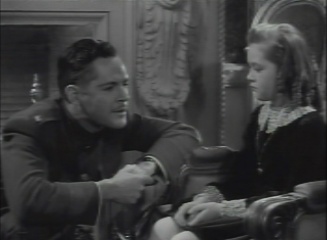
Another of the films highlighted in Majestic Hollywood, The Greatest Films of 1939 is Golden Boy, a boxing drama starring Barbara Stanwyck, Adolphe Menjou, and---in one of his earliest film appearances---William Holden. Based on Clifford Odets' 1937 play, this Reuben Mamoulian film, which features Lee J. Cobb, Joseph Calleia, and Sam Levene in support, garnered a Best Music Academy Award nomination.
Joe Bonaparte (William Holden) is a sensitive young violinist, who lives with his father (Lee J. Cobb), sister, and brother-in-law above the family's grocery store. Although Joe plays the violin beautifully and could possibly have a future in music, he wants to make money quickly and, therefore, begins boxing for Tom Moody (Adolphe Menjou).
Joe becomes an overnight sensation in the boxing ring, but since a violinist needs his hands and he could possibly injure his hands boxing, he talks about backing out. Moody knows that he has a money-maker in Joe, though, so he's not about to let him walk away and, therefore, instructs his secretary/mistress, Lorna Moon (Barbara Stanwyck), to change Joe's mind. Joe has fallen in love with Lorna, and after she leads him to believe she loves him too and that there can be a future for them, Joe returns to the boxing world, much to the disappointment of his father.
Because Joe is such a sensation, he quickly attracts the attention of another promoter, one who promises him bigger and better things. Joe jumps at the opportunity and leaves Moody's organization, which infuriates Moody and sends Lorna, once again, to Joe's side in an attempt to change his mind.
Joe soon becomes disillusioned with boxing....but does he quit? Does he return to the violin? Does he really love Lorna? Does she really love him? Those are the questions which play out in the balance of the film.
Though Golden Boy is not one of my favorite Bill Holden films (or even one of my favorite boxing films), it is a solid, interesting, well-acted drama, and it gives an opportunity to catch Mr. Holden before his star had begun to rise. Although it's easy to see why he went on to become the star that he did, at the outset, it would have appeared that Holden's career was over even before it began. The seemingly-endless boxing lessons, violin lessons, and dramatic coaching were exhausting to Holden; according to Majestic Hollywood, "It was a dreadful period for the young actor, and he expected to be replaced at any time. However, Barbara Stanwyck believed in Holden and went to bat for him. Telling Columbia boss Harry Cohn that he hadn't given the young man a chance, she promised to work with him. With Miss Stanwyck coaching him, Holden regained his confidence and was able to take direction from Mamoulian; after Golden Boy, Holden was suddenly in demand and on his way to a successful, Academy Award-winning career. He never forgot Barbara Stanwyck's support and help; in years to come, he would always send her flowers on April 1, the anniversary of Golden Boy's first shooting day." [1]
Beyond Bill Holden's performance, is that of Lee J. Cobb. He is absolutely terrific! He would reprise his role in 1952, when Golden Boy, again, played on Broadway. Interestingly, in that production, one of my other great loves---John Garfield---would take on the Joe Bonaparte role.
Barbara Stanwyck is my #3 gal (sometimes even #2), and William Holden is one of my "terrific 10," so even though Golden Boy isn't a favorite, I do enjoy their pairing here. They have great chemistry together. I'm calling this 3 stars, but it's more like 3.5
Out on DVD, Golden Boy should be quite easy to track down.
Happy viewing!!
[1] Majestic Hollywood, The Greatest Films of 1939, by Mark A. Vieira, Running Press, 2013.
Classic movies are not just antiquated films from a bygone era...rather, they are beautiful, well-acted, well-written gems that ought not to fade into obscurity. Truly, Hollywood just doesn't make 'em like they used to!!! I hope you'll discover some must-sees by your visit here.
Showing posts with label Barbara Stanwyck. Show all posts
Sunday, February 16, 2014
Friday, July 20, 2012
She Aged Beautifully!!
When I was growing up in the 60's and 70's, one of my favorite TV shows was The Big Valley. It used to be on in the afternoons, around 3:30 or 4:00, so many an afternoon, when I got home from school, I would grab the stereotypical plate of cookies and glass of milk and settle in to watch it. I'm pretty much thinking I was watching re-runs, because to my recollection, this was happening in the early 70's, and the show ended in 1969 after a 4-season run. At that time, my draw to The Big Valley was Lee Majors.
When I got into classic films, imagine my surprise to discover that Miss Barbara Stanwyck, who I had known as Victoria Barkley since childhood, was a famous actress with a long and distinguished movie career. At the time I was watching The Big Valley, I thought that was her only claim to fame. While I didn't ever hate Miss Stanwyck or her character, as I said, my reason for watching the show was Lee Majors. I was completely wild about him.
Now, though, I still love The Big Valley; in fact, I would deem it one of my six all-time favorite TV shows. I don't watch TV shows nowadays except for reality TV shows like The Amazing Race and Chopped, and while I enjoy them, they really don't hold a candle to old-time TV for me, so it is absolutely no lie that The Big Valley is one of my six favorite TV shows. (The others would be Little House on the Prairie, The Fugitive, The Andy Griffith Show, Streets of San Francisco, and Perry Mason.) One of the main draws for me now is my beloved Miss Stanwyck. Besides showcasing her wonderful dramatic abilities, The Big Valley showcases the beauty and grace with which Miss Stanwyck aged. In her early 60's here, she looks sensational.
About two years ago, I discovered that the first season and the first half of the second sesaon of The Big Valley had been released on DVD. I immediately purchased them, and have enjoyed watching every single one of the episodes. Sadly, though, no further episodes have come out...not the remainder of the second season, nor any future seasons. Recently, however, I discovered a network called The Inspiration Network (INSP), which is part of my dish program, and it airs an episode of The Big Valley every weekday. So, I am adding to my collection.
So for any of you who are fans of The Big Valley, see if your cable/dish package includes The Inspiration Network. Even if "the powers that be" won't release the entire Big Valley series on disc, through that network, you will still be able to catch that great show.
Happy viewing!!
When I got into classic films, imagine my surprise to discover that Miss Barbara Stanwyck, who I had known as Victoria Barkley since childhood, was a famous actress with a long and distinguished movie career. At the time I was watching The Big Valley, I thought that was her only claim to fame. While I didn't ever hate Miss Stanwyck or her character, as I said, my reason for watching the show was Lee Majors. I was completely wild about him.
Now, though, I still love The Big Valley; in fact, I would deem it one of my six all-time favorite TV shows. I don't watch TV shows nowadays except for reality TV shows like The Amazing Race and Chopped, and while I enjoy them, they really don't hold a candle to old-time TV for me, so it is absolutely no lie that The Big Valley is one of my six favorite TV shows. (The others would be Little House on the Prairie, The Fugitive, The Andy Griffith Show, Streets of San Francisco, and Perry Mason.) One of the main draws for me now is my beloved Miss Stanwyck. Besides showcasing her wonderful dramatic abilities, The Big Valley showcases the beauty and grace with which Miss Stanwyck aged. In her early 60's here, she looks sensational.
About two years ago, I discovered that the first season and the first half of the second sesaon of The Big Valley had been released on DVD. I immediately purchased them, and have enjoyed watching every single one of the episodes. Sadly, though, no further episodes have come out...not the remainder of the second season, nor any future seasons. Recently, however, I discovered a network called The Inspiration Network (INSP), which is part of my dish program, and it airs an episode of The Big Valley every weekday. So, I am adding to my collection.
So for any of you who are fans of The Big Valley, see if your cable/dish package includes The Inspiration Network. Even if "the powers that be" won't release the entire Big Valley series on disc, through that network, you will still be able to catch that great show.
Happy viewing!!
Monday, July 16, 2012
Happy Birthday, Barbara Stanwyck!!
Today is the 105th birthday of my #3 gal---the sensational Miss Barbara Stanwyck. (July 16, 1907-January 20, 1990)
Born Ruby Stevens, the four-time Oscar-nominated Miss Stanwyck, had an amazing career which spanned six decades. She very successfully made the transition from film to television and was appearing in a series only a few years before her 1990 death. She is easily my #3 gal, and sometimes, she even pushes #2 gal Susan Hayward out of that spot and claims #2 for herself. Without question, Miss Stanwyck is one of my absolute favorite actresses, and I never tire of watching her films.
My all-time favorite Barbara Stanwyck film is Stella Dallas (reviewed HERE). One of my top 15 movies of all-time, this heart-tugging tearjerker was said to have been Miss Stanywck's own personal favorite. As Stella, her task "was to convince audiences that Stella's instincts were fine and noble even though, on the surface, she was loud, flamboyant, and a bit vulgar." I must say, she definitely convinced me of that, because I see Stella as a woman of sacrifice, not selfishness.
Rounding out my list of five favorite Barbara Stanwyck films are:
2. Double Indemnity (with Fred MacMurray)
3. Ball of Fire (with Gary Cooper)
4. Christmas in Connecticut (with Dennis Morgan)
5. Clash by Night (with Robert Ryan and Paul Douglas---reviewed HERE)
So, here's to you, Miss Barbara Stanwyck, on your 105th birthday. You were an amazingly talented actress, and you will always be one of my absolute favorites. Thanks for making so many wonderful movies and TV shows.
Tuesday, July 10, 2012
These Wilder Years (4 stars)
With July being James Cagney and Barbara Stanwyck month here at They Don't Make 'Em Like They Used To, I thought it would be appropriate to review the only pairing of those two amazing stars---1956's These Wilder Years, a drama which features Walter Pidgeon and Betty Lou Keim in supporting roles.
Back in 1936, college student Steven Bradford (James Cagney) impregnated his girlfriend, and when he refused to marry her, the little boy she bore was given up for adoption. Now, 20 years later, having gotten older and lonely, Bradford is on a quest to locate that son and, therefore, makes a trip to the small-town orphanage which handled the adoption. Used to getting his way, the wealthy businessman first begins his quest at the desk of agency director, Ann Dempster (Barbara Stanwyck), but she assures him that adoption laws are strict and that she will not break them to accommodate Mr. Bradford. For his part, Bradford maintains that the boy is his son and that no one has the right to keep him away from him...except the boy himself.
While at the agency, Steve makes the acquaintance of Susie (Betty Lou Keim), a sweet 16-year old pregnant girl. When a couple arrives at the agency to pick up the child they will be adopting, Susie is greatly affected and cannot stop weeping. Though Steve attempts to comfort the girl, she is grieved because the day of giving away her own baby is drawing near, and she knows she will never get over losing the child. Because he, too, longs for a child who was given up, Steve understands Susie's feelings, and the two of them form a father/daughter kind of relationship.
Although Steve tells Miss Dempster that he's not looking for the child to take something away from him but rather to give to him all that he has accomplished through the years, the agency director will not be swayed. She reminds Steve that the boy has parents who have raised him and that it would wrong to try to jump into his life at this late juncture. Finally, in desperation, Steve gets his lawyer (Walter Pidgeon) involved, and Ann Dempster is taken to court. However, will Steve, who has begun to like and respect that lady, allow her to be held in contempt of court for not relinquishing the records? And will Ann, who, likewise, respects and likes Steve, change her mind and reveal the whereabouts of the long-lost son? How it all plays out is the balance of the film.
First and foremost, I must say that I wish Mr. Cagney and Miss Stanwyck had made more than just this one film together. They were both terrific in dramatic roles, and I think they would have made a completely sensational team!! While Miss Stanwyck is her usual solid self here, the film really is James Cagney's, and, as always, he plays it perfectly! He was completely stellar in this role; in fact, given that he was highly out of character, I think it is actually one of his best performances. (However, being totally honest, I think Mr. Cagney always gave a "best" performance...he could well be the most brilliant actor there has ever been.) In this film, he shows a bit of a soft, vulnerable side...and he did it beautifully. I loved the interaction between him and the young girl, Susie. It's not often James Cagney plays paternal, so the opportunity to see him in that light, makes this film extra special.
Mr. Cagney and his wife were adoptive parents themselves (having adopted a son and a daughter), so I wonder if that made this film a bit more personal to him than some of his other films? Regardless, These Wilder Years is a sweet, touching, mildly heart-tugging film, which I believe all James Cagney fans will want to see.
The film is not out on DVD, and I do not believe it is on YouTube either, so it may be hard to track down. Do keep your eyes open for it, though, as I think it is a very worthwhile film.
Happy viewing!!
Back in 1936, college student Steven Bradford (James Cagney) impregnated his girlfriend, and when he refused to marry her, the little boy she bore was given up for adoption. Now, 20 years later, having gotten older and lonely, Bradford is on a quest to locate that son and, therefore, makes a trip to the small-town orphanage which handled the adoption. Used to getting his way, the wealthy businessman first begins his quest at the desk of agency director, Ann Dempster (Barbara Stanwyck), but she assures him that adoption laws are strict and that she will not break them to accommodate Mr. Bradford. For his part, Bradford maintains that the boy is his son and that no one has the right to keep him away from him...except the boy himself.
While at the agency, Steve makes the acquaintance of Susie (Betty Lou Keim), a sweet 16-year old pregnant girl. When a couple arrives at the agency to pick up the child they will be adopting, Susie is greatly affected and cannot stop weeping. Though Steve attempts to comfort the girl, she is grieved because the day of giving away her own baby is drawing near, and she knows she will never get over losing the child. Because he, too, longs for a child who was given up, Steve understands Susie's feelings, and the two of them form a father/daughter kind of relationship.
Although Steve tells Miss Dempster that he's not looking for the child to take something away from him but rather to give to him all that he has accomplished through the years, the agency director will not be swayed. She reminds Steve that the boy has parents who have raised him and that it would wrong to try to jump into his life at this late juncture. Finally, in desperation, Steve gets his lawyer (Walter Pidgeon) involved, and Ann Dempster is taken to court. However, will Steve, who has begun to like and respect that lady, allow her to be held in contempt of court for not relinquishing the records? And will Ann, who, likewise, respects and likes Steve, change her mind and reveal the whereabouts of the long-lost son? How it all plays out is the balance of the film.
First and foremost, I must say that I wish Mr. Cagney and Miss Stanwyck had made more than just this one film together. They were both terrific in dramatic roles, and I think they would have made a completely sensational team!! While Miss Stanwyck is her usual solid self here, the film really is James Cagney's, and, as always, he plays it perfectly! He was completely stellar in this role; in fact, given that he was highly out of character, I think it is actually one of his best performances. (However, being totally honest, I think Mr. Cagney always gave a "best" performance...he could well be the most brilliant actor there has ever been.) In this film, he shows a bit of a soft, vulnerable side...and he did it beautifully. I loved the interaction between him and the young girl, Susie. It's not often James Cagney plays paternal, so the opportunity to see him in that light, makes this film extra special.
Mr. Cagney and his wife were adoptive parents themselves (having adopted a son and a daughter), so I wonder if that made this film a bit more personal to him than some of his other films? Regardless, These Wilder Years is a sweet, touching, mildly heart-tugging film, which I believe all James Cagney fans will want to see.
The film is not out on DVD, and I do not believe it is on YouTube either, so it may be hard to track down. Do keep your eyes open for it, though, as I think it is a very worthwhile film.
Happy viewing!!
Labels:
1950's,
4 star,
Barbara Stanwyck,
courtroom,
drama,
James Cagney,
Walter Pidgeon
Tuesday, May 15, 2012
Stella Dallas (5 stars)
Stella Dallas, from 1937, is a sentimental tearjerker starring Barbara Stanwyck, in an Oscar-nominated role. Also starring John Boles, Anne Shirley, Alan Hale, and Barbara O'Neil, this beautiful, touching King Vidor film is among my 20 all-time favorites. It is one of my "mommy movies," and watching it every year on Mother's Day weekend is a must for our family. Quite honestly, Mother's Day wouldn't be the same without my annual viewing of this very beautiful movie.
The story begins in 1919 in Massachusetts, where Stella Martin (Barbara Stanwyck) lives with her blue-collar family. The daughter of one of the local mill-hands, Stella is definitely a girl from the "other side of the tracks." After reading in the society section of the newspaper about the broken engagement of the mill's advertising manager, the very blue-blooded Steven Dallas (John Boles), Stella sets her cap for the man, and in due time, she has not only met him, but has married him. Though the two come from completely different backgrounds, Steven assures Stella that he likes her just the way she is.
Within a year of their marriage, the Dallases have welcomed a baby girl, Laurel (also called Lolly), into their family, and while Stella adores her daughter, she also wants to have fun. Against Steven's wishes, Stella begins spending time with Ed Munn (Alan Hale), a man of quite unrefined behavior. Steven doesn't approve of Ed, and he tells Stella so, but, thinking he's just being a snobby stick-in-the-mud, she has no intention of severing the friendship. When Steven's job transfers him to New York, Stella refuses to go with him, thus beginning several years of a long-distance marriage.
The years go by, and Laurel (now played by Anne Shirley) grows up. She sees her father, who continues to live and work in New York, on vacations. While Lolly and her father are close, Stella's bond with her daughter is even greater. Stella adores Laurel/Lolly, and the girl is equally devoted to her.
Through the years, Stella has continued to hang around with Ed Munn, and her association with the man ultimately gives her an unsavory reputation, which negatively affects Lolly.
Eventually, Stella begins to feel that Lolly would be better off with Steven...especially because he has recently married a kind, financially stable widow. Believing that Steven and his new wife, Helen (Barbara O'Neil), will be able to provide the kind of secure, respectable life Lolly needs to garner for herself a place in society, Stella puts into motion a plan which will require every ounce of strength she possesses. How it all plays out is the balance of the film.
Stella Dallas is a beautiful, very touching film. Without question, it is my favorite Barbara Stanwyck flick---and my favorite of her roles. It's a rare role for her---she's vulnerable and maternal---and I think she played the part beautifully and perfectly. I've read reviews of this film in which people call Stella selfish, but I absolutely don't see her that way at all. Yes, she made some poor choices---running around with one man while married to another...refusing to move when her husband's job required it...choosing to dress in vulgar, gaudy ways; selfishness, however, was not among her character traits, as selfish people would never do what Stella did. She truly loved her daughter, as evidenced by the supreme sacrifice she made. After all, real love desires the best for the object of that love, and sometimes such a love requires sacrifice---which is exactly what Stella did. Giving up your child to someone who can better care for her is not selfish; somehow in recent decades we've come to think it is, but I believe it is the truest, most unselfish, love of all. Therefore, I see Stella as saintly in her willingness to do what was best for Lolly no matter how much it hurt her.
Anne Shirley was a total delight as Lolly. She's sugary sweet and quite devoted to her mother, but the reality is that children of previous generations did honor their parents. The "generation gap" mindset and disrespect for parents we accept as normal today is a relatively new phenomenon, so the reality is that Lolly's attitude toward her mother was quite the norm for that time. What a welcome change from movies of today, when children are ashamed of their parents and look down their noses at them. (By the way, the chemistry between Misses Stanwyck and Shirley was terrific.) Also refreshing in this film was the mutual respect between mother (Stella) and stepmother (Helen)...a far cry from the backstabbing, jealous relationships often portrayed.
I cannot recommend this beautiful movie highly enough. It is completely wonderful...watch it, and expect your heart to be touched and the tears to fall. The film is out on DVD, so it should be fairly easy to track down. Also, it is on the TCM shedule for Tuesday, June 26th at 8:30 a.m. (ET).
Happy viewing!!
The story begins in 1919 in Massachusetts, where Stella Martin (Barbara Stanwyck) lives with her blue-collar family. The daughter of one of the local mill-hands, Stella is definitely a girl from the "other side of the tracks." After reading in the society section of the newspaper about the broken engagement of the mill's advertising manager, the very blue-blooded Steven Dallas (John Boles), Stella sets her cap for the man, and in due time, she has not only met him, but has married him. Though the two come from completely different backgrounds, Steven assures Stella that he likes her just the way she is.
Within a year of their marriage, the Dallases have welcomed a baby girl, Laurel (also called Lolly), into their family, and while Stella adores her daughter, she also wants to have fun. Against Steven's wishes, Stella begins spending time with Ed Munn (Alan Hale), a man of quite unrefined behavior. Steven doesn't approve of Ed, and he tells Stella so, but, thinking he's just being a snobby stick-in-the-mud, she has no intention of severing the friendship. When Steven's job transfers him to New York, Stella refuses to go with him, thus beginning several years of a long-distance marriage.
The years go by, and Laurel (now played by Anne Shirley) grows up. She sees her father, who continues to live and work in New York, on vacations. While Lolly and her father are close, Stella's bond with her daughter is even greater. Stella adores Laurel/Lolly, and the girl is equally devoted to her.
Through the years, Stella has continued to hang around with Ed Munn, and her association with the man ultimately gives her an unsavory reputation, which negatively affects Lolly.
Eventually, Stella begins to feel that Lolly would be better off with Steven...especially because he has recently married a kind, financially stable widow. Believing that Steven and his new wife, Helen (Barbara O'Neil), will be able to provide the kind of secure, respectable life Lolly needs to garner for herself a place in society, Stella puts into motion a plan which will require every ounce of strength she possesses. How it all plays out is the balance of the film.
Stella Dallas is a beautiful, very touching film. Without question, it is my favorite Barbara Stanwyck flick---and my favorite of her roles. It's a rare role for her---she's vulnerable and maternal---and I think she played the part beautifully and perfectly. I've read reviews of this film in which people call Stella selfish, but I absolutely don't see her that way at all. Yes, she made some poor choices---running around with one man while married to another...refusing to move when her husband's job required it...choosing to dress in vulgar, gaudy ways; selfishness, however, was not among her character traits, as selfish people would never do what Stella did. She truly loved her daughter, as evidenced by the supreme sacrifice she made. After all, real love desires the best for the object of that love, and sometimes such a love requires sacrifice---which is exactly what Stella did. Giving up your child to someone who can better care for her is not selfish; somehow in recent decades we've come to think it is, but I believe it is the truest, most unselfish, love of all. Therefore, I see Stella as saintly in her willingness to do what was best for Lolly no matter how much it hurt her.
Anne Shirley was a total delight as Lolly. She's sugary sweet and quite devoted to her mother, but the reality is that children of previous generations did honor their parents. The "generation gap" mindset and disrespect for parents we accept as normal today is a relatively new phenomenon, so the reality is that Lolly's attitude toward her mother was quite the norm for that time. What a welcome change from movies of today, when children are ashamed of their parents and look down their noses at them. (By the way, the chemistry between Misses Stanwyck and Shirley was terrific.) Also refreshing in this film was the mutual respect between mother (Stella) and stepmother (Helen)...a far cry from the backstabbing, jealous relationships often portrayed.
I cannot recommend this beautiful movie highly enough. It is completely wonderful...watch it, and expect your heart to be touched and the tears to fall. The film is out on DVD, so it should be fairly easy to track down. Also, it is on the TCM shedule for Tuesday, June 26th at 8:30 a.m. (ET).
Happy viewing!!
Labels:
1930's,
5 star,
Barbara Stanwyck,
drama,
sentimental,
tearjerker
Saturday, March 17, 2012
The Purchase Price (3 stars)
The Purchase Price, from 1932, is a pre-code romantic dramedy starring Barbara Stanwyck, George Brent, and Lyle Talbot. With this past Thursday having been Mr. Brent's birthday, there have been several of his films on the TCM schedule this week---some, like this one, I am catching for the very first time. It's always fun making a new film discovery, and while I didn't love this movie, I found it to be an enjoyable viewing experience.
Nightclub singer Joan Gordon (Barbara Stanwyck) has grown weary of her married racketeer boyfriend, Eddie (Lyle Talbot), and to escape him, runs off to Montreal, taking on the name Francine LaRue. Despite the name change, Joan knows Eddie has ways of tracking her down, so, with the help of a hotel maid, she comes up with the perfect plan to be rid of him forever.
It seems the maid, Emily, is about to become a bride---a mail-order bride, that is---to a man she has never even met. Through a matrimonial agency, Emily was matched with wheat farmer Jim Gilson (George Brent), and she is due to leave immediately for his home in Elks Crossing, North Dakota. When Emily mentions that instead of sending a photo of herself, she sent one of Joan, the desperate-to-disappear young woman realizes she has just been given the perfect escape route---she, not Emily, will take the train to North Dakota and become the farmer's wife. After all, since Jim is expecting to marry the woman of the photograph, he will never even know a switch has been made.
Things don't go as smoothly as either the bride or groom expected; for one thing, the wedding ceremony is more like a circus...complete with a bargained-for ring which doesn't even come close to fitting Joan's finger. Also, a heavy mortgage and a merciless banker are nipping at Jim's heels; to make matters even worse, Joan intends the marriage to be in name only...an arrangement Jim is none too happy about. Slapping him when he makes advances towards her, Joan succeeds in building a wall between the two of them....and just as the wall begins to show signs of toppling, the old gangster boyfriend shows up at the farm, alerting Jim to the fact that his wife isn't the "good girl" he thought she was.
Do Jim and Joan find love together? Or does Joan go back to Eddie? Are they able to save the farm from foreclosure? These are the questions which play out in the balance of this sweet little film.
While I enjoyed The Purchase Price, I have to admit, it was beyond odd to see George Brent in this kind of role. Instead of the dapper, distinguished, suit-wearing gentleman he generally portrays (and which I prefer), here, he was a bit on the socially awkward side...and wearing long johns and jeans which were too big in the rear end. Not his usual elegant self, that's for sure. Plus, he wasn't sporting a mustache at this point in his career, and I must say, Mr. Brent is one of the few actors I love with a bit of facial hair (Clark Gable too). Also, at one point, his character got down on all fours to look for something, and there was at least a 10-second shot of his backside. Not exactly a dignified pose!! Just as uncomfortable to watch was the scene in which a mentally-challenged young man howls at the newlyweds. Still, though, despite the strange casting and the lack of sophistication, the story was sweet. Additionally, it was loads of fun seeing the lovely Miss Stanwyck way back at the tender age of 25. She's young and beautiful here, and in the very early stages of her career. What a pleasure to see her in the days before her star began to rise...we even get an opportunity to hear her sing. I know very little about Lyle Talbot, but he was quite a good-looking man...not sure why he wasn't more of a star. Finally, the scene in which the ladies are talking on the train is a definite clue that this is a pre-code film. Their conversation is filled with innuendo which would not have gotten by the censors a few years later.
This film is out on DVD as part of the Forbidden Hollywood Collection, so you might be able to track it down that way. I've been unable to locate either the entire film or even a trailer on YouTube. So...best of luck seeking this one out.
Happy viewing!!
Nightclub singer Joan Gordon (Barbara Stanwyck) has grown weary of her married racketeer boyfriend, Eddie (Lyle Talbot), and to escape him, runs off to Montreal, taking on the name Francine LaRue. Despite the name change, Joan knows Eddie has ways of tracking her down, so, with the help of a hotel maid, she comes up with the perfect plan to be rid of him forever.
It seems the maid, Emily, is about to become a bride---a mail-order bride, that is---to a man she has never even met. Through a matrimonial agency, Emily was matched with wheat farmer Jim Gilson (George Brent), and she is due to leave immediately for his home in Elks Crossing, North Dakota. When Emily mentions that instead of sending a photo of herself, she sent one of Joan, the desperate-to-disappear young woman realizes she has just been given the perfect escape route---she, not Emily, will take the train to North Dakota and become the farmer's wife. After all, since Jim is expecting to marry the woman of the photograph, he will never even know a switch has been made.
Things don't go as smoothly as either the bride or groom expected; for one thing, the wedding ceremony is more like a circus...complete with a bargained-for ring which doesn't even come close to fitting Joan's finger. Also, a heavy mortgage and a merciless banker are nipping at Jim's heels; to make matters even worse, Joan intends the marriage to be in name only...an arrangement Jim is none too happy about. Slapping him when he makes advances towards her, Joan succeeds in building a wall between the two of them....and just as the wall begins to show signs of toppling, the old gangster boyfriend shows up at the farm, alerting Jim to the fact that his wife isn't the "good girl" he thought she was.
Do Jim and Joan find love together? Or does Joan go back to Eddie? Are they able to save the farm from foreclosure? These are the questions which play out in the balance of this sweet little film.
While I enjoyed The Purchase Price, I have to admit, it was beyond odd to see George Brent in this kind of role. Instead of the dapper, distinguished, suit-wearing gentleman he generally portrays (and which I prefer), here, he was a bit on the socially awkward side...and wearing long johns and jeans which were too big in the rear end. Not his usual elegant self, that's for sure. Plus, he wasn't sporting a mustache at this point in his career, and I must say, Mr. Brent is one of the few actors I love with a bit of facial hair (Clark Gable too). Also, at one point, his character got down on all fours to look for something, and there was at least a 10-second shot of his backside. Not exactly a dignified pose!! Just as uncomfortable to watch was the scene in which a mentally-challenged young man howls at the newlyweds. Still, though, despite the strange casting and the lack of sophistication, the story was sweet. Additionally, it was loads of fun seeing the lovely Miss Stanwyck way back at the tender age of 25. She's young and beautiful here, and in the very early stages of her career. What a pleasure to see her in the days before her star began to rise...we even get an opportunity to hear her sing. I know very little about Lyle Talbot, but he was quite a good-looking man...not sure why he wasn't more of a star. Finally, the scene in which the ladies are talking on the train is a definite clue that this is a pre-code film. Their conversation is filled with innuendo which would not have gotten by the censors a few years later.
This film is out on DVD as part of the Forbidden Hollywood Collection, so you might be able to track it down that way. I've been unable to locate either the entire film or even a trailer on YouTube. So...best of luck seeking this one out.
Happy viewing!!
Labels:
1930's,
3 star,
Barbara Stanwyck,
comedy,
drama,
George Brent,
pre-code,
romance
Wednesday, March 07, 2012
The Gay Sisters (4 stars)
The Gay Sisters, from 1942, is an Irving Rapper romantic drama starring Barbara Stanwyck, George Brent, and Geraldine Fitzgerald, with Nancy Coleman, Donald Crisp, and Gig Young taking on supporting roles. Having enjoyed Miss Stanwyck and Mr. Brent together in My Reputation, I was anxious to see their other collaborations, so when this film appeared on the TCM schedule early last year, I made it a point to set the DVR. As part of my George Brent birthday celebration, I thought a re-watch was in order.
After losing his wife in the sinking of the Lusitania, wealthy Penn Gaylord enlists to serve in the first world war, leaving his three young daughters in the care of the family servants.
Telling the oldest daughter, Fiona, that she is now the head of the household, Penn instructs her to see to it that the house, which has been in the family for three generations, continues to be run by the Gaylord servants in the Gaylord manner.
After reminding Fiona that the land is the Gaylord's religion and obtaining her promise to never sell the land, Mr. Gaylord sets off for Europe, where not long afterwards, he is killed in battle. Although Gaylord's will had been considered indestructible, for twenty years it has been contested and appealed, leaving the girls unable to receive their inheritance.
Each of the three Gaylord daughters---now a grown woman---has her own struggles and heartache. There's Susanna (Nancy Coleman), the baby of the family. In love with an artist named Gig Young (played by Gig Young), she wants to annul a hastily-made 4-hour marriage. When the husband refuses to give her an annulment, Susanna hopes to buy him off with part of the Gaylord fortune---if the will ever gets probated, that is.
Middle daughter, Evalyne (Geraldine Fitzgerald), had run off to England years earlier, where she married a man in the RAF and captured the title Lady Burton for herself. Now back home, she is up to her old habit of wanting whatever it is Susanna has---this time wanting Gig.
Strong, feisty, tough-as-nails oldest daughter, Fiona (Barbara Stanwyck), is the one who refuses to allow the will to be settled.
Clinging tightly to her promise to always hold onto the land, she has no intention of allowing it to slip into the hands of Charles Barclay (George Brent)---even if the man does claim her father made another will while overseas...a will which gave his charity possession of the land.
It soon becomes apparent, though, that Fiona's refusal to settle with Barclay has just as much to do with her secret past relationship with the man as it does with her promise to her father.
What is it about Barclay which so raises Fiona's ire? Why won't Barclay compromise with Fiona? Will Susanna get the money for her divorce and, thus, marry Gig before Evalyne steals him from her? Does Evalyne really even want him? Does he want her? And just who is the little boy Fiona brought home from a trip to the country? These are the questions which play out in this enjoyable film.
The Gay Sisters is a great little film, which showcases the completely wonderful talent of Barbara Stanwyck. She is terrific in this role---strong and feisty, yet with a touch of tenderness. Her scenes with the little boy are adorable. Nancy Coleman and Geraldine Fitzgerald were both really great in their roles as well, and I must say the casting of the little girl who portrayed the young Susanna was spot-on. I could truly see that girl growing up to look exactly like Nancy Coleman. And George Brent---he's really wonderful here...strong, dashing, exciting. His chemistry with Miss Stanwyck was super. Actually, I think he had great chemistry with whomever he worked with! I guess he just had one of those personalities which mixed well with everyone. Gig Young playing Gig Young was a bit on the odd side---not sure what that was all about, but he was more than adequate in the role.
This movie is not out on DVD; however, it is available on YouTube (in several different parts). Go HERE for part 1. Also, it is on the TCM schedule for this Friday, March 9th at 9:00 a.m. (ET). Hope you get a chance to see it.
Happy viewing!!
After losing his wife in the sinking of the Lusitania, wealthy Penn Gaylord enlists to serve in the first world war, leaving his three young daughters in the care of the family servants.
Telling the oldest daughter, Fiona, that she is now the head of the household, Penn instructs her to see to it that the house, which has been in the family for three generations, continues to be run by the Gaylord servants in the Gaylord manner.
After reminding Fiona that the land is the Gaylord's religion and obtaining her promise to never sell the land, Mr. Gaylord sets off for Europe, where not long afterwards, he is killed in battle. Although Gaylord's will had been considered indestructible, for twenty years it has been contested and appealed, leaving the girls unable to receive their inheritance.
Each of the three Gaylord daughters---now a grown woman---has her own struggles and heartache. There's Susanna (Nancy Coleman), the baby of the family. In love with an artist named Gig Young (played by Gig Young), she wants to annul a hastily-made 4-hour marriage. When the husband refuses to give her an annulment, Susanna hopes to buy him off with part of the Gaylord fortune---if the will ever gets probated, that is.
Middle daughter, Evalyne (Geraldine Fitzgerald), had run off to England years earlier, where she married a man in the RAF and captured the title Lady Burton for herself. Now back home, she is up to her old habit of wanting whatever it is Susanna has---this time wanting Gig.
Strong, feisty, tough-as-nails oldest daughter, Fiona (Barbara Stanwyck), is the one who refuses to allow the will to be settled.
Clinging tightly to her promise to always hold onto the land, she has no intention of allowing it to slip into the hands of Charles Barclay (George Brent)---even if the man does claim her father made another will while overseas...a will which gave his charity possession of the land.
It soon becomes apparent, though, that Fiona's refusal to settle with Barclay has just as much to do with her secret past relationship with the man as it does with her promise to her father.
What is it about Barclay which so raises Fiona's ire? Why won't Barclay compromise with Fiona? Will Susanna get the money for her divorce and, thus, marry Gig before Evalyne steals him from her? Does Evalyne really even want him? Does he want her? And just who is the little boy Fiona brought home from a trip to the country? These are the questions which play out in this enjoyable film.
The Gay Sisters is a great little film, which showcases the completely wonderful talent of Barbara Stanwyck. She is terrific in this role---strong and feisty, yet with a touch of tenderness. Her scenes with the little boy are adorable. Nancy Coleman and Geraldine Fitzgerald were both really great in their roles as well, and I must say the casting of the little girl who portrayed the young Susanna was spot-on. I could truly see that girl growing up to look exactly like Nancy Coleman. And George Brent---he's really wonderful here...strong, dashing, exciting. His chemistry with Miss Stanwyck was super. Actually, I think he had great chemistry with whomever he worked with! I guess he just had one of those personalities which mixed well with everyone. Gig Young playing Gig Young was a bit on the odd side---not sure what that was all about, but he was more than adequate in the role.
This movie is not out on DVD; however, it is available on YouTube (in several different parts). Go HERE for part 1. Also, it is on the TCM schedule for this Friday, March 9th at 9:00 a.m. (ET). Hope you get a chance to see it.
Happy viewing!!
Labels:
1940's,
4 star,
Barbara Stanwyck,
drama,
George Brent,
Irving Rapper,
romance
Tuesday, March 06, 2012
B.F.'s Daughter (3 stars)
B. F.'s Daughter, starring Barbara Stanwyck and Van Heflin, is a 1948 romantic drama. Featuring Charles Coburn, Spring Byington, Keenan Wynn, and Margaret Lindsay in supporting roles, this film is one of several which enabled me to see Mr. Heflin in a new and satisfactory light.
In October, 1932, wealthy industrialist B. F. Fulton (Charles Coburn) tells his wife (Spring Byington) and daughter, Polly (Barbara Stanwyck), that he is optimistic about the Depression. Having started years earlier as a little guy and worked himself to his present powerful position, B. F. has faith in Americans to pull themselves up out of the economic downtimes.
On the opposite side of the political spectrum is Martin Ainsley (Keenan Wynn), an activist who is continually denouncing B. F. and others like him and blaming them for the Depression. Most of Ainsley's ideas come from the books and economic ideas of university professor Tom Brett (Van Heflin). Both men are completely opposed to and have little use for wealthy capitalists.
At a speakeasy one afternoon, Polly and her friend Apples Sandler (Margaret Lindsay) find themselves entering into conversation with Tom Brett.
Not knowing who he is, or how much he despises wealth and luxury, Polly is rather taken with Tom's boldness and ends up having lunch with him. When he takes her home and discovers she lives in a fancy Park Avenue apartment, he is rather unsettled; yet, he is even more unsettled when he realizes that Polly is none other than the daughter of B. F. Fulton---a man about whom he has written three not-so-nice chapters in his recent book. Despite their completely different political viewpoints, though, Tom and Polly are very much attracted to one another and fall in love. Breaking her engagement to a rather stuffy attorney, Polly marries Tom, declaring that she wants to make him into a great man.
Tom, however, doesn't want the financial and social "bonuses" which come through being married to B. F. Fulton's daughter. He wants to make it on his own and, in fact, yearns for Polly to need him and what he can do for her as opposed to needing what she can do for him. Therefore, not using his connections with the rich and powerful Fulton's, Tom seeks to make a life for him and Polly on his own, but in the midst of the Depression, there aren't any who are willing to send an unknown man on a political and economic lecture tour.
Wanting to help Tom become the successful lecturer he longs to be, Polly uses her money and influence, even pressuring the lecture committee to give him a chance. After Polly promises to guarantee any financial loss, things begin to change for Tom, and eventually, his career is completely successful, even landing him on a presidential-appointed fact finding committee. As the years go by, though, the radical difference in Tom's and Polly's idealogy becomes more and more pronounced. Whereas she is used to wealth and luxury, Tom despises those things, and he continues to resent her father's money being used for his comforts. How will he react when Polly purchases a museum-sized house for them? And what will he do when he discovers that the Fulton name is the only reason he was given a lecture opportunity in the first place? Can Tom, who wants a wife who needs him, and Polly, whose financial and social status have always precluded her from needing anyone, keep their love alive? Can their marriage survive the vast differences in their political and economic idealogies? These are the questions which play out in the balance of this film.
While B.F.'s Daughter is not a spectacular film, it is definitely a solid, 3-star viewing experience. The storyline is interesting, and I came to really care about both characters. I adore Barbara Stanwyck and think she was her usual terrific self; Van Heflin, though, was definitely her equal. While Miss Stanwyck takes top billing, Van more than holds his own with her and makes a very enjoyable romantic lead. Plus, the two of them had great chemistry together here. Incidentally, I've seen them together in another film (East Side, West Side), and I think they connected very well there too. Charles Coburn---always fantastic in his roles---is wonderful here, as is Keenan Wynn as the liberal, anti-capitalist radio announcer.
This film is not out on DVD, and I've also been unable to locate it on YouTube. However, TCM airs it quite regularly, so you can probably catch it there fairly soon.
Happy viewing!!
In October, 1932, wealthy industrialist B. F. Fulton (Charles Coburn) tells his wife (Spring Byington) and daughter, Polly (Barbara Stanwyck), that he is optimistic about the Depression. Having started years earlier as a little guy and worked himself to his present powerful position, B. F. has faith in Americans to pull themselves up out of the economic downtimes.
On the opposite side of the political spectrum is Martin Ainsley (Keenan Wynn), an activist who is continually denouncing B. F. and others like him and blaming them for the Depression. Most of Ainsley's ideas come from the books and economic ideas of university professor Tom Brett (Van Heflin). Both men are completely opposed to and have little use for wealthy capitalists.
At a speakeasy one afternoon, Polly and her friend Apples Sandler (Margaret Lindsay) find themselves entering into conversation with Tom Brett.
Not knowing who he is, or how much he despises wealth and luxury, Polly is rather taken with Tom's boldness and ends up having lunch with him. When he takes her home and discovers she lives in a fancy Park Avenue apartment, he is rather unsettled; yet, he is even more unsettled when he realizes that Polly is none other than the daughter of B. F. Fulton---a man about whom he has written three not-so-nice chapters in his recent book. Despite their completely different political viewpoints, though, Tom and Polly are very much attracted to one another and fall in love. Breaking her engagement to a rather stuffy attorney, Polly marries Tom, declaring that she wants to make him into a great man.
Tom, however, doesn't want the financial and social "bonuses" which come through being married to B. F. Fulton's daughter. He wants to make it on his own and, in fact, yearns for Polly to need him and what he can do for her as opposed to needing what she can do for him. Therefore, not using his connections with the rich and powerful Fulton's, Tom seeks to make a life for him and Polly on his own, but in the midst of the Depression, there aren't any who are willing to send an unknown man on a political and economic lecture tour.
Wanting to help Tom become the successful lecturer he longs to be, Polly uses her money and influence, even pressuring the lecture committee to give him a chance. After Polly promises to guarantee any financial loss, things begin to change for Tom, and eventually, his career is completely successful, even landing him on a presidential-appointed fact finding committee. As the years go by, though, the radical difference in Tom's and Polly's idealogy becomes more and more pronounced. Whereas she is used to wealth and luxury, Tom despises those things, and he continues to resent her father's money being used for his comforts. How will he react when Polly purchases a museum-sized house for them? And what will he do when he discovers that the Fulton name is the only reason he was given a lecture opportunity in the first place? Can Tom, who wants a wife who needs him, and Polly, whose financial and social status have always precluded her from needing anyone, keep their love alive? Can their marriage survive the vast differences in their political and economic idealogies? These are the questions which play out in the balance of this film.
While B.F.'s Daughter is not a spectacular film, it is definitely a solid, 3-star viewing experience. The storyline is interesting, and I came to really care about both characters. I adore Barbara Stanwyck and think she was her usual terrific self; Van Heflin, though, was definitely her equal. While Miss Stanwyck takes top billing, Van more than holds his own with her and makes a very enjoyable romantic lead. Plus, the two of them had great chemistry together here. Incidentally, I've seen them together in another film (East Side, West Side), and I think they connected very well there too. Charles Coburn---always fantastic in his roles---is wonderful here, as is Keenan Wynn as the liberal, anti-capitalist radio announcer.
This film is not out on DVD, and I've also been unable to locate it on YouTube. However, TCM airs it quite regularly, so you can probably catch it there fairly soon.
Happy viewing!!
Labels:
1940's,
3 star,
Barbara Stanwyck,
Charles Coburn,
drama,
romance,
Van Heflin
Wednesday, December 21, 2011
Remember the Night (4 stars)
Remember the Night, from 1940, is a little-known holiday film starring Barbara Stanwyck and Fred MacMurray. This delightful movie, which features Beulah Bondi and Sterling Holloway in supporting roles, is the first of four pairings between Stanwyck and MacMurray.
Lee Leander (Stanwyck), a compulsive shoplifter, has just been picked up for her third offense. While she has gotten off easy in the past, since her problem is a habitual one, her case, this time, is sent to trial, with John Sargent (MacMurray) set as the prosecutor. When Lee's trial is postponed until after the holidays, Sargent, who doesn't want her to have to be in jail at Christmas, bails her out; with nowhere to go, and thinking there were strings attached to the bail-out, Lee shows up at John's apartment just as he is getting ready to go home to Indiana for the holiday.
Upon discovering that Lee, too, is from Indiana, John offers to take her along with him, promising to drop her off on the way to his mom's house and to pick her up on his return. Lee's reunion with her mom doesn't go well, though, and John ends up inviting her to share Christmas with his family. As the two spend time together, they begin to fall in love---but with John's prosecution of Lee hanging over their heads, do they have any chance for happiness?
Remember the Night is a very sweet film. Yes, it's rather predictable, but it is lovely and sentimental and very much worth watching during the Christmas season. Barbara Stanwyck, who is easily one of my all-time favorite actresses, is really wonderful here. As usual, her character is a bit rough around the edges, but with a heart of gold. She and Fred MacMurray worked very well together here and had really great chemistry.
This film was released on DVD last year, so you should be able to track it down. It's also available in its entirety on YouTube (HERE). I definitely think it's a perfect addition to the holiday viewing schedule.
Happy viewing!!
Labels:
1940's,
4 star,
Barbara Stanwyck,
Beulah Bondi,
drama,
Fred MacMurray,
holiday,
romance
Monday, November 28, 2011
Jeopardy (3 stars)
Jeopardy, from 1953, is a mildly suspenseful drama starring Barbara Stanwyck, Barry Sullivan, and Ralph Meeker. Not suspenseful in a scary sense, this movie is more of a "can't wait to see how it turns out" kind of movie. I really was quite riveted to the storyline.
Helen and Doug Stilwin (Stanwyck and Sullivan) and their little boy, Bobby, have headed to Mexico for a 2-week camping trip.
After leaving the populated city of Ensenada, they travel South on a lonely, desolate road, hardly seeing a single car or person along the way. Their destination is an isolated beach, hundreds of miles down the coast. (Just an aside, I have to say that lonely, desolate roads and I absolutely do not mix. I have had some horrible panic attacks when my husband has decided that we needed to venture on those kinds of roads....so my fear of those situations really made this movie incredibly vivid to me.)
After reaching their destination, little Bobby, not knowing that the word "peligro" means "danger," begins exploring a very broken-down pier. When he gets his foot stuck between some boards, his dad goes to his rescue; just after Bobby has made it safely back to shore, though, one of the pier's rotting timbers breaks, causing that section of the pier to collapse, pinning Doug's lower leg beneath it.
Doug can't pull loose from the massive weight holding him down, and try as she might, Helen can't budge the timber either. With the tide beginning to come back in, and knowing that he has only about four hours before he will be drowned, Doug sends Helen back up the desolate road in search of help. With time running out, Helen finally comes upon someone who might be able to help her...only thing is, he is a dangerous criminal who really has zero interest in doing so.
Will this man change his mind and help Helen? Will they get to Doug in time? Those are the questions that play out in this riveting film.
Jeopardy is definitely an interesting, exciting film. Barbara Stanwyck, who is near the very top of my favorite actress list, is, as always, fabulous in her role. Ralph Meeker was really good as well, as was Barry Sullivan. I don't have much exposure to either of those men, but I thought they were both excellent in their roles. This movie is one which, had it been a trifle longer and developed just a bit more, I would easily give 4 stars. However, at 70 minutes, it's simply an extremely solid 3-star film.
Out on DVD as part of a Barbara Stanwyck double feature (with To Please a Lady), Jeopardy should be fairly easy to track down. Additionally, TCM airs it fairly regularly.
Happy viewing!!
Helen and Doug Stilwin (Stanwyck and Sullivan) and their little boy, Bobby, have headed to Mexico for a 2-week camping trip.
After leaving the populated city of Ensenada, they travel South on a lonely, desolate road, hardly seeing a single car or person along the way. Their destination is an isolated beach, hundreds of miles down the coast. (Just an aside, I have to say that lonely, desolate roads and I absolutely do not mix. I have had some horrible panic attacks when my husband has decided that we needed to venture on those kinds of roads....so my fear of those situations really made this movie incredibly vivid to me.)
After reaching their destination, little Bobby, not knowing that the word "peligro" means "danger," begins exploring a very broken-down pier. When he gets his foot stuck between some boards, his dad goes to his rescue; just after Bobby has made it safely back to shore, though, one of the pier's rotting timbers breaks, causing that section of the pier to collapse, pinning Doug's lower leg beneath it.
Doug can't pull loose from the massive weight holding him down, and try as she might, Helen can't budge the timber either. With the tide beginning to come back in, and knowing that he has only about four hours before he will be drowned, Doug sends Helen back up the desolate road in search of help. With time running out, Helen finally comes upon someone who might be able to help her...only thing is, he is a dangerous criminal who really has zero interest in doing so.
Will this man change his mind and help Helen? Will they get to Doug in time? Those are the questions that play out in this riveting film.
Jeopardy is definitely an interesting, exciting film. Barbara Stanwyck, who is near the very top of my favorite actress list, is, as always, fabulous in her role. Ralph Meeker was really good as well, as was Barry Sullivan. I don't have much exposure to either of those men, but I thought they were both excellent in their roles. This movie is one which, had it been a trifle longer and developed just a bit more, I would easily give 4 stars. However, at 70 minutes, it's simply an extremely solid 3-star film.
Out on DVD as part of a Barbara Stanwyck double feature (with To Please a Lady), Jeopardy should be fairly easy to track down. Additionally, TCM airs it fairly regularly.
Happy viewing!!
Tuesday, November 22, 2011
There's Always Tomorrow (3 stars)
There's Always Tomorrow, from 1956, is a romantic drama starring Barbara Stanwyck, Fred MacMurray, and Joan Bennett. Produced by Ross Hunter, and directed by Douglas Sirk, this film was the final of four pairings between Stanwyck and MacMurray. They had previously worked together in Remember the Night (1940), Double Indemnity (1944), and The Moonlighter (1953). This film is a remake of a 1934 film, also entitled There's Always Tomorrow, starring Frank Morgan and Binnie Barnes.
Toy manufacturer Cliff Groves (Fred MacMurray) is feeling a bit overlooked in life. His wife Marion (Joan Bennett) and their three children have their own lives, and there just doesn't seem to be room for him. In fact, the children seem to be Marion's life...no matter what Cliff wants to do, she cannot tear herself away from the children. Though it is Marion's birthday and Cliff had planned to surprise her with dinner and theatre tickets, Marion is unable to do that. Their youngest child has a ballet recital that evening, and she absolutely will not disappoint the child by not attending. With his son and older daughter also having their own plans, Cliff is left home alone, with the theatre tickets about to go to waste.
At that point, an old acquaintance stops by for a visit. Norma Vale (Barbara Stanwyck), a fashion designer who used to work for Cliff and who left town due to her unrequited love for him, is in town on business, and at Cliff's suggestion, the two of them make an evening of it. They have a great time together---strictly platonically.
Later that week, Cliff had hoped that his wife would accompany him on a business trip; as it turns out, though, the sprained ankle of their youngest child changes Marion's plans. Telling Cliff to go on without her, Marion, once again, puts the children ahead of Cliff.
When Cliff arrives at the conference center, he is notified that his business appointment cancelled on him; at the same time, he discovers that Norma is registered at the same hotel. Since they are both there, Cliff decides to stay on, and he and Norma spend the next two days together...swimming, dancing, riding, laughing, talking. While it is all very above-board, Cliff's son, who has driven down to the conference center himself, discovers them and gets a wrong impression of things.
Though things with Norma and Cliff didn't begin with the intention of falling in love, that is exactly what happens. After realizing that Norma has been in love with him all these years, Cliff acknowledges his love for her as well. The two of them are forced to make hard choices about what the future can be for them. Meanwhile, Cliff's son, determined to get Norma out of his dad's life, is watching Cliff's every move. How it all plays out is the focus of the remainder of this film.
While I enjoyed this movie, it really didn't touch me the way other Ross Hunter and/or Douglas Sirk films have done. Ross Hunter produced such sobbers as Madame X, Imitation of Life, and Back Street, and Sirk directed Imitation of Life, All That Heaven Allows, and Magnificent Obsession; all those films moved me deeply and were definite tearjerkers; There's Always Tomorrow, however, just didn't ignite that same fire. Oh, I enjoyed the movie, but I was disappointed that it didn't touch my heart like the other films did. Still, though, Barbara Stanwyck, one of my absolute favorite actresses, gave her usual stellar performance. Plus, she and Fred MacMurray worked well together, which made for an enjoyable film.
This film is out on DVD, as part of the 6-film Barbara Stanwyck Collection. It should be quite easy to track down. Happy viewing!!
Labels:
1950's,
3 star,
Barbara Stanwyck,
Douglas Sirk,
drama,
Fred MacMurray,
Joan Bennett,
romance
Saturday, November 05, 2011
Internes Can't Take Money (2 stars)
For Joel McCrea's November 5th birthday, I decided to watch Internes Can't Take Money, from 1937, a drama in which Joel stars with Barbara Stanwyck. (The fabulous Miss Stanwyck actually gets first billing here, and the film is available as part of the Barbara Stanwyck Collection.)
Janet Haley (Stanwyck), the widow of a bank robber, is newly out of jail. While she had no part in the robbery, she was given a 2-year sentence for not turning her husband in. She couldn't turn him in, though, because in order to keep Janet quiet, her estranged husband had kidnapped their 11-month-old daughter. He died before ever revealing to her where the child was, so now that she's out of jail, Janet's sole goal in life is to locate her daughter. The only people that know the little girl's location, however, are the gangsters with whom her husband ran, and they won't help Janet for free---it's either $1,000 or her as a mistress.
Dr. Jimmy Kildare, a hospital intern who recently treated Janet for a burned wrist, happens to be sitting in a bar when a shooting occurs. Wanting to keep the shooting from the police, the victim's friends convince Dr. Kildare to operate on the man right there in the bar, something to which he reluctantly agrees. Janet, who had been in the same bar in order to meet with one of her late husband's gangster friends, acts as nurse for the surgery. There is a definite connection between Janet and the doctor.
The shooting victim survives and, grateful, he gives a $1,000 cash payment to Dr. Kildare; however, since internes are not allowed to take money for their services, the doctor knows he cannot keep it. But when Janet discovers that the doctor, with whom she is having dinner at her apartment, has $1,000, she decides to steal it.
Does Dr. Kildare, who is attracted to Janet, discover the theft? Does Janet ever find her little girl? These are the questions that play out in the remainder of this film.
Internes Can't Take Money never really interested me all that much. While I totally love Barbara Stanwyck and really enjoy Joel McCrea, the film just fell flat for me. I just never really got into their characters. I do own this film since it's part of the Barbara Stanwyck Collection, but I will probably not ever watch it again.
Happy viewing!!
Tuesday, September 20, 2011
Crime of Passion (3 stars)
Crime of Passion, from 1956, is a crime/drama starring Barbara Stanwyck and Sterling Hayden, with Raymond Burr taking on a co-starring role. Always on the lookout for a Barbara Stanwyck film I haven't seen, I was excited to discover this on Net Flix instant viewing. It's an interesting story and features the usual stellar performance of Miss Stanwyck.
Kathy Ferguson (Barbara Stanwyck) is an ambitious newspaper columnist in San Francisco. While covering a murder, she meets Los Angeles policeman, Bill Doyle (Sterling Hayden), and the two quickly fall in love and get married. Kathy leaves her job and makes the move to Los Angeles, to Bill's very suburban home.
While Kathy loves Bill very much, she soon grows bored with their extremely middle-class life. Adding to Kathy's struggle is the fact that Bill is quite content with being just a police officer. He sees the value in what he's doing and has no desire to climb the ladder of success to obtain a more prestigious job. Kathy, however, wants more for him, so she manipulates and schemes to get Bill in tight with the commissioner and to estrange him from his friends. Eventually, sure her actions will get Bill promoted, she begins an affair with the commissioner (Raymond Burr). The commissioner, though, has his own plans, and promoting Bill is not among them. What will Kathy do when she discovers that her affair has been for nothing?
Barbara Stanwyck is one of my top five actresses (#3 on my list), and I think her films are always worth watching. She was an extremely capable actress, and I think she aged beautifully and gracefully. This film is definitely interesting and entertaining, so I hope you get a chance to see it. Happy viewing!!
Kathy Ferguson (Barbara Stanwyck) is an ambitious newspaper columnist in San Francisco. While covering a murder, she meets Los Angeles policeman, Bill Doyle (Sterling Hayden), and the two quickly fall in love and get married. Kathy leaves her job and makes the move to Los Angeles, to Bill's very suburban home.
While Kathy loves Bill very much, she soon grows bored with their extremely middle-class life. Adding to Kathy's struggle is the fact that Bill is quite content with being just a police officer. He sees the value in what he's doing and has no desire to climb the ladder of success to obtain a more prestigious job. Kathy, however, wants more for him, so she manipulates and schemes to get Bill in tight with the commissioner and to estrange him from his friends. Eventually, sure her actions will get Bill promoted, she begins an affair with the commissioner (Raymond Burr). The commissioner, though, has his own plans, and promoting Bill is not among them. What will Kathy do when she discovers that her affair has been for nothing?
Barbara Stanwyck is one of my top five actresses (#3 on my list), and I think her films are always worth watching. She was an extremely capable actress, and I think she aged beautifully and gracefully. This film is definitely interesting and entertaining, so I hope you get a chance to see it. Happy viewing!!
Labels:
1950's,
3 star,
Barbara Stanwyck,
crime,
drama,
Raymond Burr,
Sterling Hayden
Monday, July 11, 2011
My Reputation (1946)
My Reputation, starring Barbara Stanwyck and George Brent, is a 1946 romantic drama which explores the theme of finding new love after the death of a spouse. Jessica (Jessie) Drummond (Barbara Stanwyck) has just buried her husband, Paul, a man who had been her whole world for fifteen years. Although Jessie has two sons, they are unable to fill the void left by Paul's death; besides the fact that they want to spend time with their friends, they are about to depart for a boarding school their dad had attended.
Distraught and lonely after the boys leave for school, Jessie agrees to accompany a friend and her husband to Lake Tahoe. While skiing, she meets Major Scott Landis (George Brent), and the two of them enjoy several wonderful days together; however, Jessica is not quite ready for romance again, and when Scott makes a move to kiss her, she backs away. Shortly thereafter, they go their separate ways...Jessie back home to Lake Forest, Illinois, and Scott to his new post.
As it turns out, Scott has been stationed right there in Illinois, and he and Jessica soon meet up again. This time, Jessica is interested, and she accepts his dinner invitation. Unfortunately, disapproval and criticism are rampant...even her mother condemns the new romance. The tongues of Jessie's society friends begin to wag, and she finds that her reputation is being tarnished. Ultimately, Jessie will need to determine if she is going to allow herself to love again or if she is going to live her life based on the opinions of others.
While there is no high drama in My Reputation, it is, nevertheless, a very solid 4-star film with likeable characters and an interesting storyline. I am a huge fan of both Barbara Stanwyck and George Brent, and I think they were great together. This movie is out on DVD and should be quite easy to track down.
Happy viewing!!
Wednesday, June 29, 2011
Clash by Night (4 stars)
Clash by Night, directed by Fritz Lang, is a 1952 steamy, soap-opera kind of drama, starring Barbara Stanwyck, Paul Douglas, Robert Ryan, and Marilyn Monroe. The future sister-in-law of Stanwyck's character, Monroe is a supporting player and has somewhat minimal screen time, but the other three are pretty much equals...though Stanwyck gets top billing.
Mae Doyle (Barbara Stanwyck) has just returned to her small fishing village hometown, after ten years of being away in the big city. Because things hadn't worked out as she had hoped, Mae is disillusioned, especially with regards to men. At a local bar, she runs into fisherman Jerry Damato (Paul Douglas), who is immediately smitten with her.
After taking Mae on a date, Jerry introduces her to his friend, Earl Pfeiffer (Robert Ryan), a cynical, unlikeable man, who is as disillusioned about women as Mae is about men. It is not a good first impression for either Mae or Earl...they argue and quibble and exchange barbs within minutes of meeting one another.
Eventually, because she wants the feeling of being protected by a strong man, Mae agrees to marry Jerry; however, she knows she doesn't really love him, nor is she cut out for the housewife kind of life. Although Mae soon gives birth to a baby girl, she's bored with marriage and with Jerry and finds herself drawn to the newly-divorced Earl. Though she at first fights the attraction she feels for Earl, Mae soon succumbs to her passion, and the two embark on an affair. In a small town, though, everyone seems to know everyone's business, and their relationship is found out.
What will Jerry do when he learns of Mae's affair with his best friend? What will Mae do when she's forced to choose between stability with Jerry and their baby daughter and passion with Earl? Can she figure out what she really wants out of life? And Earl? He says he loves Mae...but can such a selfish man ever really love? These are the questions that will play out in this very interesting film.
Clash by Night stars two of my favorites...Barbara Stanwyck and Robert Ryan. Stanwyck is my third favorite actress, and Ryan, one very under-rated actor in my opinion, is my co-#1 guy. I'm not sure why I like that man so much...the characters he generally portrays are almost never likeable...they're usually cynical, angry "bad boys," which is not at all in line with who I am as a person. Even so, though, I am completely crazy about Mr. Ryan, and when I see his name among the cast of a film, I always give it a try.
As an aside, I want to say that Clash by Night is VERY dated (translation: chauvenistic) with regard to a man's treatment of his wife. There were several statements that made me cringe; however, it is what it is...a reflection of a different time, so I can easily overlook those statements. I just wanted y'all to be aware because some might be offended.
This film is out on DVD and should be readily available and quite easy to track down. (I got it from Net Flix.) Anyhow, happy viewing!!!
Labels:
1950's,
4 star,
Barbara Stanwyck,
drama,
Fritz Lang,
Robert Ryan
Saturday, June 25, 2011
East Side, West Side (4 stars)
East Side, West Side, from 1949, is a soap-opera kind of drama which features four big names in its cast. Top billing goes to Barbara Stanwyck, with James Mason, Van Heflin, and Ava Gardner rounding things out.
Stanwyck and Mason are Jessie and Brandon Bourne, a married couple who have weathered the storm of the husband's infidelity. The viewer is made aware that prior to the start of the movie, Brandon had an extra-marital affair with model Isabelle Lorrison (the gorgeous Ava Gardner). Said affair ended, however, and Isabelle left town, and because Jessie knew that even if she divorced Brandon, she would never stop loving him, she chose to forgive his unfaithfulness. Though all is well in the Bourne's marriage at present, a friend asks Jessie what would happen if Isabelle returned to town.
Isabelle does, indeed, return to town and, in short order, begins her pursuit of Brandon once more. At first, Brandon, determined to be faithful to his wife, resists Isabelle's advances, but she is relentless in her pursuit, and, in the end, he succumbs to her seduction, causing him to stand Jessie up at a party.
Jessie is devastated by Brandon's failure to arrive at the party, particularly when she phones his office to check on him and learns he had left hours earlier with Miss Lorrison. To her rescue comes a new acquaintance, Mark Dwyer (Van Heflin), who has very quickly fallen in love with Jessie. He escorts her home, where he cooks dinner for her and even manages to make her smile. Mark tells Jessie that although he loves her, he is not in the wife-stealing business, so it's a good thing he will soon be leaving town. When Brandon returns home that night and is confronted by Jessie about his infidelity, he is broken and repentant, and he promises to never see Isabelle again.
Can Brandon keep his promise? Isabelle is sure that all she has to do is phone Brandon and he will come running. Will he? What about Jessie? Can she forgive Brandon for, once more, being unfaithful to her? And what about Mark? Will he gracefully bow out of Jessie's life? These are the questions that will play out in the film.
I thought the cast of this film was totally fantastic. For starters, I am already a huge Barbara Stanwyck fan...she is my third favorite actress...and I enjoy almost anything she does. James Mason...what can I say, except, wow, what a voice! I have only recently discovered how much I like him...can't wait to see more of his work. Van Heflin is likeable and totally charming...very much the romantic. And Ava Gardner is her usual stunningly beautiful self. Each of these four was perfect in the role they played.
East Side, West Side is a very interesting, thoroughly entertaining film, and I highly recommend it. Out on DVD, it should be readily available and quite easy to track down. I hope y'all get a chance to see it.
Happy viewing!!
Stanwyck and Mason are Jessie and Brandon Bourne, a married couple who have weathered the storm of the husband's infidelity. The viewer is made aware that prior to the start of the movie, Brandon had an extra-marital affair with model Isabelle Lorrison (the gorgeous Ava Gardner). Said affair ended, however, and Isabelle left town, and because Jessie knew that even if she divorced Brandon, she would never stop loving him, she chose to forgive his unfaithfulness. Though all is well in the Bourne's marriage at present, a friend asks Jessie what would happen if Isabelle returned to town.
Isabelle does, indeed, return to town and, in short order, begins her pursuit of Brandon once more. At first, Brandon, determined to be faithful to his wife, resists Isabelle's advances, but she is relentless in her pursuit, and, in the end, he succumbs to her seduction, causing him to stand Jessie up at a party.
Jessie is devastated by Brandon's failure to arrive at the party, particularly when she phones his office to check on him and learns he had left hours earlier with Miss Lorrison. To her rescue comes a new acquaintance, Mark Dwyer (Van Heflin), who has very quickly fallen in love with Jessie. He escorts her home, where he cooks dinner for her and even manages to make her smile. Mark tells Jessie that although he loves her, he is not in the wife-stealing business, so it's a good thing he will soon be leaving town. When Brandon returns home that night and is confronted by Jessie about his infidelity, he is broken and repentant, and he promises to never see Isabelle again.
Can Brandon keep his promise? Isabelle is sure that all she has to do is phone Brandon and he will come running. Will he? What about Jessie? Can she forgive Brandon for, once more, being unfaithful to her? And what about Mark? Will he gracefully bow out of Jessie's life? These are the questions that will play out in the film.
I thought the cast of this film was totally fantastic. For starters, I am already a huge Barbara Stanwyck fan...she is my third favorite actress...and I enjoy almost anything she does. James Mason...what can I say, except, wow, what a voice! I have only recently discovered how much I like him...can't wait to see more of his work. Van Heflin is likeable and totally charming...very much the romantic. And Ava Gardner is her usual stunningly beautiful self. Each of these four was perfect in the role they played.
East Side, West Side is a very interesting, thoroughly entertaining film, and I highly recommend it. Out on DVD, it should be readily available and quite easy to track down. I hope y'all get a chance to see it.
Happy viewing!!
Labels:
1940's,
4 star,
Barbara Stanwyck,
drama,
James Mason,
Van Heflin
Tuesday, February 22, 2011
Witness to Murder (3 stars)
Witness to Murder is a crime drama from 1954, starring Barbara Stanwyck, George Sanders, and Gary Merrill. Barbara Stanwyck is Cheryl Draper, who upon looking out her apartment window in the middle of the night, witnesses the man across the street murdering a woman. Cheryl immediately calls the police, but when they arrive at the apartment of Albert Richter (George Sanders), there is no body to be seen and absolutely no evidence of a crime having been committed. In fact, Mr. Richter had been asleep. The police, therefore, conclude that Cheryl had only dreamed she had witnessed a crime.
Cheryl, however, is not convinced it was a dream, so she finds a way to get inside Richter's apartment to investigate. She is sure that the earrings she discovers on his desk belong to the dead woman...and she is equally sure that the tear in the drapes was from the struggle that went on. Mr. Richter, though, is aware that Cheryl had been in his apartment, and he always manages to stay one step ahead of her as far as the police go, even after the body of a woman is discovered in a nearby park.
Eventually, Mr. Richter receives threatening letters, claiming that the writer had seen him commit murder and that the police would soon find him out. Since the letters appear to have been typed on Cheryl's typewriter, it is determined that she, in fact, is their author, despite the fact that she doesn't recollect having done so. Her confusion about things lands her in the mental ward of the county hospital.
Policeman Larry Mathews (Gary Merrill) has begun to fall for Cheryl, and he wants to believe her claims about the murder, so he begins to heavily investigate any possible connection between Mr. Richter and the body found in the park. Cheryl, meanwhile, has been released from the hospital and is more convinced than ever that Richter not only murdered a woman, but that he has been manipulating the whole circumstance to make it look as though she is losing her mind. She is also sure that he fully intends to silence her...by killing her.
And that is where I will leave off. Is your curiosity aroused? Are you wondering whether Cheryl really saw a murder? Or was it just her imagination? Is Richter really someone to be feared? To find out, you will just have to watch this movie for yourself. I'm not sure if it is out on DVD or not, so I'm not sure how easy it will be to track down. I discovered it through Net Flix instant viewing, so if you are a Net Flix member, you can see it that way too.
Cheryl, however, is not convinced it was a dream, so she finds a way to get inside Richter's apartment to investigate. She is sure that the earrings she discovers on his desk belong to the dead woman...and she is equally sure that the tear in the drapes was from the struggle that went on. Mr. Richter, though, is aware that Cheryl had been in his apartment, and he always manages to stay one step ahead of her as far as the police go, even after the body of a woman is discovered in a nearby park.
Eventually, Mr. Richter receives threatening letters, claiming that the writer had seen him commit murder and that the police would soon find him out. Since the letters appear to have been typed on Cheryl's typewriter, it is determined that she, in fact, is their author, despite the fact that she doesn't recollect having done so. Her confusion about things lands her in the mental ward of the county hospital.
Policeman Larry Mathews (Gary Merrill) has begun to fall for Cheryl, and he wants to believe her claims about the murder, so he begins to heavily investigate any possible connection between Mr. Richter and the body found in the park. Cheryl, meanwhile, has been released from the hospital and is more convinced than ever that Richter not only murdered a woman, but that he has been manipulating the whole circumstance to make it look as though she is losing her mind. She is also sure that he fully intends to silence her...by killing her.
And that is where I will leave off. Is your curiosity aroused? Are you wondering whether Cheryl really saw a murder? Or was it just her imagination? Is Richter really someone to be feared? To find out, you will just have to watch this movie for yourself. I'm not sure if it is out on DVD or not, so I'm not sure how easy it will be to track down. I discovered it through Net Flix instant viewing, so if you are a Net Flix member, you can see it that way too.
Subscribe to:
Posts (Atom)

_01.jpg)
_09.jpg)
_13.jpg)
_01.jpg)