Showing posts with label romance. Show all posts

Thursday, December 10, 2015

I'll Be Seeing You (1944)

My husband and I began our holiday viewing last week, and the first film on this year's "must watch" list was 1944's I'll Be Seeing You.  This movie is one of my 25 all-time favorites, and though I've reviewed it here before, that was back in 2011---the first year of They Don't Make 'Em Like They Used To's life; therefore, I'm going to re-run that article, as I think the Christmastime setting (including a singing of "O, Come, All Ye Faithful")  makes this a perfect movie to add to your holiday viewing schedule.


A touching wartime romantic drama, I'll Be Seeing You stars Ginger Rogers and Joseph Cotten, with Tom Tully, the always-delightful Spring Byington, and a teenaged Shirley Temple taking on supporting roles.  Directed by William Dieterle, this charming film just might bring a mist to your eye.


The story is about Mary Marshall (Ginger), who is on furlough from a women's prison. (You'll find out during the movie why she was sent to prison.) While on a train traveling to visit her aunt, uncle, and cousin for Christmas, she meets Zachary Morgan (Joseph Cotten), a handsome soldier who has recently left an Army hospital, where he was being treated for the effects of what we now know as Post Traumatic Stress Disorder.

Mary and Zach both disembark the train at the same stop, and upon Zach's request, Mary gives him her uncle's telephone number.  They begin spending time together and soon fall in love. However, since Zach's emotional state is still quite tenuous, Mary doesn't tell him that she's been in prison and will soon be going back.  And with Zach working through his own personal demons, can there possibly be a future for these two hurting souls?


I'll Be Seeing You is a sweet and tender movie, and although it doesn't bring huge sobs, it definitely gets me misty-eyed a couple of times.  I think all hopeless romantics will love it.  With its Christmastime setting, it's a lovely film to watch this time of year.  Out on DVD, it should be quite easy to track down; plus, it's on TCM's schedule twice this month---Friday, December 18th at 8:00 p.m. and Friday, December 25th, at 12:45 p.m. (ET). 

Happy viewing!!

Monday, January 27, 2014

Bachelor Mother (1939)

First up in my focus on the films highlighted in Majestic Hollywood, the Greatest Films of 1939, is Bachelor Mother, a sweet romantic comedy starring Ginger Rogers and David Niven. Co-starring Charles Coburn and Frank Albertson, this delightful movie, which received a Best Writing Academy Award nomination, garners 4-stars from me.  The film was remade in 1956, as the musical Bundle of Joy, with Debbie Reynolds and Eddie Fisher in the starring roles.


The movie begins with Polly Parrish (Ginger), being let go from her job as a seasonal salesclerk for the John D. Merlin & Sons Department Store. While walking home after her final day at work, Polly passes by the local foundling home, where she sees a woman leaving a baby on the doorstep. After ringing the bell of the home, the woman turns to leave, but Polly scolds her for abandoning her baby. Denying that the child is hers, the woman rushes away, leaving Polly with the baby in her arms as the foundling home door is opened. Of course, the directors of the home assume that the baby belongs to Polly, and though she tries to convince them otherwise, they don't believe her and keep insisting that she not abandon her baby.


When the directors of the foundling home learn that Polly was recently let go from Merlin's Department Store, they assume her lack of employment is why she wants to give up her child, so they approach the store owner David Merlin (David Niven) about giving Polly her job back. Of course, David is happy to enable Polly to keep her baby and offers her full-time employment.

Satisfied that Polly will now be able to keep "her baby," the foundling home directors deliver said child to Polly's apartment, letting her know that because Mr. Merlin gave her her job back, she can keep "her baby." However, knowing it's not her baby, plus having plans that evening, Polly delivers the child to Mr. Merlin's home, telling his butler that "Mr. Merlin got her into this mess and that the child is his responsibility." The young man Polly is with overhears her words to the butler and assumes that David Merlin is the father of Polly's baby, and in a moment of jealousy, lets the senior Mr. Merlin (Charles Coburn) know that he has a grandchild.


As the movie continues, senior Mr. Merlin is convinced his son is the father of the baby, and junior Mr. Merlin is convinced that the baby really is Polly's. How everything plays out is the balance of the film.


Bachelor Mother is not a profound film---and it's totally predictable---but it really is very sweet and lots of fun, plus it gives Ginger Rogers an opportunity to show that she was much more than just a dancer. She's lovely here, and delightfully funny, clearly establishing herself in "a new career as a comedienne." [1]  My husband quite adores Ginger---she's his #1 gal---and this is the film which began the love affair.

According to Majestic Hollywood, the Greatest Films of 1939, just days before production of Bachelor Mother was to begin, Ginger Rogers complained about the script.  Producer Pandro S. Berman attempted to assure her that the script "was better than 90 percent of Hollywood scripts going into production;" Ginger disagreed, however, and refused to begin the film.  After being put on suspension, she eventually backed down, made the film, and even said she "loved working with David Niven and the precious baby."  In the end, Ginger's hesitancy about doing Bachelor Mother was proven wrong, for audiences were wild about it.  In fact, it was said to be "the best comedy of the year." [1]

Out on DVD, Bachelor Mother should be fairly easy to track down; plus, it's on the TCM schedule for Friday, March 21st, at 10:00 a.m. (ET).  I hope you get a chance to see it.

Happy viewing!!

[1]  Majestic Hollywood, the Greatest Films of 1939, by Mark A. Vieira, Running Press, 2013.


Tuesday, October 01, 2013

To Stay in the Sun

The Great Imaginary Film Blogathon begins today over at Silver Scenes.  A "wishful thinking" event, this blogathon gives us the chance to do whatever we can imagine with a film. We might make a movie that's never been made, shake-up the cast of a perennial favorite, even use a different director or locale.  In my case, it's about imagining a non-existent scene in my all-time favorite movie. With nearly two dozen participants, this is sure to be a fantastic blogathon. Go HERE to visit all the other entries.


As stated, my addition to this terrific blogathon is a scene I've imagined from my all-time favorite movie, 1951's A Place in the Sun. Starring October's star of the month (and one of my most beloved guys), Montgomery Clift, Elizabeth Taylor, and Shelley Winters, this George Stevens film won six Academy Awards (including Best Director for Mr. Stevens) and was nominated for three more.  I absolutely love love love this movie, and no matter how many times I watch it, I always wish it had a different ending than it does.  While I'm not one for spoilers and almost never give any, because of the scene on which my story is based, I will be letting out a bit of the story.  So, if you haven't seen A Place in the Sun, be warned---there are spoilers in this post.

You can read my full synopsis and review of this fantastic movie HERE.  However, for purposes of my imaginary scene, all you need to know is that I see Montgomery Clift's character in a sympathetic light.  While some (make that most) people I know consider George Eastman as no good and rotten to the core, I don't see him that way at all.  Since we're not privy to what is actually going on in George's mind in that very pivotal scene on the lake, I've imagined what he might be thinking.  Of course, my scene---had it actually been a part of the film---would give me the different ending I so desire. When George took the stand in his murder trial and was grilled by none other than beloved Perry Mason in a prosecuting role, these events would have been recalled, proving that Alice's death really was an accident.  While many of y'all may not agree, that is okay, as it seems I often march to the beat of my own drum. So, alone on the planet or not, this is how I see George Eastman.


After a long, hot summer, the early September evening air felt chilly----downright cold even---to George Eastman as he paddled the shabby canoe on the far side of Loon Lake.  A shiver racked George's body, but it wasn’t just the setting sun’s lack of warmth which brought about the shiver.  No, it was much more than that…it was the venomous, coldblooded thoughts coursing through his mind.

Like the proverbial “life flashing before the eyes” final thoughts of a dying man, the pictures flashing through George Eastman’s mind were coming fast and furiously…instantaneously almost…one right on top of the other.  Barely three minutes had passed, but an entire summer’s worth of living had been re-lived in his mind, bringing him to his reason for being on a remote lake just as the sun was setting.


Angela…her exquisite beauty had captivated him from the moment he saw her.  Never had he seen such a stunning creature; truly, she took his breath away.  Yet she hadn’t even noticed him…hadn’t given him the time of day---at first.  God must have been looking with favor upon him, though, because the next time he saw her---at the party at his uncle’s house---she had not only noticed him, but she had talked with him…and danced with him for hours.  By the time the evening ended, George knew there could never be any other woman for him---he was completely, totally, and forever in love with Miss Angela Vickers.


They saw each other again, and to the utter shock of a poor boy such as he, Angela---in all her beauty and wealth---loved him in return.  What he had ever done to be given such a gift, he didn’t know.  All he could do was thank his lucky stars that he was given it.  With Angela by his side and in his arms, life for George promised to be pure bliss.


George’s delirious joy---and the vivid image of Angela’s stunning beauty---was immediately eclipsed by the picture of another face…one which he did not love and, in fact, had come to hate.  He had never loved Alice…not for a minute.  She had been nothing more than a kindhearted person with whom he could spend time.  God knew how lonely he was…how starved for friendship…for someone to talk to.  Moving to California to take a job at his uncle’s factory, George had expected to be welcomed into the family fold…to be a part of their social circle.  Alas, nothing could have been further from what he got.  While his uncle gave him a job at the factory---feeling obligated to, no doubt---friendship with the family was not part of the deal.  They looked at him as the poor relation, and George knew it.  He wasn’t good enough to run in their social circle, so they ignored him….tended to look right through him as if he wasn’t there.  But George was there, and he was desperately lonely.  How he longed for a friend…and Alice offered that friendship.

He had never loved Alice…he had liked her, yes, but he had never loved her, and he had never lied and told her that he did.  So how it was that they ended up in bed together, he was never sure.  Just loneliness, he guessed….loneliness which engulfed both of them.  Things had just gone too far that evening, and he ended up spending the night at her place.  Oh, how he wished he could turn the clock back and relive that night…how he wish he would have walked away from Alice’s apartment before indulging in---as his mother would have said---the sins of the flesh.  It was that one mistake…that one “should never have done it” moment…which was now coming back to haunt him…threatening to rob him of Angela and the happiness he knew with only her.


A new image moved into George’s mind….that of a baby.  He couldn’t believe his one night of passion with Alice had resulted in pregnancy.  And now she was insisting that he marry her…something he did not want to do…something he could not do.   To marry Alice would be to lose Angela forever, and he would just as soon die as be without her.  Angela was his reason for living, his sun, moon, and stars all rolled into one.  To be separated from her would be more torturous than anything he had ever known.  If only there was no baby…if there was no Alice.

No Alice…well, there was a way to remove Alice from his life, and the image of that moved into George’s mind.  He knew Alice couldn’t swim, and it was for that reason that he had come up with the plan to take her out in a canoe.  It was easy...all he had to do was capsize the canoe and Alice would drown.  He would swim to safety…back to Angela.  Alice would die on the far side of Loon Lake, and no one would ever be the wiser…no one would know that it wasn’t an accident…no one would know that George, in fact, had murdered her.


With the word “murder,” the image of his devoutly religious mother came to George’s mind.  She and his late father had devoted their entire lives to the call of God, and they had instilled a knowledge of God’s Word into their son.  Commandment Number 6, “Thou shalt not murder” filled his mind.  It was a sin to kill someone, George knew that.  But, his mind argued, no one would ever know it was murder; they would think it was an accident, and George would be in the clear.   On the heels of that thought came Jeremiah 16:17,  “I am watching them closely, and I see every sin.  They cannot hope to hide from me.”    Someone would know what he had done.  While he might be able to hide the truth from everyone else, and while he might even be able to deceive himself, he could not pull the wool over God’s eyes.  Even now, God could see the evil that was in his heart.  God would always know that he had broken the commandment against killing, and no matter where he went, no matter what he did, he would never be able to hide from God.


Brokenhearted because he knew Angela would be lost to him forever, George realized that he couldn’t go through with his plan…he could not murder Alice.  It was one thing to hide his actions from everyone else, but it was entirely another thing to hide from God.  To stay in the sun---that beautiful, warm, radiant, breathtaking place he knew with Angela---would require him to try to hide from God for the rest of his days, and he knew that such an endeavor was futile.  He would have to leave the sun in order to be able to live with himself.


The image of Angela’s beautiful, beloved face and their time spent together moved once more into George’s mind.  “Goodbye, my darling.  I will always love you” were his final thoughts before Alice stood up in the far side of the dilapidated canoe, causing it to tip precariously to one side and then capsize completely, sending them both into the dark waters of the mountain lake.  By the time George resurfaced, Alice was nowhere to be seen…


If you have never seen A Place in the Sun, I highly, highly, highly recommend it.  It is a 5-star, "love it," "can't get enough of it" film for me.  The story is meaty, intense, and thought-provoking; the acting is fantastic---both Montgomery Clift and Shelley Winters received Lead Performer Academy Award nominations for their work here (Monty is spectacular in all of his 17 films, but for me, this is the performance of his career---he is absolutely brilliant); Clift and Elizabeth Taylor are both breathtakingly beautiful; and the chemistry between them is fantastic.  Everything about this film just works perfectly.  And if you throw in my scene, well, you will get the happy ending you long for!


Thursday, September 19, 2013

Remember the Day (1941)

When was the last time you found yourself thinking about that middle school teacher you had such a crush on?  You know, the teacher you adored so much that you wished the entire school day belonged to English (or math, or whatever) class, just so you could be in his (or her) presence...the teacher you so wanted to impress that you worked your tail off in his (or her) class, knowing he (or she) would be proud of your efforts and accomplishments...the teacher who, in the fantasy world of the "tween," you imagined might "like you back."  Never mind that we now know it would be foolhardy, not to mention illegal, for a teacher to get involved with one of his students; in the dream world of a 1970's middle schooler, a love affair with the teacher was possible. For me, the teacher who inspired those things was 6th grade English teacher, Richard Barnett---oh, was he dreamy! Though the man hasn't crossed my mind in close to 40 years, after watching the very charming, heartwarming, and sentimental Remember the Day last night, I found myself thinking about him, even vividly visualizing his handsome face and friendly smile.  One of the "new to me" films I had on my agenda for Claudette Colbert month, this lovely 1941 romantic drama also stars John Payne and features Douglas Croft, Ann Todd, Anne Revere, and Jane Seymour in supporting roles.  If you are anything like I am, this Henry King-directed film will take you on a trip down memory lane, bringing those crush-inducing teachers to your mind front and center.

                                                                       image source


Mostly told in flashback, the story begins in the present day, as presidential nominee Dewey Roberts (John Sheppard, aka Shepperd Strudwick) prepares to  speak at a Washington, D.C. event. Among those in attendance is a somewhat-older-looking woman, Nora Trinell (Claudette Colbert), who hopes for an opportunity to meet with Mr. Roberts.  After handing a note to the bellboy, Miss Trinell allows her mind to travel back to April, 1916, when she first met little boy Dewey (Douglas Croft).


                                                                    image source


A student at Auburn Grammar School, the school where Nora has just begun teaching, Dewey Roberts is a bright and friendly young man.  In very short order, a special bond is formed between the boy and his teacher, with Miss Trinell even stopping by Dewey's home when he is absent due to a knee injury and with Dewey naming his model ship the Miss Trinell. Although Dewey's plan has long been to attend his father's old prep school the following year, because of his attachment to Miss Trinell, he changes his mind.  Telling his beloved teacher that she's beautiful, Dewey informs her that he is going to stay on at Auburn and play football under Mr. Hopkins (John Payne).


                                                                image source

A fellow teacher at Auburn, Dan Hopkins coaches the baseball and football teams.  He and Nora fall in love, yet with their positions at the school to be considered, they don't publicly declare their love. Both Nora and Dan are quite close to Dewey, and through postcards they each send him, their relationship comes to the attention of the school principal.  Mindful that his teachers need to be setting a good moral example for the students, Mr. Steele requests a resignation.  (I don't want to give too much of the story away, so I won't reveal more than that.)


                                                              image source


The years go by...Dewey Roberts grows to be a successful man with presidential aspirations...Nora Trinell gets older, touching the lives of countless other students along the way.  Now, here in 1941, will they have a chance to speak with one another?  And if they do, will Dewey even remember the teacher he used to love so dearly?  These questions will play out in the remainder of the film.


                                                                       image source

Remember the Day is a charming, extremely sentimental movie, with enjoyable performances from all. Miss Colbert and Mr. Payne have terrific chemistry together, and Ann Todd (Ann E. Todd, not British actress Ann Todd) is her usual delightful self.  Douglas Croft, who would grow up to be Gary Cooper in Pride of the Yankees and James Cagney in Yankee Doodle Dandy, is another child actor I enjoy watching.  He does a great job here.  Incredibly heartwarming, this film didn't just get me misty-eyed---it had me heartily weeping.

The film was released shortly after the attack on Pearl Harbor, in December, 1941, so, obviously it did much more than simply entertain; with its nostalgic, patriotic tone, I'm sure it inspired audiences as well.  It definitely worked its nostalgia on me, reminding me of one of the most wonderful, inspiring (and crushable) teachers I ever had---6th grade English teacher, Richard Barnett. I think now is a good time to pull those boxes of yearbooks out of the far recesses of the garage!

Remember the Day is out on DVD (and available through Classic Flix); it used to be available on YouTube, but I can't find it there anymore.  I do hope you get a chance to see it, as it is a lovely, heartwarming story and, easily, a 4-star film for me.

Happy viewing!!

Tuesday, July 09, 2013

Princess O'Rourke (1943)

Princess O'Rourke, from 1943, is a sweet little romantic comedy starring Olivia deHavilland and Robert Cummings, with Jack Carson, Jane Wyman, and Charles Coburn taking on supporting roles.  Garnering an Academy Award win for Norman Krasna's screenplay, Princess O'Rourke is somewhat like Roman Holiday, in that it is the story of a royal-blooded heroine falling in love with a common man.


Having been run out of her European country due to Nazi activity, Princess Maria (Olivia deHavilland), along with her uncle/guardian (Charles Coburn), is living in a New York hotel. Because Maria is of an age where she is expected to fulfill her duty to marry and have children---boys preferably---eligible men are continually calling on her.  Not attracted to any of the "acceptable" men, Maria is rather bored and unhappy; deciding that a change of scenery might do wonders for Maria's state of mind, Uncle arranges for her to visit a ranch in California.

Flying under the name of Mary Williams, our lovely heroine, in the hopes of catching a few z's and sleeping through the flight, downs far too many sleeping pills.  With bad weather keeping the plane in New York, Maria/Mary has no opportunity to sleep off the effects of the pills, thus, as everyone deplanes, she is out cold.  Feeling responsible for the woman, yet unable to determine where she belongs, pilot Eddie O'Rourke (Robert Cummings) takes her for coffee at a local diner.  Thinking that the slightly-dazed lady before him is simply in need of a good night's sleep, the waiter slips a sleeping pill into her coffee, causing her to pass out completely. Not knowing what else to do, Eddie takes the sleeping beauty to his apartment, where she spends the night.

Eddie and Maria begin seeing each other, but she doesn't tell him the truth about herself.  In fact, she invents a story which has Eddie believing she is a refugee, bound for a housemaid job in California. He asks her to marry him, but much as Maria loves Eddie and wants to marry him, she is pretty sure her uncle would not approve of a marriage between them, so she attempts to break things off.  Unbeknownst to Maria, however, her bodyguard has been following her and reporting back to Uncle, and when Uncle discovers that Eddie is one of nine boys and that his father was one of eleven boys, he embraces such a union.  Only thing is, the couple now has to run their romance according to the rules and regulations of Uncle and royal proclamation...and that poses a problem.  How it all plays out is the balance of the film.


While not a spectacular film, Princess O'Rourke is definitely cute, enjoyable, and loads of fun. Olivia deHavilland is sweet and well-suited to this role---and she's stunningly beautiful! Robert Cummings is delightful.  Jack Carson, who is absolutely not a favorite, is out of character here---and for that reason, he doesn't bug me like he usually does.  Jane Wyman, also not a favorite, is enjoyable in her role as well.  And Charles Coburn is terrific.  I got a huge kick out of him, especially as he reveled in the number of male offspring in O'Rourke's family, calling it a "veritable goldmine of boys." Again, this isn't a great movie...it's just a sweet, solid, 3-star film, well worth viewing.

The film is out on DVD, so it should be fairly easy to track down.  Additionally, it is on the TCM schedule for Saturday, August 24th, at 9:45 a.m. (ET).

Happy viewing!!

Wednesday, July 03, 2013

Light in the Piazza (1962)

First up for Olivia deHavilland month is Light in the Piazza, a touching romantic drama from 1962. Shot on location in Italy, this Guy Green-directed film also stars Rossano Brazzi, Yvette Mimieux, and George Hamilton, with Barry Sullivan taking on a supporting (and very pivotal) role.


Vacationing in Florence, Italy, are Americans Meg Johnson (Olivia deHavilland) and her 26-year old daughter, Clara (Yvette Mimieux).  Years earlier, Clara had been kicked in the head by a pony, resulting in a brain injury which left her with the mental capabilities of a 10-year old. As Clara grew to adulthood, she began being attracted to boys---and they to her; feeling that such relationships could never work given Clara's limited mental state, Meg and her husband Noel (Barry Sullivan) determined that their daughter should be taken abroad and, thus, removed from potential love situations.


Obviously, if one is trying to avoid love, Italy is not the place to visit, for, Clara soon makes the acquaintance of Fabrizio Naccarelli (George Hamilton).  Never suspecting that Clara's childlike innocence is because she really is a child, Fabrizio finds her charming and delightful.  Clara adores him too---which greatly unsettles her mother.  Hoping to nip the relationship in the bud, Meg attempts to explain the situation to Fabrizio's father (Rossano Brazzi), but when she is unable to do so, she determines that the only way out is to leave Florence---and Fabrizio.


After meeting up with husband, Noel, in Rome, and learning that he wants to send Clara to a special school, Meg begins to see the whole situation differently. Although Noel insists that Clara's condition is the same and has not improved, Meg, who has been living with the dream that Clara will one day be able to live a normal life, is convinced that the trip has done Clara good and that she has begun to get well.  Further, knowing that Fabrizio adores Clara just as she is, Meg begins to believe that a marriage between them would not only work, but that it would be good for both of them.  Despite her husband's instructions to the contrary, Meg is determined to do whatever it takes to see to it that Clara and Fabrizio are joined together in marriage.  How it all plays out is the balance of the film.


A lovely, charming story, Light in the Piazza is definitely a "discussion piece" kind of film. Would we really deem a 10-year old capable of handling all the aspects of marriage?  Do we think it's right to withhold information from those whom it affects?  Each of us will have to wrestle with those questions as we watch this.

The Italian backdrop to the film is gorgeous!  If I didn't already want to visit Italy, I certainly would be wanting to after my viewing of this.  Olivia deHavilland is gorgeous here---stunning, really!  She's 46 and even more beautiful (I think) than she was in her 1940's films!  She gives a terrific, heart-tugging performance. What mom doesn't want a normal life for her child?!  What mom wouldn't do everything in her power to see her child happy?!  I could really identify with her heart, even if not her actions.

Rossano Brazzi is incredibly handsome and dashing---very much the stereotypical Italian gentleman.  And his lovely accent only adds to his charm!  George Hamilton is very good in his role.  While there are moments when his character seems a bit too immature to be a 23-year old man, the bulk of the time, he is kind, caring, loving, and sincere.  Mr. Hamilton brings Fabrizio beautifully to life.

Yvette Mimieux---in one of her earliest films---is really terrific. She's incredibly beautiful here, and she plays the part of the innocent, childlike Clara perfectly. She was 20-years old at the time, portraying a character who was supposed to be 26.  I never took her for 26...and not just because her character's brain injury had left her with a mental capacity of a 10-year old.  Had the film not given the age she was supposed to be, because she is so youthful-looking, I would have taken her for about 18, 20 at the most.

Filled with wonderful, gracious characters you can't help but care about, Light in the Piazza is a lovely, charming, heart-tugging film, well worth viewing.  I'm calling it 3 stars, but it's more like 3.5, and very close to 4.  Out on DVD, it should be fairly easy to track down.

Happy viewing!!


NOTE:  This article has also been published at Olivia & Joan: Sisters of the Silver Screen  (HERE)

Wednesday, June 05, 2013

The Wild and the Innocent (1959)

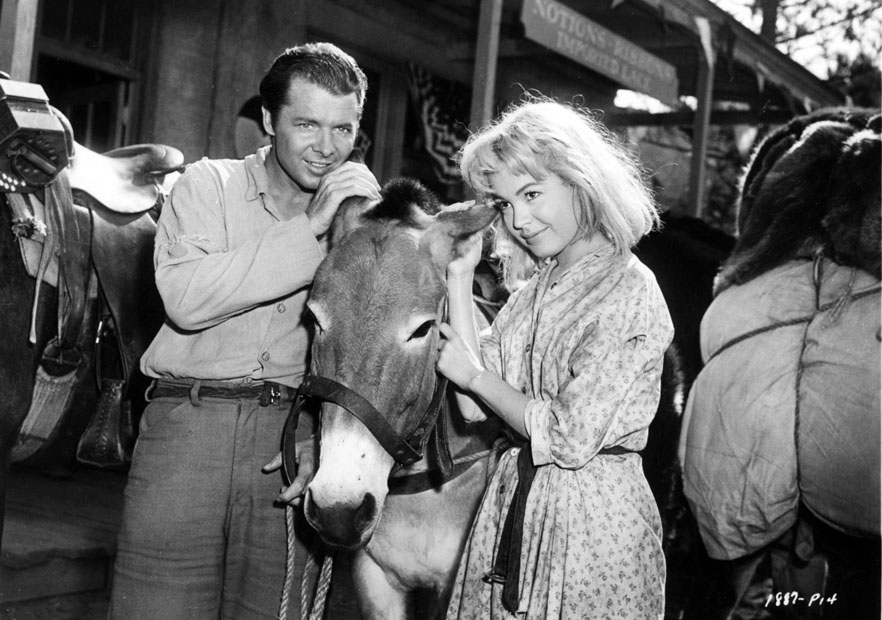
What do you get when you cross Audie Murphy with Sandra Dee?  An unlikely pairing, right? Maybe...but you also get the fun and sweet The Wild and the Innocent.  From 1959, this romantic comedy Western also features Joanne Dru, Gilbert Roland, and Jim Backus in supporting roles.  Strother Martin and Peter Breck (of Big Valley fame) also have parts in this charming little film.


Somewhere in the mountains of Wyoming, Yancy Hawks (Audie Murphy) lives with his uncle and his uncle's wife.  Trappers, the two men have been in the mountains for years; in fact, Yancy's never been out of them and in a town before.  After his uncle is mauled by a bear and needs to be still in order to recuperate, Yancy is sent on to the trading post to get needed supplies.  To his dismay, he discovers that the trading post has been closed and in order to sell his pelts and purchase what he needs, he will have to go into the big city---to the general store in Casper.


Enroute to the "big city," Yancy comes across a man (Strother Martin) traveling westward with a whole passel of kids.  Saying she would make a good wife, the man offers to trade his daughter, Rosalie (Sandra Dee), for half of Yancy's furs. Insisting that he would have to love a woman in order to marry her, Yancy declines the man's offer and continues on his way.


Not long afterwards, the dirty, unkempt Rosalie, who has run away from her pa, re-enters Yancy's life.  Sure that her father would have traded her to the first man who would take her, she chose to strike out on her own.  Since she figures she'll be able to find a job in the big city, and since that is Yancy's destination, Rosalie requests that he take her with him.  Although he doesn't really want the responsibility of the girl, Yancy agrees, and two very innocent, naive souls soon have their first-ever taste of city life.


The city's 4th of July celebration is in full-swing, so after cleaning up and getting some new clothes, both Yancy and Rosalie enjoy a night on the town.  Not knowing exactly what a dance hall girl is, Yancy is soon quite smitten with one of them (Joanne Dru).  Meanwhile, Rosalie, who is in love with Yancy and yearns for him to notice her, is romanced by the town's sheriff (Gilbert Roland) and offered a job at the dance hall.  She's unsettled about the type of gown she must wear and the kind of work she's expected to do, but since she has to support herself, what choice does she have?


Both Yancy and Rosalie are so innocent that the sheriff makes the comment that one doesn't know the kind of world he's in and the other doesn't even know she's pretty.  Will these two innocents get taken for a ride in the big city?  Will Yancy realize Rosalie loves him?  Or will he keep his attentions on the dance hall girl?  And what will Yancy do when he discovers Rosalie will soon be part of the dance hall establishment? How it all plays out is the balance of this very delightful film.


Although I'm calling this 3-stars, it's more like 3.5---it's cute, fun, sweet, totally charming, and somewhere between "like it" and "really like it" for me. There are a few parts which caused me to giggle like crazy.  First, when new clothes are bought for Rosalie---one of the items is a corset, and she has no idea what it is, nor does Yancy.  She tells him that she was informed it was to "hold her up."  Yancy's response, "Hold you up where?"  was quite comical.  Later, after she had donned her new gown over the corset, Yancy told her to take the corset off, that it made her bulge in places.  (Yes, the innocence of those statements is laughable to us today, but that is part of the film's charm.)


Besides the delightfully winsome storyline, it's fun seeing Sandra Dee in this change-of-pace role.  I think she did a great job.  The Big Valley's Peter Breck portrays one of the rowdy, drunken cowpokes who wants to bully the ill-equipped-for-city-life mountain man. Breck seemed totally in character, as on The Big Valley, he is usually the first one of the Barkley brothers to get into a scuffle.  Audie Murphy is perfect in this role; in fact, his character is much how I think of him in real life---an unsophisticated, small-town guy, able to stand right there with the best of them. Oh, and it must be mentioned that Audie is incredibly handsome at this point in his career!  While he was in his mid-30's here, his naturally youthful looks allowed him to believably portray a character who was probably supposed to be in his late teens.  (Audie was 17 years older than Sandra Dee, and, quite honestly, that fact didn't even occur to me until I was doing this post and realized her birth year---she actually could have passed for early 20's here.  And since Audie looked younger than his years, their pairing worked.)

The movie is corny, predictable, and (of course) very dated, but it's also charming, sweet, and unpretentious.  Put on your 1950's lenses, sit back, and enjoy a trip back to a more innocent time.

While not out on DVD or on the TCM schedule anytime soon, The Wild and the Innocent is available in its entirety on YouTube.  It's in four 20-minute parts, and although it's always a bit of a pain to watch in parts, it's definitely better than nothing.  I do hope you get a chance to see this.

Happy viewing!

NOTE:  All photos in this post were obtained from the Audie L. Murphy Memorial Website (HERE)


Thursday, May 23, 2013

Saraband for Dead Lovers (1948)

For years, I have been fascinated by the British monarchy---and I'm not just talking about the current Mountbatten-Windsors.  I've been enthralled by the Tudors, the Stuarts, the Hanovers, and the Windsors.  In fact, my passionate interest in the monarchy extends back to the Lancasters and the Yorks and their War of the Roses.  So, upon looking through Stewart Granger's filmography and discovering a film based on an actual incident in the life of one who would become a British monarch, I knew it was a must-see for me.  That film---1948's Saraband for Dead Lovers---is about the real-life wife of the man who would become England's King George I.  Also starring Joan Greenwood and featuring Peter Bull, Michael Gough, and Flora Robson in supporting roles, this British film, which received an Academy Award nomination for Best Art Direction, is easily a 4-star film for me.


As the story begins in 1700's Germany, a dying woman pleads to be allowed to write a letter to her son.  Knowing that he was brought up believing that his mother had brought dishonor to the House of Hanover, she longs for him to know the truth, and as she writes the letter, her story is brought to life.


For political gain, 16-year old Sophie Dorothea of Celle (Joan Greenwood) is wed to George Louis, Prince of Hanover (Peter Bull).  It's a marriage neither party wants, but because they must live their lives for politics, marry for politics, and bear children for politics, they do their duty.  First a son, then a daughter are born, and for Sophie Dorothea, the children are the only bright spot in her lonely life, as her husband has his share of mistresses and virtually ignores her.  All too soon, the children are taken from her to begin training for their futures.


In the summer of 1689, Count Phillip Konigsmarkk of Sweden (Stewart Granger) makes a visit to Hanover.  There is an immediate connection between him and Princess Sophie, and they soon fall in love.  Though their love may never have been consummated (according to history, there is some doubt as to whether it was), the Count's feelings for Sophie are not lost on the powerful, hateful Countess Clara Platen (Flora Robson).  Attracted to Konigsmarkk herself, Clara throws herself at him, but when he fails to respond to her, she is furious.  Of course, there is no fury like that of a woman scorned, and the Countess puts in motion a plan to separate the lovers forever.


This movie is fascinating, and it appears that it hasn't greatly altered any historical facts. Sophie Dorothea and Count Konigsmarkk really did fall in love (though they may or may not have been lovers).  He did, in fact, die under mysterious circumstances, presumably at the bidding of George Louis or his henchmen, and the Princess Sophie really did spend the final thirty years of her life imprisoned, while her husband took his place on the British throne.

Stewart Granger said the Saraband "script fascinated him, as he had no idea that love affair was the reason why the wife of George I of England, the mother of George II, spent the last thirty years of her life as a prisoner in the castle at Ahlden."  Further, he said, he loved the story and the character he was to portray.  In the end, according to his autobiography, Sparks Fly Upward, Saraband for Dead Lovers "is one of the few films he'd always been proud of."


Mr. Granger is so incredibly handsome here, and he is terrific in the role.  Also, he gets a chance to wield his sword a bit...which is always fun to watch.  Joan Greenwood is exquisitely beautiful and plays her tragic part to perfection.  Flora Robson, though, takes the prize for her performance.  She is evil and nasty in a way I have never seen her before.  Finally, the film's costumes are stunning---Oscar-worthy, in my opinion.  All these things, plus my interest in the subject matter, combine to make this a 4-star, "like it a lot" film for me, quite shaking things up on the bottom half of my "top-5 Stewart Granger films" list.

Though the film is not currently on the TCM schedule, nor to my knowledge is it out on DVD, it is available in its entirety on YouTube (in parts.)  I think it's well worth viewing, especially for those who like British drama, Stewart Granger, Joan Greenwood, Flora Robson, or British monarchs.

Happy viewing!!

NOTE:  For more information about Sophie Dorothea, her alleged affair with Phillip Konigsmarkk, and her imprisonment, go HERE.

Monday, May 20, 2013

Love Story (aka A Lady Surrenders) 1944

From Britain's Gainsborough Pictures, Ltd., comes Love Story, a wartime romantic drama from 1944. Starring Margaret Lockwood and Stewart Granger, this film bore the title A Lady Surrenders upon its release in the United States.  It's a film I had never even heard of until I went on the prowl for some of Mr. Granger's earlier works.


Wanting to do more for the war effort, concert pianist, Felicity Crichton (Margaret Lockwood), purposes to leave her career behind and take a position with the RAF WAC's.  In the physical exam required for admission to the corp, it is discovered that the fainting spells she had been having are not due to nerves as she had thought; rather, they are indicative of a fatal heart condition, resulting from her childhood battle with scarlet fever.  According to her doctor, death is inevitable...and not far off. Wanting to enjoy every single minute of the few months she has left to live, Felicity journeys to the English coast, taking on the name Lissa Campbell for anonymity.

Also visiting the English coast is Kit Firth (Stewart Granger), a former RAF pilot no longer able to serve, due to an optic nerve injury which has left him with a prognosis of blindness. Although a surgical procedure could repair the damage, the odds aren't in Kit's favor, so he has refused the operation, a decision reinforced by his childhood friend, Judy (Patricia Roc).  One of the few people aware of his condition, Judy is secretly in love with Kit and for that reason, views his impending blindness as a good thing, as it will keep him dependent upon her.

Though Lissa and Kit fall in love, in typical melodramatic fashion, neither will reveal their condition to the other.  Not wanting to burden one another, they vow a "no strings attached" kind of relationship, which means their love may not even survive the short time they could have together.


Though not spectacular, this film is well worth watching.  It is a bit on the slow side, but the story is sweet, Stewart Granger is incredibly handsome, Margaret Lockwood is lovely, and the music is beautiful.  Definitely, for me, an enjoyable, 3-star viewing experience.

Love Story is out on DVD and available through Classic Flix.  It is also available in its entirety on YouTube.

Happy viewing!!


Wednesday, April 24, 2013

Death Takes a Holiday (1934)

In recent weeks, I have bumped Fredric March from one of my top-10 faves to one of my "beloveds."  (I now have 8 great loves, with over a dozen more hovering just below that status.)  I have been an appreciator of Mr. March's talents since the first time I ever saw him---in The Best Years of Our Lives; however, the more I see of his works, the more impressed I am with him and the more I love him.  I have come to completely adore him!!  Thus, I've been on a quest to see as many of his films as I can, and Death Takes a Holiday was one I was dying to see (pun intended).  A romantic drama from 1934, the film also stars Evelyn Venable, with Guy Standing, Henry Travers, and Helen Westley taking on supporting roles.


Fredric March is Death, and in an endeavor to discover why mortals fear and hate him, he takes a 3-day holiday from that role, and, inhabiting the body of a prince, becomes a mortal himself. Spending his holiday at the home of Duke Lambert (Guy Standing), he finds himself falling in love with the beautiful Grazia (Evelyn Venable).  While some of the duke's house guests find him odd and even fear him, Grazia does not.  She loves him and is willing to follow him anywhere.  But does anywhere mean leaving the land of the living?


This is an interesting, well-acted film...and Fredric March is more handsome than I have ever seen him. Except for that early-1930's "lipstick look" which makes the men a bit too feminine-looking for my taste, I think he is completely gorgeous here!  Looks aside, Mr. March's acting in Death Takes a Holiday is completely over-the-top, something I happen to think is spot-on.  Given that he was playing an other-worldly character, I think the overacting goes with the territory; however, I know others who think he was actually laughable in this role.  Each viewer will need to make up his own mind.

The supporting players are all a real treat.  I would have liked to have seen their characters fleshed out a bit more, though that is hard to do in a 78-minute movie.  Had the film been longer and more developed, I might have rated it higher.  As it is, I'm calling this a solid 3-star film.


The film is out on DVD and part of the Classic Flix inventory (that's how I caught it); however, it is also available in its entirety on YouTube (HERE).

Happy viewing!!

Monday, April 15, 2013

Send Me No Flowers (1964)

Regular readers of They Don't Make 'Em Like They Used To know that I don't lean much to comedy.  Of my 40 all-time favorite movies, only five of them are comedies---and two of those I would classify more as dramedies than out-and-out comedies.  Despite my usual lack of tolerance for that genre, though, for some reason, the three romantic comedies pairing Doris Day and Rock Hudson quite appeal to me.  In fact, I actually love and 5-star two of them, one of which is 1964's Send Me No Flowers.  Also starring Tony Randall and featuring Paul Lynde and Clint Walker in small roles, Send Me No Flowers is the final of Rock and Doris's three pairings.


A hypochondriac to the max, George Kimball (Rock Hudson) is convinced he is dying. Although he had seen his doctor and had a complete check-up two weeks earlier, he is sure that the pain in his chest means he's on his last legs, so he makes another trip to his doctor's office.  After listening to George's heart, the diagnosis is indigestion, and George is sent home with another bottle of pills, to add to his already-burgeoning medicine cabinet.  At George's previous visit, the doctor had taken a cardiogram, the results of which have not come back yet.  While George is in the restroom, the doctor takes a phone call about one of his other patients---a man who is dying. Overhearing the doctor's side of the conversation, George is certain he is the patient being discussed and that the results of the cardiogram indicate it is he who has only a few weeks to live.


Determining that it would be best to not tell his wife, Judy (Doris Day), the horrible news---lest she go to pieces---George shares the news of his "condition" with neighbor/friend, Arnold (Tony Randall) and then sets out to be sure Judy will be taken care of after his "death."  He purchases cemetery plots, dictates a goodbye message, then attempts to set her up with another man (Clint Walker).  Through a series of misunderstandings, Judy comes to believe that George is actually having an affair with a neighbor lady, and she kicks him out of the house.  When he attempts to explain the situation, Judy doesn't believe a word he says, and George finds himself further in the doghouse.


Does George ever realize that the doctor was talking about another patient and that he really has nothing wrong with him?  Does Judy figure out why George is pushing her into the arms of another man?  Does she believe him when he insists he is not having an affair?  Those are the questions which play out in the remainder of the film.


For a variety of reasons, I find Send Me No Flowers to be a completely delightful film.  For one thing, the chemistry between Rock and Doris is awesome.  I know Rock was gay and that there was never anything more than deep friendship between the two of them, but, boy, they could have fooled anyone.  They are amazing together, and that is part of what makes this film work for me.


Another reason I love the film is that I completely relate to it.  Twenty years ago, I was the kind of hypochondriac George Kimball is.  I was continually convinced that I had every form of cancer there is and that I was going to die before six months was up.  I remember my son's 3rd birthday in November, 1994.  Though I wouldn't be diagnosed for a few more days, I had pneumonia at the time, and I was horribly sick.  I remember crying to my mother-in-law at my son's birthday party, telling her that that was the last of Garrett's birthdays I would ever see.  I was completely and totally convinced I was dying.  AND, my daughter has inherited this propensity to hypochondria, having every form of cancer there is herself.  A black and blue mark, and she's convinced she has leukemia, a headache, and she's convinced it's a brain tumor, etc.  So, as we watch George Kimball obsess about his ailments, my daughter and I howl with laughter, seeing ourselves in the entire situation, thereby making the film even more amusing to us.

Tony Randall, as the Kimball's next-door-neighbor, and Paul Lynde, as the cemetery salesman, are both quite hilarious in their roles.  Doris is her usual perky, lovely self.  She sports some beautiful outfits here, especially her bright green suit.  Rock is gorgeous, absolutely gorgeous.   And, finally, Doris sings the film's theme song.  All those things combine to make this a film I absolutely love.

Out on DVD, Send Me No Flowers should be quite easy to track down.  If you like Pillow Talk, I'm sure you will enjoy this film as well.  It's a definite 5-star, "love it" film for me, and I highly recommend it.

Happy viewing!!


Tuesday, March 19, 2013

Meet the Stewarts (1942)

In need of a William Holden fix and, also, wanting to show my co-#1 guy some love in the midst of my John Garfield mania, I recently tracked down one of his lesser-known films, Meet the Stewarts. From 1942, this romantic comedy, also starring Frances Dee, is from very early in Mr. Holden's career---when he was just a mere 24-years old.


Socialite Candy Goodwin (Frances Dee) yearns for her hardworking, yet minimally paid, boyfriend, Mike Stewart (William Holden), to propose to her.  Much as Mike loves Candy, however, he refuses to pop the question, sure that his salary wouldn't be sufficient to keep her living in the style to which she's accustomed.  Additionally, he doesn't want to be seen as the fortune hunter Candy's dad thinks he is, so until such time as he can afford to support a wife on his own, he will not marry her.

Determined to snag her man, Candy promises Mike that she will live on a budget, while her father insists that there will be no financial help from him if the two do get married...that Candy will go to the marriage with nothing more than a few personal belongings.  Of course, those are exactly the words Mike wants to hear, so he and Candy tie the knot.


Returning from their honeymoon, the couple discovers that they are over-budget on the furniture for their house.  Determined to live within their means, they realize they will have to return some of their purchases...but just what they'll return remains to be seen, as everything is a "must have" for Candy.  Also, although Candy is used to a maid and a cook, those things are not in the Stewart's budget, so she will have to learn to get along without them.  The film chronicles the couple's attempts to live within their modest means.


Meet the Stewarts is not a terrific movie, but it's clean, fun, and enjoyable...a solid 3 stars.  It's very dated (with such cringe-inducing lines as "All wives have to be smacked around a little.") and there are a few slapstick moments, but overall it's very sweet, with some lessons about debt and spending that our current "have to have it now, so I'll buy it on credit" society would do well to put into practice.

Out on DVD, this film is available through Classic Flix.  It is also available in its entirety on YouTube.  HERE is the link to part 1.  I hope you get a chance to see it.

Happy viewing!!

Saturday, March 02, 2013

John Garfield Blogathon---Saturday's Children (1940)

One of my favorite online social forums is The Golden Age of Hollywood (HERE), and it is through there that I met today's guest.  Mad, as she likes to be called, is one of my dearest friends over there.  She hails from Canada, and though she would be too humble to say this about herself, I certainly think it is the truth---she is the biggest Claude Rains fan on the planet.  Given that both Mr. Rains and Mr. Garfield were initially stage actors, they knew each other well; in fact, Mr. Garfield has said that Claude Rains was rather a mentor to him as he transitioned from stage to screen.  The two men appeared together in several films, including the little-known Saturday's Children, which is one of the few Garfield films I have yet to see.  In true #1 fan form, Mad has seen Mr. Rains' entire filmography, which means Saturday's Children has crossed her path, and it is that film she will be showcasing here today.  It definitely sounds like a "must see" film to me!  (Of course, I'm on a quest to see every Garfield film, so I guess, they are all must-sees.)

I'm thrilled to have Mad as my guest, so without further ado...I'll turn things over to her.


SATURDAY’S CHILDREN (1940)

I am often surprised to discover classic era films of true quality that have somehow sunk into obscurity.  Saturday’s Children is one of these little-known gems.  To begin with, the film has an excellent pedigree.  The script was written by Julius and Philip Epstein (Casablanca, Four Daughters, Mr. Skeffington), from the Pulitzer-winning play by Maxwell Anderson (What Price Glory, Key Largo).  It’s directed by Vincent Sherman (Mr. Skeffington, Old Acquaintance), with Irving Rapper as dialogue director (later to direct Now, Voyager and Deception).  In addition to having a great cast, it’s also one of those rare treasures – a John Garfield comedy.


Our story begins with an average morning for the Halevy family.  Dad (Claude Rains) is resisting Mom’s (Elisabeth Risdon) efforts to get him out of bed to go to his dull job as a bookkeeper.  Meanwhile daughter Bobby (Anne Shirley) is excited about her first day of work at the same firm (where Dad has got her a job).  Sharing their New York brownstone is her older sister Florrie (Lee Patrick) and Florrie’s husband Willie (Roscoe Karns).  When she’s not trading wisecracks with Willie, Florrie is trying to educate Bobby in the ways of the world – particularly concerning the battle of the sexes.  To Florrie’s dismay, Bobby is resistant to what she feels are dishonest tricks for landing a husband.

At work, Bobby meets fellow employee Rims Rosson (Garfield), whose hobby is inventing crazy gadgets that he admits are not ‘commercially practical’.  He does have one practical dream - to discover a way to manufacture silk from hemp.  It’s obvious from the start that Rims and Bobby share the same wry sense of humour and directness, and they begin dating as part of a weekly bowling night.  When Rims gets a job offer in the Philippines to work on his hemp-to-silk idea, Florrie convinces Bobby that she’ll lose him unless she takes certain ‘foolproof steps’ to get him to propose.  Further complications ensue for the young couple, with some dramatic turns that I would rather leave viewers to discover for themselves.


By this time, Garfield had made eight movies, playing a street-smart tough guy in most of them.  Here he plays a rather distracted, guileless fellow, who wears glasses to read and is slightly awkward at the dating game.  He is attracted to Bobby because of her straightforwardness.  Rims is an eccentric soul with a quirky sense of humour and a positive outlook on life.  It’s a marked contrast to some of the hard-bitten roles we have seen him in, but Rims is no weakling and Garfield still creates a fascinating three-dimensional character.  In Rims, Garfield shows us a more casual, easygoing type.  He’s no stranger to disappointment, but he’s a realist - not a cynic.  It’s a rare joy to see Garfield get to play this relaxed character with a sense of humour.  He’s a bit of a dreamer, and definitely a person you would enjoy getting to know.

Garfield is well matched by Anne Shirley as Bobby – torn between a selfish (but normal) desire to keep Rims with her, and a feeling of guilt that she is preventing him from pursuing his dreams.  She’s not only cute and likeable, but I was impressed with her as an actress in this movie – she often gets to be the ‘strong one’ for those around her.  (I’ve read that Warners originally wanted Priscilla Lane, but fearing it would be rewritten as another ‘Lane Sisters’ movie, Garfield lobbied for Anne Shirley.)

This movie is a romantic comedy with an intelligent storyline.  What I love about these old Warner Brothers pictures is that they show average people struggling to get by, and still managing to find happiness.  Not being rich isn’t seen as a tragedy to be ‘solved’ in the last reel.  The characters cope in the best way they can, without a lot of self-pity and in ways that ring true.  The title refers to the poem predicting the traits of children according to the day of the week on which they were born, in which “Saturday’s child has far to go”.  (The usual version is “… works hard for a living” but the spirit is the same.)  Money troubles may be the catalyst, but the couple’s problems are really about honesty and compromise in love and marriage.  Their story isn’t maudlin or sappy; their joys and pains are those we can relate to, and we laugh with them as if it were our own family.  A quality script has a lot to do with this, but ultimately it’s Garfield and Shirley that bring these characters to life and make us care.


The supporting cast has some stellar character actors, including my own personal favourite – Claude Rains.  Rains and Anne Shirley have a wonderful chemistry as father and daughter.  Their scenes together are affectionate and heartwarming.  Always a commanding presence, Rains was a master at intelligent emotional scenes.  His heart-to-heart talks with Bobby about regrets in his own life are touching and honest, without being over-sentimental.  His ‘Pops’ is a complicated mix of cheerful resilience and melancholic resignation.  Rains also had a fine comedic sense; often a witty and sarcastic villain, here he is charming and funny as a teasing, loving father.  (I once read a comment that, with the exception of Lon Chaney Jr. in The Wolf Man, Rains always had daughters in the movies - often four at a time!).  This was the fifth picture Rains and Garfield were in together, continuing a friendship that began when Rains mentored him on Four Daughters. 


Lee Patrick and Roscoe Karns share some of the funniest of the Epsteins’ lines, with Patrick as the big sister always trying to ‘help’ with Bobby’s love life, and Karns as her henpecked husband who fights back with wisecracks.  They complement each other perfectly and their banter is fast and clever.  Their underlying affection is quite believable, and that’s probably why it’s so much fun to watch them bicker.  There is more witty dialogue at work, from Bobby’s fellow clerk Dennie Moore and her hapless boyfriend George Tobias.  Elisabeth Risdon (as the mother) is the only one not given much to do; although sympathetic, she never seems to be consulted on the family’s emotional crises. 


I have read that Saturday’s Children was one of Garfield’s happiest film experiences, and a performance of which he was very proud.  I can see why – it’s sweet, it’s funny, and it gave him a chance to show his versatility as an actor.  Unfortunately, it wasn’t a success at the box-office, which may be why it’s not well known today.  It does not seem to be available on DVD, but if you have access to TCM in North America, you can catch it on March 4th at 8:45 am (ET), and I heartily recommend that you do.  It deserves to be re-discovered.


Saturday's Children does, indeed, sound like a terrific movie, and I cannot wait to see it.  A huge thank you to Mad for this awesome write-up!  What a fantastic addition to the blogathon! To read all the other terrific blogathon pieces, go HERE.

NOTE:  After finally having a chance to watch this film, I am giving it 4-stars.