Showing posts with label action/adventure. Show all posts

Wednesday, June 12, 2013

The Gun Runners (1958)

It was last June, in honor of Audie Murphy's birthday, that I discovered The Gun Runners, and while I reviewed it then, since it is one of my two (so far) favorite Murphy films, it would be totally remiss of me not to spotlight it while he is star of the month.  Besides, while my first viewing of this film found me rating it 4---and very close to 5---stars, repeated viewings have definitely moved it into the 5-star "love it" category.  (Alas, since I "discovered" this film last year, it will not be part of my "5-star film discoveries of 2013.")  So, without further ado, here is a revision and expansion of my review of The Gun Runners.


The third film adaption of Ernest Hemingway's To Have and Have Not is 1958's The Gun Runners, starring Audie Murphy and Eddie Albert.  Directed by Don Siegel, this film, which features Patricia Owens and Everett Sloane in supporting roles and introduces Gita Hall (in the first of her two films), is my second favorite version of the Hemingway story (John Garfield's The Breaking Point is my absolute favorite).


Living in Key West, where he runs a charter fishing service with his boat, the Lucy M, is former Navy man, Sam Martin (Audie Murphy), a good guy who doesn't have it in him to do wrong. Though finances are a constant struggle, he and his wife Lucy (Patricia Owens) are happy and very much in love.


After failing to be paid close to $1,000 for a job, Sam hits a local casino, where his financial burden comes to the awareness of craps player Hannigan (Eddie Albert), who hires Sam to take him fishing.


Accompanying Hannigan on the excursion is Eva (Gita Hall), and though she puts the moves on him, Sam has no intention of cheating on his wife.  (The lines he uses to decline her advances are the exact same ones John Garfield uses to turn down Patricia Neal in The Breaking Point.)


Using the fishing excursion only as a ploy, Hannigan's real destination is Havana, where he has arranged a meeting with a band of Cuban revolutionaries.  After an eventful night--in which Hannigan shoots a man---Sam returns to Key West, completely determined to avoid any future contact with his lawbreaking passenger and the political unrest in Cuba.


However, when the mortgage on the Lucy M is bought by Hannigan, Sam has no choice but to do the man's bidding.  Behind on his payments, Sam finds his boat in foreclosure, and the only way he will be able to get her back is to deliver Hannigan---and the guns he is supplying the revolutionaries---to Cuba...something he absolutely does not want to do.

Will this man, who doesn't have it in him to go bad, go bad after all?  How it all plays out is the balance of the film.


As stated above and discussed HERE, John Garfield's The Breaking Point is my absolute favorite version of this story (and the most faithful to Mr. Hemingway's work).  The Gun Runners, though, is easily my second favorite (and not far behind The Breaking Point), leaving the Bogey/Bacall adaption as the one I like the least (and a 2-star film for me). Sacrilege, I know, but To Have and Have Not just doesn't do it for me.  Oh, I readily admit that Bogey and Bacall have amazing chemistry, but the story itself doesn't touch me at all.  I don't care about any of the characters, and both times I watched the film, I found myself longing for it to end.  The Gun Runners, though, as with The Breaking Point, I completely and totally love.

Because I don't care for To Have and Have Not, I very nearly didn't even give the other two adaptions a try. It was only because of my determination to see John Garfield's entire filmography that I bothered with The Breaking Point, and I must be honest, I wasn't expecting much. Wow, would I have been missing out if I had skipped it, for it immediately became my absolute favorite John Garfield film (still is).  Because of that positive experience, and because I like Audie Murphy, I took a chance with The Gun Runners, and as with The Breaking Point, I was so glad I did.  I was wild about it, and it immediately shot to the top of my "favorite Murphy films" list.  Repeated viewings have only served to increase my love for it.

I completely adore Audie in this film.  Besides loving his character, I love his look.  In his early 30's here, his face has matured from his earlier Westerns, and he is incredibly handsome. Acting wise, while Audie Murphy was no John Garfield, he is extremely solid in this role---I find him to be just as believable as Garfield; and with his soft-spoken demeanor, Mr. Murphy brings a different kind of vulnerability to the character than Garfield does. The film's storyline is interesting, exciting, and thought-provoking, the characters are memorable, and the playful, romantic interaction between Murphy and his wife is very sweet---it's not often you get a chance to see a romantic side of Audie. (The same playful interaction occurred between John Garfield and wife Phyllis Thaxter in The Breaking Point, and I loved it there as well.)


Eddie Albert is terrific in his role as the "heavy."  Who knew he had that kind of stuff in him?  I sure didn't.  He is about as far from Green Acres' Oliver Wendell Douglas here as he is from the moon!  Taking on the Walter Brennan/Juano Hernandez role here is Everett Sloane, and he puts in a good performance.  I'm not familiar with Patricia Owens at all, but she is sweet wife material.  I really like her in this role.  Plus, she and Audie have great chemistry together.

All these things work together to make The Gun Runners a 5-star "love it" film for me.  If you are a fan of Audie Murphy, you will definitely want to see this.  Also, if you've read the Hemingway story, you might want to watch this and see how it compares.

Out on DVD, The Gun Runners ought to be fairly easy to track down; plus it is available through instant viewing on Net Flix.  I do hope you get a chance to see it, as I think it is terrific!

Happy viewing!!


NOTE:  All photos in this post were obtained from the Audie L. Murphy Memorial Website (HERE)


Thursday, May 30, 2013

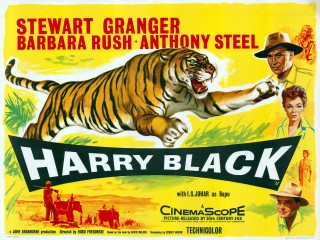
Harry Black and the Tiger (1958)

Another of Stewart Granger's action/adventure films is 1958's Harry Black and the Tiger. Shot on location in India, this film, which also stars Barbara Rush, Anthony Steel, and I. S. Johar, is based on David Walker's novel Harry Black.  Taking on such themes as lost love, courage, fear, and contentment, this Hugo Fregonese film tackles far more than just a tiger.


With a man-eating tiger on the loose and terrorizing the residents of a small Indian village, big-game hunter, Harry Black (Stewart Granger), is brought in to kill the animal.  Accompanied by a native guide, Pabu (I. S. Johar), tin-legged Harry tracks the animal, narrowly missing him on a couple occasions. One time, due to the misfiring of an accompanying man's rifle, the big cat jumps Harry, severely injuring him.


People from Harry's past live in the area, and his arrival has brought them back into his life. Desmond Tanner (Anthony Steel), is an old Army buddy, now overseeing a local plantation. As he spends time with Desmond while recovering from the tiger attack, Harry finds himself reliving the scene in which Desmond's cowardice resulted in the loss of his (Harry's) leg and the need for a prosthesis. Attempting an escape from a German POW camp, Desmond's fear paralyzed him, causing Harry to hesitate and lose precious moments. While he did manage to escape, the few-seconds' delay enabled the enemy to get a shot off, shattering Harry's leg, leaving him with no choice but amputation.

Upon being released from the hospital, Harry called upon Desmond's family, and he and Desmond's wife, Christian (Barbara Rush), ended up falling in love.  Knowing the futility and heartbreak of such a relationship, Harry said goodbye to Christian and moved into a life without her. Seeing each other once more, though, has brought their feelings for one another back to the surface. When Harry wonders if she has been happy, Christian responds that while there have been no flashes of lightning, she has been content. 


Unsettled by Christian's nearness and the realization that his love for her has never died, Harry's ability to capture the tiger is hampered, so hampered, in fact, that after his own moment of cowardice, he determines to give up the quest.  Yet when Desmond and Christian's young son, Michael, is thrown from his horse and is stranded alone in the jungle where the man-eating beast lurks, Harry will have to put his feelings aside.  How it all plays out is the balance of the film.


While Harry Black and the Tiger is not one of my most favorite Granger films, the character of Harry Black is one I like a lot. He is a very likable man...one you can't help rooting for.  His rapport with young Michael is very sweet, as is his rapport with the guide Pabu.  Obviously, the on-screen chemistry with Mr. Johar was felt off-screen as well, for about him, Granger wrote, "His lilting accent and marvellous (sic) hand gestures were a joy, and our obvious affection for each other played a big part in the success of the film."  The scenery is beautiful, as is the tiger...and so is Stewart Granger.  The man looks fantastic with the touch of gray in his hair!

Having worked so well with Deborah Kerr in other films, Mr. Granger had really hoped to have her as his co-star/love interest once more.  However, "to his bitter disappointment, Twentieth Century wouldn't release her," so Barbara Rush was given the nod.  Even if Miss Rush wasn't to Granger's liking, though, the sexual tension between the star-crossed lovers seemed very believable to me.


In Sparks Fly Upward, Mr. Granger shares some fun facts about the making of Harry Black. During the early part of the filming, the star tiger (a tigress, not the male they had thought) was in season and loudly called to the males each night.  Besides being kept awake by all the racket, in the morning, they always discovered evidence that cats had been wandering through their camp the night before.  Eventually, "the star" went out of season, and things settled down. Also adding to the excitement of filming in India was the fact that there had recently been a cholera outbreak, resulting in water so "cleaned up" that they felt they were drinking pure chlorine.  Coupling that with having curry for every meal, he writes that his "memories of that enchanting camp were smells of curry and chlorine."  (The things people go through to bring a movie to us!!)


Although Leonard Maltin gave Harry Black and the Tiger 0 out of 4 stars, I'm going with 3 out of 5.  I found it to be an interesting, enjoyable, solid film.  For me, it's right up there with King Solomon's Mines as an exciting trek through the jungle (albeit on two different continents).  Both films feature a brave adventurer, native guides, superstition, danger, and a woman in love with a man other than her husband.  While there were times the film dragged, I found that to be true with King Solomon's Mines as well.  In the end, I was interested enough in the story to persevere through the slow parts, and even though I will probably never watch Harry Black and the Tiger again, I, nevertheless enjoyed it.  It even touched me a bit and got me lightly misty-eyed at one point.

While not on the TCM schedule in the near future and not out on DVD here in the U.S. (though a Region 2 disc has been released) the film is available in its entirety on YouTube.

Happy viewing!!

NOTE:  All quoted material derived from Sparks Fly Upward, by Stewart Granger, G. P. Putnam's Sons, 1981

Monday, May 13, 2013

The Prisoner of Zenda (1952)

The Prisoner of Zenda---so far---is in no danger of losing its status as my favorite Stewart Granger film.  Although many blog readers thought Scaramouche---which I caught for the first time last week and will be reviewing later this month---would usurp that #1 position, it didn't. Oh, I liked the film tremendously, and I thought Mr. Granger was more handsome in that film than in any other I have seen (and I think he's always gorgeous---at least when he is clean-shaven); however, The Prisoner of Zenda is so dear to me that it was able to withstand the competition and remain my favorite Stewart Granger film.  Loving that film as I do, I thought re-working and expanding on its previous post was a definite must for Mr. Granger's centennial celebration here at They Don't Make 'Em Like They Used To.


Based on Anthony Hope's 1894 adventure story, The Prisoner of Zenda has seen several film adaptions through the years.  Perhaps the best known of them is the Ronald Colman/Douglas Fairbanks, Jr. one from 1937; this lavish Technicolor 1952 version---which stars Stewart Granger and Deborah Kerr and features Louis Calhern, Jane Greer, and James Mason in support---is, according to Robert Osborne, nearly the exact likeness of the 1937 film.  In fact, the same script was used, as was the same Alfred Newman score.  The only differences, according to Osborne, were a new cast and the addition of technicolor.  Many people prefer the '37 film; I, however, have not yet seen that one, so I cannot compare the two and am basing my rating solely on how this particular film affected me.


The film begins just before the coronation of Rudolph V, king of the fictional country of Ruritania.  Just happening to be on his way through the country at the time is a distant cousin of the king, an Englishman who also bears the name of Rudolph.  Except for the fact that the Englishman has a mustache and is graying at the temples, he is the exact image of the king. (Stewart Granger plays this dual role.)  The Englishman is invited to dine with the king on the eve of the coronation.  In his usual fashion, the king drinks to excess; later, however, he collapses...having been poisoned through his wine.

King Rudolph's allies know that the king's half-brother Michael, who wants the crown for himself, is likely the one behind the poisoning; they also know that if the coronation does not go on as scheduled, Michael will be crowned instead.  Since Rudolph the Englishman looks virtually identical to the king, it is suggested that he impersonate the king for the coronation ceremony, after which time, the effects of the poisoning will have worn off, and Rudolph can take his throne and the Englishman may continue on his journey, with no one ever knowing that it was not the real king who was actually crowned. Convinced that the plan will work, Rudolph the Englishman takes the king's ring and the plan is set in motion, with the real king being hidden away in the wine cellar.


Is Rudolph the Englishman successful at convincing everyone that he is the real king?  And what about when he meets the Princess Flavia (Deborah Kerr), the woman promised to the king?  Do Michael and his cohorts sit back quietly and allow their plans for Michael to usurp the throne to be thwarted?  These are the questions which play out in this exciting little film. The dashing (and beautiful voiced) James Mason portrays one of Michael's partners in crime, and there is a terrific fencing scene between him and Stewart Granger.


According to Stewart Granger's autobiography, Sparks Fly Upward, it was his idea for the remake.  While he and Jean (Simmons) were dining with Mr. and Mrs. Ronald Colman, Mr. and Mrs. David Niven, and Deborah Kerr and husband one evening, Mr. Colman ("Ronnie," as Granger refers to him) asked if they would like to see one of his old films, and since Mr. Niven had also appeared in The Prisoner of Zenda, that is the film the guests were shown.  Enthralled with the film, Granger announced that he was going to suggest to Dore Schary (Metro) that he buy the rights and do a remake, which, of course, he did and Mr. Schary did. Though Granger had no illusion that "he could ever compete with Ronnie Colman as an actor, at least (he said), he could fight better"...or so he thought.  At one point in the filming of the sabre fight, he forgot to "parry to the left" and was caught in the mouth by the sword.  Though not a serious injury, it spilled forth quite a bit of blood and required a few stitches; however, the next day, Granger was able to get back to filming, and in only twenty-eight days, this extravagant Technicolor version of The Prisoner of Zenda was completed.  "Bloody hard work but great fun," according to Granger.  Sensational, captivating, and charming, according to me! I absolutely love this film!

Out on DVD as part of the Literary Classics Collection, The Prisoner of Zenda should be quite easy to track down.  Additionally, it is on TCM's schedule for Monday, June 24th, at 2:00 p.m. (ET).  Definitely, try to see it...it's an exciting, entertaining, 5-star gem of a film.

Happy viewing!!

NOTE:  All quoted material derived from Sparks Fly Upward, by Stewart Granger, G. P. Putnam's Sons, 1981.


Sunday, May 05, 2013

Moonfleet (1955)

When I think of Fritz Lang, I think of gritty noirs, but as 1955's Moonfleet bears out, he was quite capable of other things as well.  An action/adventure period drama starring Stewart Granger and child star John Whiteley, Moonfleet is based on J. Meade Falkner's 1898 novel of the same name.  Featuring George Sanders, Joan Greenwood, and Viveca Lindfors in support and a terrific Miklos Rozsa score, this film is right up there with The Prisoner of Zenda as my favorite Granger film.  (I have yet to see Scaramouche, so things could soon change.)

In 18th-century coastal England, young John Mohune (John Whiteley) makes his way, by night, to the little town of Moonfleet, where, directed by a letter from his recently-deceased mother, he will be able to find Jeremy Fox (Stewart Granger), who according to the letter, will be a friend to him.  Recently returned from the colonies and now living in the home once belonging to the dead woman's family, Fox and the woman appear to have been in love in their youth.  Though her family drove Fox away and married her off to a more suitable man, the dead woman is confident that Fox's former love for her will cause him to help her now-orphaned son.

Not the law-abiding man the writer of the letter once knew him to be, Fox is now the leader of a band of smugglers, with no interest in the everyday responsibility of a young boy. Wanting to be rid of the child, yet wanting to do the right thing by his mother, Fox intends to send him away to be educated; however, convinced that Fox is his friend, the lad is just as determined to remain in Moonfleet.  The little boy's unconditional love and trust eventually work their magic on Fox's cold, selfish heart.  At one point, Jeremy is forced to spar with one of his own gang in order to keep John alive.


Though in his autobiography, Sparks Fly Upward, Mr. Granger refers to Moonfleet as "another dreary costume epic, directed by the once brilliant Fritz Lang," I don't agree with his opinion at all.  I quite enjoyed this film---it is interesting, exciting, and well-acted.  Complete with a long-lost diamond, a coded treasure map, a supposedly-haunted graveyard, a cutthroat hideaway, and a short, but exciting, swashbuckling scene, this film is pretty much non-stop action.  Add to that, Mr. Granger never looked more handsome, and little John Whiteley is a charmer.  There were even a couple of touching moments which got me misty-eyed.  For me, this is easily a 4-star movie...and very close to 5.

Having never read the book upon which the film is based, I can't compare the two.  However, whether the two stories differ from one another matters little to me. In fact, it never bothers me if a film is significantly different from the book which inspired it; I see them as two separate entities, both of which can stand on their own.  I'm not sure why people get so bent out of shape when a story is changed---after all, both can have merit.

Out on DVD, Moonfleet should be fairly easy to track down.  Adventure-loving film fans ought to greatly enjoy it.

Happy viewing!!

Saturday, June 02, 2012

Soldier of Fortune (3 stars)

Soldier of Fortune, from 1955, is an action/adventure romantic drama starring Clark Gable and Susan Hayward.  Directed by Edward Dmytryk, this film, which I recently caught for the first time, features Michael Rennie, Gene Barry, and Tom Tully in supporting roles.


With her photojournalist husband missing and presumed to be a prisoner of the Chinese, Jane Hoyt (Susan Hayward) has traveled to Hong Kong (under British rule at the time) to seek information as to his whereabouts.  Without a visa, Lewis Hoyt (Gene Barry), had entered China three months earlier in order to do a story; although his camera equipment was found on a junk, the local authorities have no leads as to the man himself, but they do believe he is being held against his will in the Communist nation.

With little hope that the British agents can help her, Jane contacts American expatriate, Hank Lee (Clark Gable)---a smuggler with connections.  Attracted to Jane, Hank expects certain "favors" in return for his assistance; however, Jane angrily refuses and attempts to track down information on her own.  She's unsuccessful, though, and even finds herself tricked by unscrupulous locals, so in the end she has no choice but to turn to Hank once more.  But will Hank---who wants the beautiful lady for himself and, therefore, has something to gain by her husband remaining in captivity---really put himself in danger to locate and free Lewis Hoyt?  How it all plays out is the balance of the film.


Soldier of Fortune is a very solid, interesting, exciting film.  While I totally love Gone with the Wind and adore Clark Gable in his Rhett Butler role, I also quite appreciate him in his older years.  I think he aged well, and I love the gorgeous maturity which marks him at this point in his career/life.  He plays his part here to perfection...he's cocky and masculine, yet altogether romantic as well.  Susan Hayward---my #2 gal---is wonderful in her role---she's strong and determined, but with an element of softness and vulnerability.  I thought the two of them were really terrific together.  The supporting cast is good also, especially Tom Tully, who is a bit out of character from what I'm normally used to.  The lovely Hong Kong backdrop quite added to the authenticity of the film.

This film is out on DVD, so it ought to be easy to track it down.  Gable and/or Hayward fans will probably thoroughly enjoy it.

Happy viewing!!

Tuesday, May 29, 2012

Blood and Sand (4 stars)

Blood and Sand, from 1941, is an action/adventure Technicolor film starring Tyrone Power, Linda Darnell, and Rita Hayworth.  Featuring Laird Cregar, John Carradine, J. Carrol Naish, and Anthony Quinn in supporting roles, this film, which was brought to the screen in 1922 with Rudolph Valentino in the lead role, is based on the Vincente Blasco Ibanez novel of the same name.


Young Juan Gallardo (who will grow up to be Tyrone Power) dreams of being a bullfighter as his late father was.  Bragging that the bull which can kill him hasn't been born yet, the fearless Juan vows to be the greatest of all matadors.  After promising his childhood sweetheart, Carmen (Ann Todd, who will grow up to be Linda Darnell), that they will be married upon his return, Juan sets off for Madrid, where he will train and begin his bullfighting career.


Ten years later, Juan returns to his hometown, marries the lovely Carmen, and is very much at the top of his game.  While the bullfighting critic, Curro (Laird Cregar), was once unimpressed by Juan, the man is soon eating his words and declaring Juan to be "the greatest of the great."  Crowds are wild about Juan's abilities in the ring, and he soon becomes rich and famous.


At the height of Juan's fame, the beautiful Dona Sol (Rita Hayworth) returns to town, and in short order, the two of them have begun an affair.  As he pursues his relationship with the beautiful woman, Juan neglects all else.  His bullfighting skills falter, his critics rail against him, and his wealth disappears.  With up-and-comers on the move, and a fickle crowd always wanting something greater, will Juan be able to hang on to his fame?  Or will the illicit love of the beautiful woman bring him down?  How it all plays out is the balance of the film.


The costumes and scenery in Blood and Sand are stunning!  The story is interesting and exciting and filled with non-stop action.  Ty Power is completely perfect in this role, and he is magical with the cape---the way it twirled in front of the bull is beautiful.  He looks spectacular in every costume he wears, and his acting is terrific.  Linda Darnell is lovelier than I have ever seen her, and she and Power, as in their other films together, have great chemistry here.  Rita Hayworth (who is rapidly climbing up my favorite actress list and is now close to #10) is completely gorgeous; I was especially captivated by her in a royal blue gown.  She even has a chance to "strut her stuff" in a beautiful, sensual dance sequence with Anthony Quinn.


While bullfighting is no longer an acceptable means of entertainment, Blood and Sand is a product of its times and, as such, is easily a 4-star, must-see film.  Besides, just enjoying this movie doesn't mean one condones bullfighting, anymore than loving Gone with the Wind means one condones slavery.  This film also includes marital infidelity, and I abhor that...but I still think the film is amazing!!  Out on DVD, it ought to be fairly easy to track down.

Happy viewing!!

Wednesday, April 25, 2012

Escape from Fort Bravo (4 stars)

Escape from Fort Bravo, from 1953, is a romantic Western adventure film starring William Holden, Eleanor Parker, and John Forsythe.  Directed by John Sturges, this color film features William Demarest, Richard Anderson, and Polly Bergen in supporting roles.


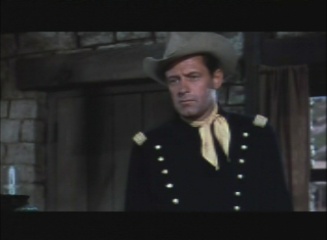
The story begins in 1863, at Fort Bravo...a remote Union prison in Arizona Territory.  One of the soldiers stationed at Fort Bravo is Captain Roper (William Holden).  A hardened, unkind, cynical man, Roper performs his duties with an iron hand.


Given the fort's remote desert location and the local warring Mescalero Indians, escape from the prison is hardly likely; however, when one man does try to escape, Roper, intending to make an example of him and, thus, discourage future break-outs, drags the man back to the fort at the end of a rope.  With Roper's rather inhumane methods, his superior, who doesn't approve of such actions, makes the statement that he's glad he and Roper are on the same army.


The Confederate prisoners, of course, despise Roper and even taunt him by whistling "Dixie" as he walks by.  Captain Marsh (John Forsythe) tells a few of his men that they are waiting for the right time and then they will break out....and the right time soon arrives...in the person of Carla Forrester (Eleanor Parker).


A friend of Roper's superior's daughter, Carla has come to the fort supposedly for a visit.


However, in actuality, she is engaged to Captain Marsh, and her purpose in being at the fort is to make arrangements with a Confederate sympathizer for guns and transportation of the prisoners.


Additionally, she is to distract Roper---a job which she does perfectly.


Completely smitten with Carla, Roper's emotionless facade begins to crack.


Totally in love with her, he asks her to marry him and to stay on at the fort.  Carla indicates she loves him too...but does she?


Has her playing at love become real?  Or are her kisses and tender words just an act?


What will Roper do when he discovers that several of his prisoners are gone...and that the woman he loves has deceived him?  And what about the Mescaleros?  As they move in for attack, will anyone be able to survive against them...especially in the harsh desert terrain of Arizona?  These are the questions which will play out in the balance of this film. 


William Holden was totally gorgeous at this point in his career!!  He is ruggedly handsome in this film, and he looks fabulous in the Union uniform.


As always, Mr. Holden's acting was super. He definitely could portray the hardened, cynical, unemotional man to the hilt.  Eleanor Parker was lovely, and although it was a bit unrealistic to think that she would have so many gowns with her (she was just visiting the fort), the gowns were stunning. There was great chemistry between Parker and Holden here---definitely passion in their kissing scenes. While I'm not a huge fan of Westerns, there was enough romance in this film to make it enjoyable for me.  The ending was a bit abrupt, though, and could have been better, so although I'm giving 4 stars, it's more like 3.5...still a very solid, enjoyable viewing experience and one which I highly recommend (even to those who don't ordinarily enjoy Westerns).

The film is out on DVD, so it ought to be fairly easy to track down.  Fans of William Holden and Eleanor Parker ought to especially enjoy it.

Happy viewing!!

Saturday, January 28, 2012

The Lion (2 stars)

The Lion, from 1962, is an action/adventure film starring William Holden, Trevor Howard, and Capucine, with juvenile actress, Pamela Franklin, in a supporting role.  As a die-hard William Holden fan, I am making it my goal to see as many of his movies as I can, so when I saw that The Lion was making its TCM premiere last night, I excitedly set my DVR.  Alas, I was disappointed; however, I'm not sorry I watched it, and I don't consider it time wasted.  Anytime I have an opportunity to see my beloved Bill Holden in a "new-to-me" film, I consider it time well spent.


Robert Hayward (Holden) and his ex-wife, Christine (Capucine), have been divorced for several years, with Chris having custody of their young daughter, Tina (Pamela Franklin).  While Rob has been living stateside since the divorce, Chris and Tina have been living in Kenya, where Christine's new husband, John Bullit (Trevor Howard), manages a game preserve.  Concerned because of Tina's isolation and her strong attachment to a full-grown lion, Chris requests that Rob make a trip to Africa to judge the situation for himself.

Though Rob at first thinks Tina is bright and well-adjusted, he comes to realize that Chris is right...Tina does, in fact, have an unhealthy attachment to the lion---and he does to her as well, even, in a dramatic moment, choosing Tina over a lioness.  Additionally, Tina is strongly connected to the tribal customs of the local natives, something which greatly concerns her mother.  Rob realizes that Tina needs to be removed from the game preserve and brought to the states to live with him; however, since his connection with his daughter had been severed when she was very young, and she now looks upon Bullit as her father, will Rob be able to convince her to leave Africa and live with him?  Making matters even worse is the fact that Rob violated the natives' tribal laws by saving a man who had been left to die.  And on top of it all is Rob and Chris's realization that they still love each other.  How everything plays out is the balance of the film.


The Lion was filmed entirely on location in East Africa.  William Holden, part-owner in a Kenyan game preserve, had long-wanted to be involved in a film such as this.  Truly, it was his passion, and, in fact, according to Robert Osborne's informational snippets, he is the one who spearheaded the effort to have this film made.  Despite his zeal for the project, though, the film didn't do it for me.  I don't generally do well with animal films...for what are probably obvious reasons.  In this movie, it appeared that Trevor Howard's character was taunting the animals with his vehicle.  Perhaps it was meant to be just playfulness, but it was a turn-off for me.  Also, I didn't feel there was much chemistry between any of the stars---funny because Holden and Capucine were involved with one another at this point in their lives (said Robert Osborne).  I didn't see their off-screen love playing out in the film.

Just because I didn't enjoy this film, though, it doesn't mean others won't love it---especially those with an interest in Africa or safari animals.  (The scenery is stunning, and the animals are completely awesome.) While I don't believe the movie is out on DVD, I am willing to part with my copy.  Given that it was a William Holden film, I assumed I would love it, so I recorded it to disc as I watched it; however, it's not a movie I will ever watch again, so I am happy to send my recorded disc to anyone who wants it.  Please don't hesitate to ask.

Happy viewing!!

Friday, November 18, 2011

Billy Budd (4 stars)

Billy Budd, based on the Herman Melville novel of the same name, is a 1962 period drama starring the sensational Robert Ryan.  Peter Ustinov, who also directed the film, stars along with Ryan, while the title role introduced newcomer Terence Stamp (in an Oscar-nominated best supporting actor performance).


While on a wartime cruise in 1797, The Avenger, a ship of the British Royal Navy, stops The Rights of Man, a merchant ship bound for the West Indies.  Needing to impress one of that ship's men into naval service, the officers board The Rights of Man and come away with Billy Budd, a young man between 17 and 19 years of age.  A simple boy, Billy cannot read or write, and when he gets nervous, he finds himself stammering, totally unable to speak.

The Master at Arms on The Avenger is John Claggart (Robert Ryan), a man as evil as the day is long.  A cruel and sadistic man, he rules over the crew with viciousness and brutality, finding pleasure in having the men flogged, often for infractions of which they're not even aware.  All the men despise Claggart, a scenario in which he delights. 

Billy Budd, on the other hand, is kind, friendly, and good.  When all the men complain about the master at arms, Billy tells them he is sure that since no man can take pleasure in cruelty, that there must be a reason when someone is flogged or put on report.  Even after Claggart forces a sick man to stand watch, Billy believes he must have had a reason for doing so.

Billy even tries to befriend Claggart while topside one evening, an act which causes the man's hatred towards Billy to increase.  And when Billy refuses to take part in an assassination attempt on the master at arms, his fate is sealed.  The evil in Claggart is so infuriated by the good in Billy that he will stop at nothing to destroy the boy. 


Billy Budd is amazingly acted.  The always-sensational Robert Ryan positively oozes evil in this film. While Ryan often portrayed "bad guys" and did a fantastic job doing so, I find this role to be perhaps his most wicked.  His portrayal of the evil, malevolent Claggart was positively brilliant.  As I've said many times, I do think Robert Ryan was one of the best actors ever and definitely one of the most under-rated. The Billy Budd character is kind, forgiving, caring, honest, trustworthy---the kind of person we wish there were more of in this world. Terence Stamp did a beautiful job as Billy.  Peter Ustinov, who produced, directed, and starred in this film, is quite good in his role as the ship's captain...a man torn between justice and mercy. This is a very thought-provoking movie---is black always black and white always white? Or are there gray areas? Definitely, a good discussion piece. But absolutely NOT a feel-good movie.

The film is out on DVD so it should be quite easy to track down.  Happy viewing!!!

Saturday, September 24, 2011

All the Brothers Were Valiant (1953)

All the Brothers Were Valiant, from 1953, is an action/adventure film, starring Robert Taylor, Stewart Granger, and Ann Blyth.  Based on Ben Ames Williams' 1919 novel of the same name, this film received an Academy Award nomination for Best Cinematography.  A remake of the 1923 Lon Chaney film of the same name and the 1928 Ramon Novarro/Joan Crawford film Across to Singapore, it's the story of a pair of 1850's brothers, whalers on the high seas.


As the film begins, Joel Shore (Robert Taylor) returns to his Massachusetts hometown, having been gone on a three-year voyage.  Upon his return, he learns that his brother Mark (Stewart Granger) did not return with his ship from his last voyage.  It was assumed that he had died, possibly at the hands of some South Pacific islanders. 

Joel is given command of Mark's old ship and is to set off on another voyage; however, before doing so, he marries his long-time love, Priscilla (Ann Blyth), a woman who has also had feelings for brother Mark.  Not wanting to leave his new bride behind for two or three years, Joel has Priscilla accompany him on the voyage, and she takes immediately to sea life. 


When they reach the Gilbert Islands---the place where Mark was last seen---it is discovered that he didn't die after all.  In fact, Mark tells Joel the story of how he had discovered a fortune in black pearls but ended up losing them in a lagoon.  He requests that Joel join him in searching for the lost treasure, a request which Joel refuses.  Mark, though, used to getting his own way and used to pushing Joel around, will not take "no" for an answer; he will do whatever it takes to get those pearls, and if that means creating a mutiny and turning Priscilla against Joel, then that is exactly what he will do.


This film is exciting and entertaining and features good performances by all.  It's a solid 3 stars for me, and rather close to 4...definitely a film I enjoy and recommend.  I do think the idea of a newlywed wife  having a "honeymoon" aboard a whaling vessel is a bit off, but, you never know, some women might have done just that.

The film is out on DVD, and it also happens to be on TCM's schedule quite often, so it should be fairly easy to track down.  Hope you get a chance to see it.

Happy viewing!!