Showing posts with label comedy. Show all posts

Friday, December 11, 2015

It Happened on Fifth Avenue (1947)

Looking for something new for your holiday viewing this year?  Look no further than the little-known 1947 heartwarmer It Happened on Fifth Avenue. Directed by Roy Del Ruth, this delightful film stars Victor Moore, Don DeFore, Charlie Ruggles, Ann Harding, and Gale Storm.  Since catching this 4-star charmer when it made its TCM premiere in 2009 (as one of their holiday movies), our family has included it in our own holiday viewing schedule.  Although the setting is more winter than Christmas---with the exception of a small tree-trimming/Christmas Eve scene---I think the message of the movie shouts that this is a holiday movie.


The story takes place on Fifth Avenue in New York City, at the home of the extremely wealthy Michael O'Connor (Charlie Ruggles).  Every winter, from November 1st to March 15th, O'Connor closes up his mansion and heads south to Virginia.  What he doesn't know is that after he moves out, the homeless Aloysius McKeever (Victor Moore) moves in.


This particular year, McKeever runs into Jim Bullock (Don DeFore), whose apartment building has just been sold, sending him to the streets in search of new living arrangements.  Unable to find anything, Jim is resting on a park bench when McKeever meets up with him.  Telling Jim he lives alone, McKeever invites Jim to be his guest for the evening.  Jim has no idea Mac (as he calls McKeever) is living in the home with the owner unaware, so he accepts the offer.


That same evening, O'Connor's daughter, Trudy (Gale Storm), who has run away from her finishing school, arrives at the house, and not wanting Mac and Jim to know of her connection to the very wealthy O'Connor, she invents a story about being in town looking for a job.  She, too, is invited to remain a guest in the mansion, and very soon, she and Jim are in love with one another.

Before long, two of Jim's Army buddies---unable to find a suitable apartment---are calling the O'Connor mansion home, and then when O'Connor himself makes an unexpected early appearance, he is assumed to be homeless and, also, is welcomed into the fold.


How long can the charade be kept up?  How long will Michael O'Connor be willing to be a guest in his own home?  And what happens when Trudy's mother---Michael's ex-wife (Ann Harding)---shows up as well?  These are the questions that play out in this very sweet little film.


According to Robert Osborne, when this film was originally being made, Frank Capra was going to direct it; however, early on, he heard about another script---the beloved It's a Wonderful Life---and he chose to direct that film instead, selling his rights to It Happened on Fifth Avenue to Roy Del Ruth.  In true It's a Wonderful Life style, though, It Happened on Fifth Avenue also features a beautiful line about friendship...  "To be without friends is a serious form of poverty." 

This sweet film is on TCM's Christmas Day schedule---Friday, December 25th at 6:00 p.m. (ET), so if you'd like to see it (and I definitely recommend it), be sure to set your DVR.  It's also TCM's lineup earlier in the month---Sunday, December 20th, at 10:00 a.m. (ET).

Happy viewing!!!

Tuesday, April 15, 2014

The Jackpot (1950)

This article is part of the James Stewart Blogathon hosted by the Classic Film & TV Cafe. You can view the complete blogathon schedule here.


The Jackpot, from 1950, is a little-known Jimmy Stewart comedy which I discovered on Fox Movie Channel a couple years ago.  It's a film I had never even heard of, let alone seen, but since my family adores Jimmy Stewart, when I saw this on the FMC schedule, I just had to set the DVR.  It's really a charming movie, and even I---drama-lover that I am---enjoyed every minute of it.  The film also stars Barbara Hale, while James Gleason and a young Natalie Wood have minor roles.  


Bill and Amy Lawrence (Stewart and Hale) are just an average, everyday family---that is, until bandleader Harry James changes their life for the worse.  Of course, it wasn't Harry James's fault--- his name just happened to be the answer to a radio show's "Mystery Husband" contest.  Though Bill at first thinks his phone number being chosen to play the game is nothing more than a gag, he soon discovers it is all very real, and he more than gets into playing along.  When, by the flip of a coin, Bill decides that Betty Grable's husband is the mystery husband and that by knowing that, he has won $24,000 worth of prizes, total mayhem descends upon his formerly mundane life.


Bill and Amy's prize package includes an assortment of goodies, some practical, some hilarious---a diamond ring, a palomino pony, a complete home makeover, a grand piano, several thousand cans of soup, a trip for two, a portrait appointment with an artist, and on and on.  The chaos begins when the Lawrences are informed that they are responsible for the income tax on everything.

When all is said and done, they owe $7,000 in taxes for all their loot, and that's where the fun of this film comes in.  Adding to their dilemma of trying to sell their winnings in order to raise the money for the tax, Amy begins to suspect that Bill is having an affair with the French artist painting the portrait.  How it all plays out is the balance of the film.


The Jackpot is just a sweet, loads-of-fun movie.  It's certainly no Academy Award winner, but it's a delightful film the whole family can enjoy . . . yes, even the little ones ought to get a huge kick out of this.  Jimmy Stewart is his usual, totally wonderful self; I feel quite sure that all Stewart fans will want to see this 4-star, little-known gem.

While this film is not out on DVD, it is on VHS.  Additionally, it is available on YouTube, in its entirety (HERE).  Definitely try to see this if you can...I'm sure you will enjoy every minute of it.


Happy viewing!!

Monday, January 27, 2014

Bachelor Mother (1939)

First up in my focus on the films highlighted in Majestic Hollywood, the Greatest Films of 1939, is Bachelor Mother, a sweet romantic comedy starring Ginger Rogers and David Niven. Co-starring Charles Coburn and Frank Albertson, this delightful movie, which received a Best Writing Academy Award nomination, garners 4-stars from me.  The film was remade in 1956, as the musical Bundle of Joy, with Debbie Reynolds and Eddie Fisher in the starring roles.


The movie begins with Polly Parrish (Ginger), being let go from her job as a seasonal salesclerk for the John D. Merlin & Sons Department Store. While walking home after her final day at work, Polly passes by the local foundling home, where she sees a woman leaving a baby on the doorstep. After ringing the bell of the home, the woman turns to leave, but Polly scolds her for abandoning her baby. Denying that the child is hers, the woman rushes away, leaving Polly with the baby in her arms as the foundling home door is opened. Of course, the directors of the home assume that the baby belongs to Polly, and though she tries to convince them otherwise, they don't believe her and keep insisting that she not abandon her baby.


When the directors of the foundling home learn that Polly was recently let go from Merlin's Department Store, they assume her lack of employment is why she wants to give up her child, so they approach the store owner David Merlin (David Niven) about giving Polly her job back. Of course, David is happy to enable Polly to keep her baby and offers her full-time employment.

Satisfied that Polly will now be able to keep "her baby," the foundling home directors deliver said child to Polly's apartment, letting her know that because Mr. Merlin gave her her job back, she can keep "her baby." However, knowing it's not her baby, plus having plans that evening, Polly delivers the child to Mr. Merlin's home, telling his butler that "Mr. Merlin got her into this mess and that the child is his responsibility." The young man Polly is with overhears her words to the butler and assumes that David Merlin is the father of Polly's baby, and in a moment of jealousy, lets the senior Mr. Merlin (Charles Coburn) know that he has a grandchild.


As the movie continues, senior Mr. Merlin is convinced his son is the father of the baby, and junior Mr. Merlin is convinced that the baby really is Polly's. How everything plays out is the balance of the film.


Bachelor Mother is not a profound film---and it's totally predictable---but it really is very sweet and lots of fun, plus it gives Ginger Rogers an opportunity to show that she was much more than just a dancer. She's lovely here, and delightfully funny, clearly establishing herself in "a new career as a comedienne." [1]  My husband quite adores Ginger---she's his #1 gal---and this is the film which began the love affair.

According to Majestic Hollywood, the Greatest Films of 1939, just days before production of Bachelor Mother was to begin, Ginger Rogers complained about the script.  Producer Pandro S. Berman attempted to assure her that the script "was better than 90 percent of Hollywood scripts going into production;" Ginger disagreed, however, and refused to begin the film.  After being put on suspension, she eventually backed down, made the film, and even said she "loved working with David Niven and the precious baby."  In the end, Ginger's hesitancy about doing Bachelor Mother was proven wrong, for audiences were wild about it.  In fact, it was said to be "the best comedy of the year." [1]

Out on DVD, Bachelor Mother should be fairly easy to track down; plus, it's on the TCM schedule for Friday, March 21st, at 10:00 a.m. (ET).  I hope you get a chance to see it.

Happy viewing!!

[1]  Majestic Hollywood, the Greatest Films of 1939, by Mark A. Vieira, Running Press, 2013.


Wednesday, August 21, 2013

The Quiet Man (1952)

Hard as it may be to believe, one of the most beloved of all classic films---1952's The Quiet Man---did not cross my radar until just this past weekend---nearly seven years into my classic film journey. Not a John Wayne fan, I've never made The Quiet Man a priority, despite the fact that nearly everyone who claims to be a classic film fanatic has seen (and loves) this film. Choosing to put my lack of enthusiasm for Mr. Wayne aside, I had always intended to view this film for Maureen O'Hara month; however, when I realized that it was going to be showing on the big screen of Boise's Egyptian Theatre, and introduced by Miss O'Hara herself, I knew that was how I would catch it for the first time.  Wow, what an amazing first-time experience it was---big screen, vintage theatre, 700+ crowd, introduction by Maureen O'Hara.  All those things---plus the stunning scenery, the gorgeous musical score, and the beauty of the story itself---worked their magic on me, and I found myself absolutely loving this film (and even liking John Wayne).  Without question, it is a 5-star film for me---making 8 such discoveries already this year, 2 of which are Maureen O'Hara films.  It's been only 4 days since I saw it, and I find myself with an intense longing to watch it again.


Winner of two Academy Awards (Best Director and Best Cinematography, Color) and nominated for five others (including Best Picture), The Quiet Man was filmed on location in Ireland.  Directed by John Ford, the film stars John Wayne, Maureen O'Hara, and Barry Fitzgerald, with Victor McLaglen, Ward Bond, and Midred Natwick among the supporting players.  Although a romantic drama, there are enough lighthearted, comical moments that the film could be considered a dramedy.


Sean Thornton (John Wayne), an ex-boxer with a past so tragic he has vowed to never fight again, has returned to his native Innisfree, Ireland, after many years of living in America. Desiring to live simply and quietly in the house in which he was born, he approaches the current owner, widow Tillane (Mildred Natwick), about the possibility of her selling.  Although "Red" Will Danaher (Victor McLaglen) had already made an offer for the property, the widow chooses to sell to Thornton instead, which, naturally, causes strife between the two men. Thus, when Sean desires to court Danaher's sister, Mary Kate (Maureen O'Hara), he is forbidden to do so.  While in America it might be acceptable for a young woman to be courted without the consent of her father or brother, in Ireland it is not, so Mary Kate and Sean are unable to pursue a relationship.


With the help of the local matchmaker (Barry Fitzgerald, in a wonderful, memorable performance) and the local preacher and priest, Will is tricked into consenting to a courtship between his sister and Sean, and the two are soon married.  However, when Will discovers he has been set up, he furiously denies Mary Kate her dowry, which while not bothering Sean, greatly upsets his bride. She demands that he obtain her full dowry from her brother, even if it means fighting him to do so. How it all plays out is the balance of the film.


Everything about The Quiet Man is perfect.  The scenery is spectacular---if I didn't already want to visit Ireland, I certain do after viewing this film.   The Academy Award-winning color cinematography captures the country's beauty completely. Maureen O'Hara is simply stunning, and she is terrific in this role.  She's fiery, feisty, and incredibly passionate, and her chemistry with John Wayne is magical---it's easy to see why they were such a successful team. John Wayne (who, as noted, I don't ordinarily care for) is wonderful in his role.  He brings Sean Thornton beautifully to life. I quite love his character---in love with the woman, not the money she will bring into the marriage. Of course, having been living in America and now unused to Irish customs, he has a bit of learning to do. All of the supporting players are wonderful too; I especially love Barry Fitzgerald and Ward Bond.  Finally, the Victor Young score is gorgeous and greatly adds to the charm of the film. The story is incredibly romantic and passionate---sensual even---and all without being trashy.  (If you doubt a film without a bit of nudity or gratuitous sex can be sensual, this scene will change your mind.)

                                                                image source

While The Quiet Man is not going to topple A Place in the Sun from its place as my favorite film of the 1950's, it's not far off.  Definitely, it's in my top 10---probably even my top 6 of the entire 1950's---and in my top 25 of all time.  It's a complete gem of a film, and I cannot recommend it highly enough.  (I only wish you could all catch it on the "big screen" of a beautiful historic theatre, like I did.)

Out on DVD, The Quiet Man should be fairly easy to track down; it would make a great film for St. Patrick's Day viewing . . . if you can wait that long!  (I can't, so even if I do make it my annual St. Patrick's Day movie, I'll be watching it again long before then.)

Happy viewing!


NOTE:  Unless otherwise noted, all photos were obtained from Doctor Macro (HERE)

Tuesday, July 09, 2013

Princess O'Rourke (1943)

Princess O'Rourke, from 1943, is a sweet little romantic comedy starring Olivia deHavilland and Robert Cummings, with Jack Carson, Jane Wyman, and Charles Coburn taking on supporting roles.  Garnering an Academy Award win for Norman Krasna's screenplay, Princess O'Rourke is somewhat like Roman Holiday, in that it is the story of a royal-blooded heroine falling in love with a common man.


Having been run out of her European country due to Nazi activity, Princess Maria (Olivia deHavilland), along with her uncle/guardian (Charles Coburn), is living in a New York hotel. Because Maria is of an age where she is expected to fulfill her duty to marry and have children---boys preferably---eligible men are continually calling on her.  Not attracted to any of the "acceptable" men, Maria is rather bored and unhappy; deciding that a change of scenery might do wonders for Maria's state of mind, Uncle arranges for her to visit a ranch in California.

Flying under the name of Mary Williams, our lovely heroine, in the hopes of catching a few z's and sleeping through the flight, downs far too many sleeping pills.  With bad weather keeping the plane in New York, Maria/Mary has no opportunity to sleep off the effects of the pills, thus, as everyone deplanes, she is out cold.  Feeling responsible for the woman, yet unable to determine where she belongs, pilot Eddie O'Rourke (Robert Cummings) takes her for coffee at a local diner.  Thinking that the slightly-dazed lady before him is simply in need of a good night's sleep, the waiter slips a sleeping pill into her coffee, causing her to pass out completely. Not knowing what else to do, Eddie takes the sleeping beauty to his apartment, where she spends the night.

Eddie and Maria begin seeing each other, but she doesn't tell him the truth about herself.  In fact, she invents a story which has Eddie believing she is a refugee, bound for a housemaid job in California. He asks her to marry him, but much as Maria loves Eddie and wants to marry him, she is pretty sure her uncle would not approve of a marriage between them, so she attempts to break things off.  Unbeknownst to Maria, however, her bodyguard has been following her and reporting back to Uncle, and when Uncle discovers that Eddie is one of nine boys and that his father was one of eleven boys, he embraces such a union.  Only thing is, the couple now has to run their romance according to the rules and regulations of Uncle and royal proclamation...and that poses a problem.  How it all plays out is the balance of the film.


While not a spectacular film, Princess O'Rourke is definitely cute, enjoyable, and loads of fun. Olivia deHavilland is sweet and well-suited to this role---and she's stunningly beautiful! Robert Cummings is delightful.  Jack Carson, who is absolutely not a favorite, is out of character here---and for that reason, he doesn't bug me like he usually does.  Jane Wyman, also not a favorite, is enjoyable in her role as well.  And Charles Coburn is terrific.  I got a huge kick out of him, especially as he reveled in the number of male offspring in O'Rourke's family, calling it a "veritable goldmine of boys." Again, this isn't a great movie...it's just a sweet, solid, 3-star film, well worth viewing.

The film is out on DVD, so it should be fairly easy to track down.  Additionally, it is on the TCM schedule for Saturday, August 24th, at 9:45 a.m. (ET).

Happy viewing!!

Wednesday, June 05, 2013

The Wild and the Innocent (1959)

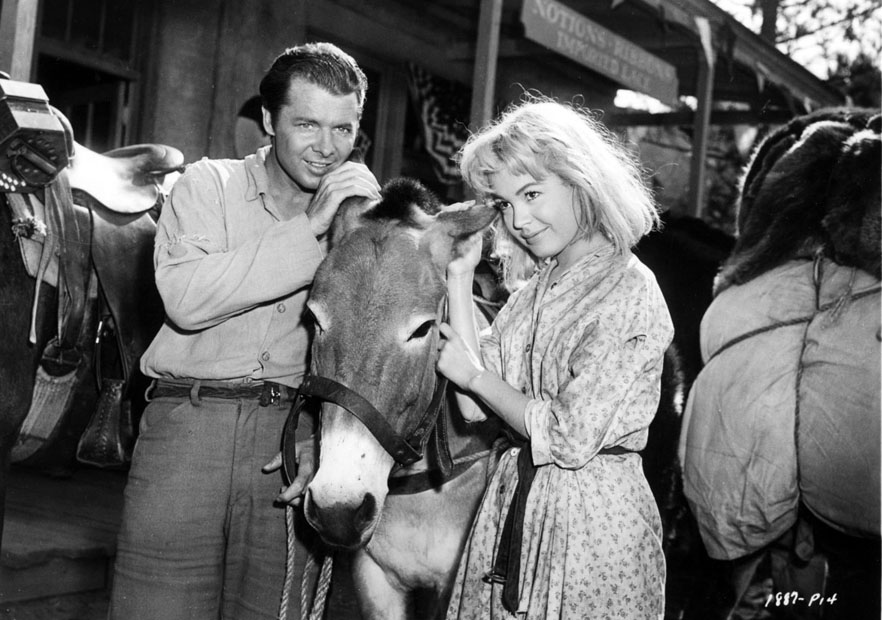
What do you get when you cross Audie Murphy with Sandra Dee?  An unlikely pairing, right? Maybe...but you also get the fun and sweet The Wild and the Innocent.  From 1959, this romantic comedy Western also features Joanne Dru, Gilbert Roland, and Jim Backus in supporting roles.  Strother Martin and Peter Breck (of Big Valley fame) also have parts in this charming little film.


Somewhere in the mountains of Wyoming, Yancy Hawks (Audie Murphy) lives with his uncle and his uncle's wife.  Trappers, the two men have been in the mountains for years; in fact, Yancy's never been out of them and in a town before.  After his uncle is mauled by a bear and needs to be still in order to recuperate, Yancy is sent on to the trading post to get needed supplies.  To his dismay, he discovers that the trading post has been closed and in order to sell his pelts and purchase what he needs, he will have to go into the big city---to the general store in Casper.


Enroute to the "big city," Yancy comes across a man (Strother Martin) traveling westward with a whole passel of kids.  Saying she would make a good wife, the man offers to trade his daughter, Rosalie (Sandra Dee), for half of Yancy's furs. Insisting that he would have to love a woman in order to marry her, Yancy declines the man's offer and continues on his way.


Not long afterwards, the dirty, unkempt Rosalie, who has run away from her pa, re-enters Yancy's life.  Sure that her father would have traded her to the first man who would take her, she chose to strike out on her own.  Since she figures she'll be able to find a job in the big city, and since that is Yancy's destination, Rosalie requests that he take her with him.  Although he doesn't really want the responsibility of the girl, Yancy agrees, and two very innocent, naive souls soon have their first-ever taste of city life.


The city's 4th of July celebration is in full-swing, so after cleaning up and getting some new clothes, both Yancy and Rosalie enjoy a night on the town.  Not knowing exactly what a dance hall girl is, Yancy is soon quite smitten with one of them (Joanne Dru).  Meanwhile, Rosalie, who is in love with Yancy and yearns for him to notice her, is romanced by the town's sheriff (Gilbert Roland) and offered a job at the dance hall.  She's unsettled about the type of gown she must wear and the kind of work she's expected to do, but since she has to support herself, what choice does she have?


Both Yancy and Rosalie are so innocent that the sheriff makes the comment that one doesn't know the kind of world he's in and the other doesn't even know she's pretty.  Will these two innocents get taken for a ride in the big city?  Will Yancy realize Rosalie loves him?  Or will he keep his attentions on the dance hall girl?  And what will Yancy do when he discovers Rosalie will soon be part of the dance hall establishment? How it all plays out is the balance of this very delightful film.


Although I'm calling this 3-stars, it's more like 3.5---it's cute, fun, sweet, totally charming, and somewhere between "like it" and "really like it" for me. There are a few parts which caused me to giggle like crazy.  First, when new clothes are bought for Rosalie---one of the items is a corset, and she has no idea what it is, nor does Yancy.  She tells him that she was informed it was to "hold her up."  Yancy's response, "Hold you up where?"  was quite comical.  Later, after she had donned her new gown over the corset, Yancy told her to take the corset off, that it made her bulge in places.  (Yes, the innocence of those statements is laughable to us today, but that is part of the film's charm.)


Besides the delightfully winsome storyline, it's fun seeing Sandra Dee in this change-of-pace role.  I think she did a great job.  The Big Valley's Peter Breck portrays one of the rowdy, drunken cowpokes who wants to bully the ill-equipped-for-city-life mountain man. Breck seemed totally in character, as on The Big Valley, he is usually the first one of the Barkley brothers to get into a scuffle.  Audie Murphy is perfect in this role; in fact, his character is much how I think of him in real life---an unsophisticated, small-town guy, able to stand right there with the best of them. Oh, and it must be mentioned that Audie is incredibly handsome at this point in his career!  While he was in his mid-30's here, his naturally youthful looks allowed him to believably portray a character who was probably supposed to be in his late teens.  (Audie was 17 years older than Sandra Dee, and, quite honestly, that fact didn't even occur to me until I was doing this post and realized her birth year---she actually could have passed for early 20's here.  And since Audie looked younger than his years, their pairing worked.)

The movie is corny, predictable, and (of course) very dated, but it's also charming, sweet, and unpretentious.  Put on your 1950's lenses, sit back, and enjoy a trip back to a more innocent time.

While not out on DVD or on the TCM schedule anytime soon, The Wild and the Innocent is available in its entirety on YouTube.  It's in four 20-minute parts, and although it's always a bit of a pain to watch in parts, it's definitely better than nothing.  I do hope you get a chance to see this.

Happy viewing!

NOTE:  All photos in this post were obtained from the Audie L. Murphy Memorial Website (HERE)


Wednesday, May 22, 2013

It Happens Every Spring (1949)

It Happens Every Spring, from 1949, is a fun little baseball comedy I caught last month for my celebration of the beginning of another Major League Baseball season.  Directed by Lloyd Bacon, It Happens Every Spring stars Ray Milland, Jean Peters, and Paul Douglas and features Ray Collins, Ed Begley, Jessie Royce Landis, and Alan Hale, Jr. in minor roles.  For anyone who has ever wanted to pitch in the majors, this delightful film is for you.


Vernon Simpson (Ray Milland) is a baseball lovin' college chemistry teacher, who is working on his doctorate degree.  Although he and the university president's daughter, Debby (Jean Peters), are in love, because of his poor financial condition, Vernon has been discouraged by her father (Ray Collins) from asking for her hand in marriage.


Convinced that an experimental serum he has developed is going to be bought by a large corporation, Vernon assures Debbie that it won't be much longer until they can be married; hardly have those words left his mouth when a baseball from the university's game comes sailing through the classroom window, knocking into his experiment, and sending the prized liquid all over the floor.  Because of the time involved in recreating the project, Vernon is quite distressed by the loss.


Very much by accident, Vernon discovers that the culprit baseball---now saturated by the spilled liquid---is repelled by wood.  After two of the university's baseball players are unable to hit a ball rubbed with the compound, Vernon sees an opportunity to revolutionize the game he loves, join the majors, and earn enough money for him and Debby to get married.  Without any explanation to anyone (even Debby) as to what he's up to, Vernon requests a leave of absence from the college, heads off to St. Louis, and barges into the team owner's office.


Claiming he can win 30 games and the pennant, Vernon brags that he's the guy they need. Though the team officials think he's just a crackpot, they give him a chance to pitch, and what they see astounds them. Casually rubbing his finger onto the "stuff" and then onto the ball, Vernon's pitches are unhittable, and he puts away one batter after another.  Convinced that they have just discovered their sure ticket to victory, the team immediately offers Vernon a contract.

Wanting to keep his true identity a secret, lest the folks back home find out and he get fired from the university, Vernon adopts the name King Kelly.  Together with his catcher, Monk Lanigan (Paul Douglas), the new pitching sensation leads his team to a successful season, all the while trying to remain incognito.


Meanwhile, because of Vernon's hasty, unexplained departure and the fact that he has been out of touch, the university has put out a 5-state search for him, and after Debby's mother happens to see him in the company of five men at the train station, she is convinced he's gotten involved with a bunch of gangsters.  It all plays out in a very fun, screwball kind of way.  


Not a spectacular film, but definitely very cute and loads of fun..a solid 3 stars.  The cast is perfect, and each person plays their part well.  I was especially charmed by Ray Milland. Some of his expressions crack me up.  Though not an Academy Award winner, the film did receive a Best Writing nomination.  Those who enjoy baseball comedies ought to greatly enjoy this.

Out on DVD, It Happens Every Spring should be fairly easy to track down.  Additionally, it is on the TCM schedule for Sunday, June 30th, at 2:30 p.m. (ET).

Happy viewing!!

Wednesday, May 08, 2013

Mad About Music (1938)

In memory of Deanna Durbin, who passed away recently at the age of 91, I thought I would review 1938's Mad About Music, which I watched about a month ago.  The third feature film for Miss Durbin, who was 16 years old at this point in time, Mad About Music also stars Herbert Marshall and features William Frawley, Arthur Treacher, and Gail Patrick in small, supporting roles.


Sent off to a Swiss boarding school because her teenage presence is a detriment to the glamour-girl image her actress mother's agent wants for her, Gloria Harkinson (Deanna Durbin) has invented a make-believe life for herself.  Although her Navy flier father died when she was a baby, she has never revealed that to her friends and, instead, has bragged that he is an important explorer.  Through weekly letters presumably from her dad, Gloria charms her schoolmates with tales of his African adventures.  One girl, however, doesn't believe a word Gloria says and is determined to prove she's lying.

Having made the claim that her father would be stopping at the school for a 1-hour visit, Gloria suddenly finds herself in completely over her head.  With all the students and even the headmistress congregating at the train station to welcome Mr. Harkinson, Gloria realizes the need to produce a father.


Composer Richard Todd (Herbert Marshall), who has traveled to Switzerland for a bit of R & R, alights the train at the school's stop, and Gloria immediately pounces on him, hugging him and welcoming him to town.  She convinces him to pose as her father, and though he is at first reluctant, he may just end up embracing the role.  How it all plays out is the balance of the film.


Nominated for four Academy Awards, Mad About Music is a sweet, enjoyable, very charming film.  Herbert Marshall is his dashing, wonderful self, and Deanna is pure delight.  She sings several songs, including "I Love to Whistle" and "Ave Maria." This is a very solid, entertaining, 3-star viewing experience.

Out on DVD, this film should be fairly easy to track down.  I think it's a film all Deanna Durbin fans will want to see.

Happy viewing!!

Monday, April 22, 2013

Keep Your Powder Dry (1945)

From 1945, comes Keep Your Powder Dry, a WWII drama starring Lana Turner, Laraine Day, and Susan Peters, with Lee Patrick, June Lockhart, Natalie Schafer, and Agnes Moorehead taking on minor roles.  Though a drama, there is a bit of comic relief.


The film chronicles the WAC experience of three women, each of whom joined the organization for different reasons---including selfish ones.  First, there's Valerie Parks (Lana Turner), a spoiled heiress, who must prove herself to be a mature, responsible adult in order to have access to her trust fund.  Val's plan is to join the WACs, look presentable enough to obtain her inheritance, then get out as soon as possible---feigning illness if she has to.  Ann Darrison (Susan Peters), whose Army husband is being shipped overseas, wants to do her part to win the war so that the two of them can be together again.  Leigh Rand (Laraine Day), is the daughter of an Army officer and has grown up with an Army mindset.


Confident that she is Army material because of her status as "Army brat," Leigh gives off a snobby, bossy air, which immediately puts her at odds with the strong-willed Val.  With kindhearted, easy-going Ann acting as a buffer between them, Leigh and Val are continually at each other's throats.  If they don't learn how to put their dislike for each other aside and learn how to get along, neither of them will graduate.


All three leads are lovely and quite good in their roles.  I already adore Lana, but I really took notice of Laraine Day and Susan Peters here.  They were both excellent.  Susan Peters has such a fragility to her in every film she's in (even as "the other woman" in Random Harvest).  Her life was so very tragic---After this film was made, but before it was released, she was involved in a hunting accident, resulting in permanent paralysis from the waist down.  From then on, until her death a few years later at the too-young age of 31, she suffered from kidney disease, depression, and anorexia nervosa.


Having minor roles as other WACs and officers are Lee Patrick (always a great wit), June Lockhart (who looks virtually the same here in 1945 as she does as the Lost in Space mom in the 1960's) and Agnes Moorehead.

This film has some touching moments...I got teary-eyed on three different occasions, even cried heartily one of those times.  While not the same caliber as some of the other female WWII movies (like So Proudly We Hail), Keep Your Powder Dry is definitely enjoyable, interesting, and worth watching.  I give it 4 out of 5 stars.

Out on DVD, the film ought to be fairly easy to track down.  Also, it is on the TCM schedule for Tuesday, June 25th, at 2:00 p.m. (ET)  I hope you get a chance to see it.

Happy viewing!!

Monday, April 15, 2013

Send Me No Flowers (1964)

Regular readers of They Don't Make 'Em Like They Used To know that I don't lean much to comedy.  Of my 40 all-time favorite movies, only five of them are comedies---and two of those I would classify more as dramedies than out-and-out comedies.  Despite my usual lack of tolerance for that genre, though, for some reason, the three romantic comedies pairing Doris Day and Rock Hudson quite appeal to me.  In fact, I actually love and 5-star two of them, one of which is 1964's Send Me No Flowers.  Also starring Tony Randall and featuring Paul Lynde and Clint Walker in small roles, Send Me No Flowers is the final of Rock and Doris's three pairings.


A hypochondriac to the max, George Kimball (Rock Hudson) is convinced he is dying. Although he had seen his doctor and had a complete check-up two weeks earlier, he is sure that the pain in his chest means he's on his last legs, so he makes another trip to his doctor's office.  After listening to George's heart, the diagnosis is indigestion, and George is sent home with another bottle of pills, to add to his already-burgeoning medicine cabinet.  At George's previous visit, the doctor had taken a cardiogram, the results of which have not come back yet.  While George is in the restroom, the doctor takes a phone call about one of his other patients---a man who is dying. Overhearing the doctor's side of the conversation, George is certain he is the patient being discussed and that the results of the cardiogram indicate it is he who has only a few weeks to live.


Determining that it would be best to not tell his wife, Judy (Doris Day), the horrible news---lest she go to pieces---George shares the news of his "condition" with neighbor/friend, Arnold (Tony Randall) and then sets out to be sure Judy will be taken care of after his "death."  He purchases cemetery plots, dictates a goodbye message, then attempts to set her up with another man (Clint Walker).  Through a series of misunderstandings, Judy comes to believe that George is actually having an affair with a neighbor lady, and she kicks him out of the house.  When he attempts to explain the situation, Judy doesn't believe a word he says, and George finds himself further in the doghouse.


Does George ever realize that the doctor was talking about another patient and that he really has nothing wrong with him?  Does Judy figure out why George is pushing her into the arms of another man?  Does she believe him when he insists he is not having an affair?  Those are the questions which play out in the remainder of the film.


For a variety of reasons, I find Send Me No Flowers to be a completely delightful film.  For one thing, the chemistry between Rock and Doris is awesome.  I know Rock was gay and that there was never anything more than deep friendship between the two of them, but, boy, they could have fooled anyone.  They are amazing together, and that is part of what makes this film work for me.


Another reason I love the film is that I completely relate to it.  Twenty years ago, I was the kind of hypochondriac George Kimball is.  I was continually convinced that I had every form of cancer there is and that I was going to die before six months was up.  I remember my son's 3rd birthday in November, 1994.  Though I wouldn't be diagnosed for a few more days, I had pneumonia at the time, and I was horribly sick.  I remember crying to my mother-in-law at my son's birthday party, telling her that that was the last of Garrett's birthdays I would ever see.  I was completely and totally convinced I was dying.  AND, my daughter has inherited this propensity to hypochondria, having every form of cancer there is herself.  A black and blue mark, and she's convinced she has leukemia, a headache, and she's convinced it's a brain tumor, etc.  So, as we watch George Kimball obsess about his ailments, my daughter and I howl with laughter, seeing ourselves in the entire situation, thereby making the film even more amusing to us.

Tony Randall, as the Kimball's next-door-neighbor, and Paul Lynde, as the cemetery salesman, are both quite hilarious in their roles.  Doris is her usual perky, lovely self.  She sports some beautiful outfits here, especially her bright green suit.  Rock is gorgeous, absolutely gorgeous.   And, finally, Doris sings the film's theme song.  All those things combine to make this a film I absolutely love.

Out on DVD, Send Me No Flowers should be quite easy to track down.  If you like Pillow Talk, I'm sure you will enjoy this film as well.  It's a definite 5-star, "love it" film for me, and I highly recommend it.

Happy viewing!!


Tuesday, March 19, 2013

Meet the Stewarts (1942)

In need of a William Holden fix and, also, wanting to show my co-#1 guy some love in the midst of my John Garfield mania, I recently tracked down one of his lesser-known films, Meet the Stewarts. From 1942, this romantic comedy, also starring Frances Dee, is from very early in Mr. Holden's career---when he was just a mere 24-years old.


Socialite Candy Goodwin (Frances Dee) yearns for her hardworking, yet minimally paid, boyfriend, Mike Stewart (William Holden), to propose to her.  Much as Mike loves Candy, however, he refuses to pop the question, sure that his salary wouldn't be sufficient to keep her living in the style to which she's accustomed.  Additionally, he doesn't want to be seen as the fortune hunter Candy's dad thinks he is, so until such time as he can afford to support a wife on his own, he will not marry her.

Determined to snag her man, Candy promises Mike that she will live on a budget, while her father insists that there will be no financial help from him if the two do get married...that Candy will go to the marriage with nothing more than a few personal belongings.  Of course, those are exactly the words Mike wants to hear, so he and Candy tie the knot.


Returning from their honeymoon, the couple discovers that they are over-budget on the furniture for their house.  Determined to live within their means, they realize they will have to return some of their purchases...but just what they'll return remains to be seen, as everything is a "must have" for Candy.  Also, although Candy is used to a maid and a cook, those things are not in the Stewart's budget, so she will have to learn to get along without them.  The film chronicles the couple's attempts to live within their modest means.


Meet the Stewarts is not a terrific movie, but it's clean, fun, and enjoyable...a solid 3 stars.  It's very dated (with such cringe-inducing lines as "All wives have to be smacked around a little.") and there are a few slapstick moments, but overall it's very sweet, with some lessons about debt and spending that our current "have to have it now, so I'll buy it on credit" society would do well to put into practice.

Out on DVD, this film is available through Classic Flix.  It is also available in its entirety on YouTube.  HERE is the link to part 1.  I hope you get a chance to see it.

Happy viewing!!

Saturday, March 02, 2013

John Garfield Blogathon---Saturday's Children (1940)

One of my favorite online social forums is The Golden Age of Hollywood (HERE), and it is through there that I met today's guest.  Mad, as she likes to be called, is one of my dearest friends over there.  She hails from Canada, and though she would be too humble to say this about herself, I certainly think it is the truth---she is the biggest Claude Rains fan on the planet.  Given that both Mr. Rains and Mr. Garfield were initially stage actors, they knew each other well; in fact, Mr. Garfield has said that Claude Rains was rather a mentor to him as he transitioned from stage to screen.  The two men appeared together in several films, including the little-known Saturday's Children, which is one of the few Garfield films I have yet to see.  In true #1 fan form, Mad has seen Mr. Rains' entire filmography, which means Saturday's Children has crossed her path, and it is that film she will be showcasing here today.  It definitely sounds like a "must see" film to me!  (Of course, I'm on a quest to see every Garfield film, so I guess, they are all must-sees.)

I'm thrilled to have Mad as my guest, so without further ado...I'll turn things over to her.


SATURDAY’S CHILDREN (1940)

I am often surprised to discover classic era films of true quality that have somehow sunk into obscurity.  Saturday’s Children is one of these little-known gems.  To begin with, the film has an excellent pedigree.  The script was written by Julius and Philip Epstein (Casablanca, Four Daughters, Mr. Skeffington), from the Pulitzer-winning play by Maxwell Anderson (What Price Glory, Key Largo).  It’s directed by Vincent Sherman (Mr. Skeffington, Old Acquaintance), with Irving Rapper as dialogue director (later to direct Now, Voyager and Deception).  In addition to having a great cast, it’s also one of those rare treasures – a John Garfield comedy.


Our story begins with an average morning for the Halevy family.  Dad (Claude Rains) is resisting Mom’s (Elisabeth Risdon) efforts to get him out of bed to go to his dull job as a bookkeeper.  Meanwhile daughter Bobby (Anne Shirley) is excited about her first day of work at the same firm (where Dad has got her a job).  Sharing their New York brownstone is her older sister Florrie (Lee Patrick) and Florrie’s husband Willie (Roscoe Karns).  When she’s not trading wisecracks with Willie, Florrie is trying to educate Bobby in the ways of the world – particularly concerning the battle of the sexes.  To Florrie’s dismay, Bobby is resistant to what she feels are dishonest tricks for landing a husband.

At work, Bobby meets fellow employee Rims Rosson (Garfield), whose hobby is inventing crazy gadgets that he admits are not ‘commercially practical’.  He does have one practical dream - to discover a way to manufacture silk from hemp.  It’s obvious from the start that Rims and Bobby share the same wry sense of humour and directness, and they begin dating as part of a weekly bowling night.  When Rims gets a job offer in the Philippines to work on his hemp-to-silk idea, Florrie convinces Bobby that she’ll lose him unless she takes certain ‘foolproof steps’ to get him to propose.  Further complications ensue for the young couple, with some dramatic turns that I would rather leave viewers to discover for themselves.


By this time, Garfield had made eight movies, playing a street-smart tough guy in most of them.  Here he plays a rather distracted, guileless fellow, who wears glasses to read and is slightly awkward at the dating game.  He is attracted to Bobby because of her straightforwardness.  Rims is an eccentric soul with a quirky sense of humour and a positive outlook on life.  It’s a marked contrast to some of the hard-bitten roles we have seen him in, but Rims is no weakling and Garfield still creates a fascinating three-dimensional character.  In Rims, Garfield shows us a more casual, easygoing type.  He’s no stranger to disappointment, but he’s a realist - not a cynic.  It’s a rare joy to see Garfield get to play this relaxed character with a sense of humour.  He’s a bit of a dreamer, and definitely a person you would enjoy getting to know.

Garfield is well matched by Anne Shirley as Bobby – torn between a selfish (but normal) desire to keep Rims with her, and a feeling of guilt that she is preventing him from pursuing his dreams.  She’s not only cute and likeable, but I was impressed with her as an actress in this movie – she often gets to be the ‘strong one’ for those around her.  (I’ve read that Warners originally wanted Priscilla Lane, but fearing it would be rewritten as another ‘Lane Sisters’ movie, Garfield lobbied for Anne Shirley.)

This movie is a romantic comedy with an intelligent storyline.  What I love about these old Warner Brothers pictures is that they show average people struggling to get by, and still managing to find happiness.  Not being rich isn’t seen as a tragedy to be ‘solved’ in the last reel.  The characters cope in the best way they can, without a lot of self-pity and in ways that ring true.  The title refers to the poem predicting the traits of children according to the day of the week on which they were born, in which “Saturday’s child has far to go”.  (The usual version is “… works hard for a living” but the spirit is the same.)  Money troubles may be the catalyst, but the couple’s problems are really about honesty and compromise in love and marriage.  Their story isn’t maudlin or sappy; their joys and pains are those we can relate to, and we laugh with them as if it were our own family.  A quality script has a lot to do with this, but ultimately it’s Garfield and Shirley that bring these characters to life and make us care.


The supporting cast has some stellar character actors, including my own personal favourite – Claude Rains.  Rains and Anne Shirley have a wonderful chemistry as father and daughter.  Their scenes together are affectionate and heartwarming.  Always a commanding presence, Rains was a master at intelligent emotional scenes.  His heart-to-heart talks with Bobby about regrets in his own life are touching and honest, without being over-sentimental.  His ‘Pops’ is a complicated mix of cheerful resilience and melancholic resignation.  Rains also had a fine comedic sense; often a witty and sarcastic villain, here he is charming and funny as a teasing, loving father.  (I once read a comment that, with the exception of Lon Chaney Jr. in The Wolf Man, Rains always had daughters in the movies - often four at a time!).  This was the fifth picture Rains and Garfield were in together, continuing a friendship that began when Rains mentored him on Four Daughters


Lee Patrick and Roscoe Karns share some of the funniest of the Epsteins’ lines, with Patrick as the big sister always trying to ‘help’ with Bobby’s love life, and Karns as her henpecked husband who fights back with wisecracks.  They complement each other perfectly and their banter is fast and clever.  Their underlying affection is quite believable, and that’s probably why it’s so much fun to watch them bicker.  There is more witty dialogue at work, from Bobby’s fellow clerk Dennie Moore and her hapless boyfriend George Tobias.  Elisabeth Risdon (as the mother) is the only one not given much to do; although sympathetic, she never seems to be consulted on the family’s emotional crises. 


I have read that Saturday’s Children was one of Garfield’s happiest film experiences, and a performance of which he was very proud.  I can see why – it’s sweet, it’s funny, and it gave him a chance to show his versatility as an actor.  Unfortunately, it wasn’t a success at the box-office, which may be why it’s not well known today.  It does not seem to be available on DVD, but if you have access to TCM in North America, you can catch it on March 4th at 8:45 am (ET), and I heartily recommend that you do.  It deserves to be re-discovered.


Saturday's Children does, indeed, sound like a terrific movie, and I cannot wait to see it.  A huge thank you to Mad for this awesome write-up!  What a fantastic addition to the blogathon! To read all the other terrific blogathon pieces, go HERE.

NOTE:  After finally having a chance to watch this film, I am giving it 4-stars.

Saturday, January 26, 2013

The Doctor Takes a Wife (4 stars)

The Doctor Takes a Wife, from 1940, is a romantic comedy starring Ray Milland and Loretta Young, with Reginald Gardiner, Gail Patrick, and Edmund Gwenn taking on supporting roles.  Falling into the screwball genre, this film is totally predictable, and you can probably guess what the outcome will be even before popping the disc into the DVD player; getting to that outcome, though, is loads of fun...and that admission is coming from someone who loudly professes that she doesn't much care for comedic films (especially screwball).


Loretta Young is June Cameron, author of the new best-seller, Spinsters Aren't Spinach.  June is a feminist who believes that women don't need men for fulfillment; her book, which is currently all the rage, encourages women to throw off the shackles of marriage.  While on vacation, June meets Tim Sterling (Ray Milland), a teacher of neuro-psychiatry, who is the polar opposite of her in his beliefs.  Telling June that "women are not equipped to take their place in a man's world," he belittles the teachings of Spinsters Aren't Spinach.

Since she needs a ride back to New York, June is forced to travel with Tim, and they find themselves bickering almost the entire way.  However, while in Greenwich, Connecticut, June asks Tim to stop at the telegraph office so she can send a wire.  As it happens, the telegraph office is adjacent to the Justice of the Peace office, and while June and Tim are both absent from the car, a boy from the JP's office accidentally places a "Just Married" banner on the wrong car...instead of the car belonging to the couple just married, the banner is put on Tim's car.  Unbeknownst to Tim or June, they travel the remainder of the way to New York in a car announcing them as newlyweds.


Upon dropping June off at her apartment, Tim realizes that she has accidentally taken one of his pieces of luggage from the car and so, leaving the "just married" car in front of the apartment building, he races after her.  However, they were spotted, and, in short order, the newspaper has given first page coverage to the marriage of the famous author and the doctor.

Sure that the press coverage of June's "marriage" will be good for her career, June's agent (Reginald Gardiner) convinces her to keep up the charade.   Tim, who is engaged to be married (to Gail Patrick), has no intention of going along with the charade...until, simply because of his new marital status, he receives a long-hoped-for promotion.  Suddenly, Tim needs to keep up the masquerade, even though his doing so greatly upsets his fiancee.


The movie chronicles Tim and June's attempts to look married without actually being married.  It's quite funny and sweet.  And, of course, as noted, it's very predictable.  Then again, most movies---especially screwball comedy---are.  I own this movie, having recorded it from TCM a few years ago.  I watch it a couple times a year, and it never ceases to make me laugh.  No, it's not the best movie ever made and it's no thought-provoking message movie.  It's just good, clean, entertaining fun.

The film is out on DVD, as part of the Icons of Screwball Comedy collection, so it should be relatively easy to track down.

Happy viewing!!

Monday, June 11, 2012

Phffft (3 stars)

Phffft, from 1954, is a romantic comedy starring Judy Holliday and Jack Lemmon, with Kim Novak and Jack Carson taking on supporting roles.  Probably the strangest-named film I have ever heard of, Phffft, which features Miss Holliday and Mr. Lemmon in their second pairing, was part of my Judy Holliday birthday celebration.  While it's not one of my favorite of Judy's films, it is enjoyable and quite funny in parts.


After eight years of marriage, Robert and Nina Tracey (Lemmon and Holliday) are bored with each other and have decided to call it quits.  When Nina announces that she wants a divorce, Bob agrees that it's a good idea; in fact, he tells her, he's been wanting to suggest that very thing for six months.  In agreement that they need to end their marriage, Nina flies off to Reno.


Newly single, Bob moves in with his Navy buddy, Charlie (Jack Carson).  Quite the playboy, Charlie immediately suggests that Bob begin seeing other women; Bob, however, isn't interested at first and ends up reminiscing about how he and Nina met.  Soon, though, Charlie fixes Bob up with a friend, Janice (Kim Novak), but since Bob still thinks of himself as a married man, the date doesn't go well.


Nina, also, is attempting to move into a new season of life.  Besides dating an overly aggressive colleague, she seeks to bone up on her "culture" by taking French lessons and dance classes.  Bob, too, enrolls in dance lessons, and now hot on their feet, the two of them happen to meet up on the dance floor while on dates with others.


In due time, both Bob and Nina feel like giving their relationship another chance; however, when Nina informs Bob that with his newly-acquired mustache and 3-piece suit, he resembles either Graucho Marx or a gigolo, and Bob counters that Nina is looking like a middle-aged woman, all hopes for a reconciliation are off...that is until Charlie moves in on Nina himself.


What will Nina do when Charlie puts his playboy moves on her?  What will Bob do when he discovers his best friend is moving in on "his wife?"  These are the questions which play out in the balance of this film.


While Phffft is an enjoyable film, it is definitely only so-so in my book.  Miss Holliday and Mr. Lemmon were paired earlier in 1954 in It Should Happen to You---a film which I find vastly superior to this one.  That said, here in Phffft, Judy is her usual delightful self, and Jack (Lemmon) is completely wonderful as well.  Quite honestly, I think Mr. Lemmon stole the show.  While I don't see Jack Carson as the playboy type, he actually worked quite well in this role.  Kim Novak, though---at least for me---was definitely miscast.  While I think she's wonderful in several dramatic films (Middle of the Night, Picnic, The Man with the Golden Arm, The Eddy Duchin Story), I don't think she fits in a comedic role.  I didn't find her funny at all; in fact, because I'm used to her in dramatic roles and, therefore, see her as much more than the "dumb blonde" she portrays here, I found her character annoying rather than funny.

At any rate, I adore Judy Holliday (which is quite surprising since most of her works are comedic and I'm not a huge comedy fan), so I do view this film occasionally...I just happen to enjoy several of her other films more than this one.  However, it is a very solid, 3-star film (4 stars according to my husband and kids), and fans of Miss Holliday, Mr. Lemmon, or Miss Novak won't want to miss it.  The film is out on DVD, so it should be easy to track down.  Additionally, it is on the TCM schedule for Wednesday, August 22nd, at 6:00 a.m. (ET).

Happy viewing!!


Thursday, June 07, 2012

Bells Are Ringing (5 stars)

Bells Are Ringing, from 1960, is an adorable musical romantic comedy starring the totally delightful Judy Holliday and Dean Martin.  Directed by Vincente Minnelli, this film, which features the wonderful supporting cast of Jean Stapleton, Eddie Foy, Jr., Fred Clark, Frank Gorshin, and Bernard West, first appeared as a Broadway musical in 1956.  Both Miss Holliday and Miss Stapleton portrayed their same characters in each venue, and for Miss Holliday, her Broadway performance garnered her a Lead Actress Tony Award.


Kind, compassionate Ella Peterson (Judy) works as a phone operator at Susanswerphone, her cousin Sue's (Jean Stapleton) answering service.  Far more than just a job to Ella, her position gives her access to the lives of people she has come to care about.  Though Sue continually warns Ella not to get involved in their clients' lives, lest the service be shut down for law violations, Ella simply can't help herself; she loves people too much to not do everything in her power to make their lives happy.

Ella is especially attached to Jeffrey Moss (Dean Martin), a playboy playwright who is struggling with his latest script.  Wanting to do more than just give and take messages for Mr. Moss, Ella, using an old lady voice, has developed a phone relationship with him. Thinking that his message taker is a motherly old woman, Jeffrey calls Ella "mom" and feels very comfortable sharing his troubles with her.

When Jeffrey's agent leaves a message indicating that he is down to his final chance, Ella wants to encourage him to do the writing she knows is in him.  However, with his phone unplugged and her call not getting through, drastic measures are necessary.  Only a trip to his apartment will work, and when Ella manages to get inside and she sets eyes on her client for the first time, she finds that he is "Better Than a Dream."


As the kindhearted woman encourages him along, Jeffrey writes...and his agent loves it. Before long, Jeffrey has fallen in love with Ella...only thing is, Ella has never told him her true identity, and now, not wanting him to know that she deceived him, she is afraid to do so.

In addition to helping Mr. Moss write his play, Ella has gotten involved in the life of a dentist who aspires to write music (Bernard West) and a down-on-his-luck actor (Frank Gorshin). How those men's dreams entwine with Jeffrey's, all the while two detectives are investigating Susanswerphone as a possible escort service, makes for a very sweet, heartwarming film.


Judy Holliday is, as always, pure delight.  From beginning to end, she is a total joy.  Her character is the kind of person we need more of in this world; she's caring, compassionate, unselfish, friendly, warm, and kind.  I love the way Judy brought Ella to life.  I love her wardrobe too---the blue dress, the pink one, the white, the red...they were all gorgeous, and as I often do, I found myself wondering why women threw away that kind of a wardrobe.  The scene in which she dresses in grubs and dons a Marlon Brando-type voice is quite amusing...one of the funniest in the whole film.  Sadly, Bells Are Ringing would be Judy's final film performance.

Dean Martin is terrific in his role.  I have to admit, when I first saw this film about four years ago, I was lamenting that Frank Sinatra wasn't cast in the part.  As a huge Ol' Blue Eyes fan and a lover of his musicals, I thought he would have been the icing on the cake here in Bells Are Ringing.  However, the more I've seen this film (4 or 5 times now), the more Dean grows on me, and now, I've come to the place of not only thinking he was perfect, but of being interested in listening to more of his music and discovering more of his works.  I really love him here, and when he broke into "Just in Time," I was thrilled.


Nominated for the Best Music Academy Award, Bells Are Ringing features ten lovely songs, and I loved every one of them, which is often not the case (for me) with musicals. Usually, there are two or three songs I don't care for, but here, I loved them all.

Finally, my whole family loves this film.  When I said we were watching a Judy Holliday film for her birthday month, both my kids made the same request..."Bells Are Ringing" please.  While Born Yesterday is my favorite Judy film, this one is definitely my family's favorite...and a 5-star second favorite for me.  Those who enjoy fun, lighthearted musicals, Judy Holliday, or Dean Martin, ought to completely love this.  Out on DVD, this film should be very easy to track down.

Happy viewing!!