Classic movies are not just antiquated films from a bygone era...rather, they are beautiful, well-acted, well-written gems that ought not to fade into obscurity. Truly, Hollywood just doesn't make 'em like they used to!!! I hope you'll discover some must-sees by your visit here.
My husband and I began our holiday viewing last week, and the first film on this year's "must watch" list was 1944's I'll Be Seeing You. This movie is one of my 25 all-time favorites, and though I've reviewed it here before, that was back in 2011---the first year of They Don't Make 'Em Like They Used To's life; therefore, I'm going to re-run that article, as I think the Christmastime setting (including a singing of "O, Come, All Ye Faithful") makes this a perfect movie to add to your holiday viewing schedule.
A touching wartime romantic drama, I'll Be Seeing You stars Ginger Rogers and Joseph Cotten, with Tom Tully, the always-delightful Spring Byington, and a teenaged Shirley Temple taking on supporting roles. Directed by William Dieterle, this charming film just might bring a mist to your eye.
The story is about Mary Marshall (Ginger), who is on furlough from a women's prison. (You'll find out during the movie why she was sent to prison.) While on a train traveling to visit her aunt, uncle, and cousin for Christmas, she meets Zachary Morgan (Joseph Cotten), a handsome soldier who has recently left an Army hospital, where he was being treated for the effects of what we now know as Post Traumatic Stress Disorder.
Mary and Zach both disembark the train at the same stop, and upon Zach's request, Mary gives him her uncle's telephone number. They begin spending time together and soon fall in love. However, since Zach's emotional state is still quite tenuous, Mary doesn't tell him that she's been in prison and will soon be going back. And with Zach working through his own personal demons, can there possibly be a future for these two hurting souls?
I'll Be Seeing You is a sweet and tender movie, and although it doesn't bring huge sobs, it definitely gets me misty-eyed a couple of times. I think all hopeless romantics will love it. With its Christmastime setting, it's a lovely film to watch this time of year. Out on DVD, it should be quite easy to track down; plus, it's on TCM's schedule twice this month---Friday, December 18th at 8:00 p.m. and Friday, December 25th, at 12:45 p.m. (ET).
The Search, from 1948, is a somewhat sentimental post-war drama, directed by Fred Zinnemann and starring Montgomery Clift in his second film appearance. Also starring Wendell Corey, Aline MacMahon, and Ivan Jandl, The Search provided Mr. Clift with his first Best Actor Academy Award nomination. According to Clift's biography, Monty considered The Search to be "the most fulfilling artistic experience of his life." (From Montgomery Clift, a Biography, by Patricia Bosworth.)
The movie begins with a trainload of displaced children arriving at a relief center, where they will be temporarily housed while a search is made for their relatives. Though the intent of the center is to help, many of the children, having previously been herded onto trains and shipped off to concentration camps, are understandably terrified and untrusting. One little boy in particular, Karel Malek, is so frightened that he actually finds a way to run away, escaping on his own into war-torn Germany.
Ralph "Steve" Stevenson (Monty Clift), an American soldier still stationed in Germany, happens upon the hungry and frightened little boy.
Feeling that the boy shouldn't be wandering around on his own, Steve feeds him and then takes him back to his apartment, with the intent to locate his parents.
Though fearful and untrusting at first, Karel comes to realize that Steve is his friend and wants to help him.
Meanwhile, in another part of the city, Hannah Malek is combing the relief centers in search of the son from whom she was separated at Auschwitz, hoping against hope that he still lives.
A sweet, mildly heart-tugging film, The Search always gets me misty-eyed. Montgomery Clift is extremely good in this Oscar-nominated role, and his chemistry with the little boy (Ivan Jandl) is terrific. Wanting to be completely prepared for his role, before shooting began, Mr. Clift lived for a time in an army engineer's unit, dressed in army fatigues, and toured U. N. Relief and Rehabilitation camps in Germany. He was totally driven to make his character and the film authentic, which resulted in numerous improvisations of the script and endless battles with the film's producer. In the end, though, the film received unanimous acclaim and Monty, who was pleased with his performance, became one of Hollywood's hottest stars.
A solid 4-star film, The Searchisdefinitely worth watching, and since it is available on DVD, it ought to be fairly easy to track down. If you are a Montgomery Clift fan, or if you like post-war films, definitely see this. You're sure to enjoy it.
Although many people define courage as being fearless---completely unafraid---I don't think of it that way at all. Rather, I think of courage as being afraid of something, yet facing the object of that fear head-on...not letting it render you powerless or cause you to turn and run the other way. Really, if there is no fear, then it takes no courage to face a situation. So, for me, courage can only be exhibited in the presence of fear, and that is precisely the theme of 1943's This Land Is Mine. Winner of an Academy Award for Best Sound, this Jean Renoir-directed film stars Charles Laughton and Maureen O'Hara, with George Sanders, Kent Smith, Walter Slezak, and Una O'Connor among those taking on supporting roles.
Somewhere in Europe, the Nazis are on the march, conquering one city after another. While the citizens of each occupied city are encouraged to trust the new regime, resistance literature urges them to drive the conquerors out, lest they become their slaves. In one such town, the word has come down that several of the school's textbooks have unacceptable pages which must be destroyed. While timid, milque-toasty schoolmaster, Albert Lorry (Charles Laughton), meekly instructs his students to remove the offending pages from their books, his fellow teacher, Louise Martin (Maureen O'Hara), with whom Albert is secretly in love, vehemently announces that the day will come when she will paste the pages back.
In the midst of the school day, the air raid siren blares, and the students and their teachers take to the shelter, with Albert's controlling, overbearing mother (Una O'Connor), who lives nearby, joining them. As the planes roar overhead, Albert cowers in his mother's arms. Later, Albert admits his cowardice to the schoolmaster, who reminds him that the truth can be kept alive if the children believe in them and admire them, because those whom children admire, they will follow; therefore, in order to conquer the Nazis, they all must be the kind of men the children will desire to follow.
Other residents of this little village are Paul Martin (Kent Smith), Louise's brother and a resistance worker, and George Lambert (George Sanders), Louise's fiance, who, unbeknownst to her, is a Nazi sympathizer. Believing that democratic ideas ruined his country, George wants the "new order" and works in collaboration with them to achieve it.
When a grenade thrown by a resistance fighter kills two German soldiers, ten of the local townspeople are taken hostage and threatened with execution unless the criminal gives himself up. Albert, eventually, is one of those arrested, and when he is put on trial---and comes face to face with his fear of what the Nazis will do to him---he finds that he is not a coward after all. With his courage shining brightly in the face of fear, Albert uses the courtroom to inspire people everywhere to keep on resisting the invading evil.
What they call a "propaganda piece," This Land Is Mine is an inspiring, encouraging, well-acted drama. Made in the middle of the war, when the tide had not yet turned and there was no way of knowing how much longer it would go on, this film was obviously a boost to homefront morale. Mr. Laughton's performance is spectacular...not quite up there with The Hunchback of Notre Dame (which, as I said in a review earlier this week (HERE), I think has to be the performance of his career), but terrific nonetheless. The way he changed from a cowering bowl of jello to a man of conviction and strength was beautiful to watch. And his speeches---wow. Such great truth in every word he uttered, and that truth is as relevant today as it was 70 years ago.
Maureen O'Hara is quite wonderful in her role as well. She brings her fiery, passionate character to life with much believability. Plus, she's so lovely, and it is always a delight to watch her. The supporting players---Una O'Connor, Kent Smith, George Sanders, and Walter Slezak---all are very good in their roles.
This Land Is Mine is out on DVD and is available through Classic Flix. It is also on the TCM schedule for Sunday, November 17th, at 6:15 a.m. (ET). I hope you get a chance to see it, as it is a very inspiring film.
Perhaps in an attempt to get away from the Western roles into which he had been typecast, Audie Murphy starred in the little-known, low-budget 1961 World War II flick, Battle at Bloody Beach. Set in the Philippines during the time of the Japanese occupation, this Herbert Coleman film also stars Gary Crosby and Dolores Michaels and introduces Alejandro Rey.
Having been in the Philippines at the time of the Japanese invasion, American civilian, Craig Benson (Audie Murphy), and his new bride, Ruth (Dolores Michaels), were separated in the resulting chaos. Craig was evacuated with other Americans to Australia, and now, two years later, feeling sure that his wife was not killed or taken prisoner but is hiding out somewhere, he has returned to the islands to search for her. With Craig's knowledge of the islands, the U.S. Army has given him authority to arm Filipino resistance leaders, one of whom is Julio Fontana (Alejandro Rey).
Before providing Julio with the guns and ammunition, Craig insists that Julio bring to him any Americans he has been hiding, so that they may be evacuated to Australia. Seven people are brought forth, one of whom is Ruth, who had been rescued and taken in by some kindly Filipinos. Since her rescue, she has been working for the resistance efforts, and also, believing Craig to have been killed in the air raid, she became romantically involved with Julio. Although Craig's plan is to gather his wife and the other Americans and return to the States, Ruth isn't ready to leave the resistance fighting...and maybe not Julio either.
While at the beach where they will meet up with the U.S. sub which will carry them to safety, the Japanese Army approaches. Will any of the Americans survive the onslaught? And if they do, will Ruth choose to stay behind with Julio and the resistance? Or will she choose to travel home with her husband? These are the questions which play out in the balance of the film.
This film has many horrible reviews, yet I am actually going to recommend it---but not without a caveat and an explanation of my movie-viewing habits. When it comes to movies, I often march to the beat of my own drum. Many films that critics (and movie viewers) love do nothing for me; similarly, many films trashed by others are quite acceptable to me. I suppose that's because I'm just a (classic) film enthusiast, not a film critic, and, therefore, I don't put on a critic's hat when I sit down to watch a movie. I'm not looking to pick it apart or to point out all that's wrong with it; in fact, if the film's storyline interests me, I may not even notice its imperfections, and even if I do, I can easily overlook them and focus, instead, on the positive. Thus, while Battle at Bloody Beach is a flawed film and has many horrible reviews on IMDB, I was able to look past the flaws and enjoy it (unlike most of the reviewers).
Some pluses: Interesting storyline---and one not covered a great deal in WWII films. Also, Mr. Murphy gives a good performance and is very believable in his role. His character is extremely likable---you can't help caring about him.
Another plus (for me) is how Audie looks in this film. He's 36 here...and gorgeous! Although he still looks young, gone is the cute little babyface. Instead, there's a mature, very handsome, man, with a few light lines on his face and a tiny touch of gray in his hair.
Other pluses are Alejandro Rey and Dolores Michaels, both of whom are believable in their roles. I liked them both. This is a low-budget film, though, and that is very apparent in some of the scenes. Also, because the film was fairly short (83 minutes), the characters weren't fully developed. In addition to Ruth, there were 6 other Americans to be evacuated. There was a mother and a young son, a bickering married couple, and an older married couple. The film's short length precluded an opportunity to get to know enough about those characters to really care about them. Even the love triangle between Ruth, Craig, and Julio wasn't all that intense or passionate. Still, Battle at Bloody Beach is what it is---an interesting, watchable, low-budget film.
Although nowhere near the caliber of earlier war films, this one may pique the curiosity of those who have interest in WWII's Pacific theatre, especially the occupation of the Philippines. Also, Murphy completists will undoubtedly want to watch this. If, however, you're looking for a cinematic masterpiece and can find no enjoyment in a somewhat-flawed, low-budget effort, you will probably want to skip this. I, though, enjoyed it enough to rate it 3 stars ("good, enjoyable, like it okay")...and to record it to disc, so I can watch it again.
This film is not out on DVD, but, thanks to the Audie L. Murphy Memorial Website's "rerun" page, I discovered that it was being shown on Fox Movie Channel yesterday. They will be airing it again this Thursday, June 13th, at 10:00 a.m. (ET), so set your DVRs if you'd like to catch it. If, however, you'd like to see it and don't get FMC, shoot me an email. I still have it in my DVR and would be happy to record you a copy and toss it in the mail. (After all, we Audie fans have to help each other out when possible!)
Happy viewing!!
All photos used in this post were obtained from the Audie L. Murphy Memorial Website (HERE).
NOTE: I was born during the production of this film (filming was January 16, 1961 through February 15, 1961). Maybe that is another reason I have a soft spot for it.
In just a few days, Audie Murphy will be taking over Stewart Granger's role as "man of the month" here at They Don't Make 'Em Like They Used To. However, with this being Memorial Day weekend and Mr. Murphy being the most decorated U.S. soldier of the Second World War, I thought it was perfectly appropriate to showcase him today as well. Additionally, tomorrow is the 42nd anniversary of his untimely death (May 28, 1971), so I think Mr. Granger would totally approve of giving Audie a bit of attention a few days early.
Audie Murphy came into my life about six years ago, and he did so through the medium of homeschooling. Teaching my children myself enabled me to tailor-make a curriculum for each of them. While we studied the mandatory subjects, for those subjects which really grabbed my kids' attention, we delved deeper. In fact, we often took two complete school years to do a more comprehensive study of certain topics, and for my son, World War II was one of the things he wanted to explore in-depth. He devoured book after book about every aspect of the war---battles, soldiers, prisoners---and in the course of his reading, he learned about the most decorated soldier of the war...a brave and courageous young man who received over two dozen military medals, including the Congressional Medal of Honor...a man named Audie Murphy.
As surprising and hard to believe as it may be, I had never heard Mr. Murphy's name until my son mentioned him to me. Back when I was going to high school (in the late '70’s), I never heard a word about him. My American history book said nothing about him, nor did my American History teacher. The most decorated soldier of the Second World War, and I never heard his name until well into adulthood?! I find that shocking---and shameful!
Intrigued by Mr. Murphy's war experience and wanting to learn more about him, my son read Murphy's war memoirs, To Hell and Back. Not long afterwards, we discovered the 1955 movie of the same name, starring none other than Audie Murphy himself.
The film, in which Audie portrays himself and which also stars Charles Drake, Marshall Thompson, David Janssen, and a few others, chronicles Murphy's years of service to our country during World War II. Underage and small in stature, Audie is rejected by other branches of the military, before being accepted into the U.S. Army. (In later years, Audie would admit to falsifying his age in order to enlist.) Though his size might dictate otherwise, Audie is courageous, capable, and committed and soon garners the respect of his superiors. Seeing action in Africa and Europe, he proves his bravery again and again, ultimately fighting off the enemy from atop a burning tank, an action for which he would earn the Congressional Medal of Honor.
Even if you're not a fan of Murphy's Westerns, watch this movie---then read the book of the same name, which is superior to the film and which more vividly describes the incredibly dangerous conditions that brought about Murphy's medal---then be thankful for Murphy and men like him who so bravely fought for the cause of freedom. (Isn't this an awesome photo?!)
5 stars for the film...5 stars for the book...10 stars for the man!!
In honor of Memorial Day, war films are on the schedule for the next two days here at They Don't Make 'Em Like They Used To. First up is 1943's Sahara, which features the all-male cast of Humphrey Bogart, Bruce Bennett, Dan Duryea, Lloyd Bridges, J. Carroll Naish, Rex Ingram, Richard Nugent, Kurt Krueger, and a few others. This film, as its name implies, showcases a bit of the North African fighting in World War II. While films depicting European and Pacific theatres of war are numerous, there are precious few bringing life to what went on in Africa. For that reason alone, this film is worth viewing. Directed by Zoltan Korda, Sahara was the recipient of three Academy Award nominations, among them a Best Supporting Actor nod for J. Carroll Naish.
It's June, 1942, in the desert of North Africa; a 4-man U.S. Army tank unit led by Sgt. Joe Gunn (Humphrey Bogart) has been ordered to abandon their training mission and to retreat. Because of increased Nazi activity surrounding them, they are instructed to retreat to the South, a route which will require miles of harsh desert travel. With their tank, Lulubelle, damaged, and a minimal amount of water, the retreat will be difficult, but only a short distance into the journey, it becomes even more so.
Stranded in the blazing desert are five Allied soldiers, all somehow the only men left from their respective units. Though the American's water supply is hardly adequate to take on more men, they know that they really have no choice, for to leave a man behind means sure death. Because they need to live so they can fight again, the Americans take the Allies on board their tank.
As the nine soldiers make their way across the desert, desperately in search of water, two men are struggling through the harsh sands. One of them is an Ally---a British Sudanese, whose company died in battle; with him is his Italian prisoner (J. Carroll Naish). With a knowledge of the desert terrain, the Sudanese soldier informs Sgt. Gunn that there is a caravan trail leading to a well 160 miles away; able to guide them there, he, also, is taken on board the tank. Although Sgt. Gunn at first intends to leave the prisoner behind in the desert since there isn't enough water or food for him, he relents and takes him on board.
l
As these 11 thirsty men traverse the unyielding desert in a tank low on fuel and plagued with engine problems, a Nazi aircraft fires on them, injuring one of their own. Although they shoot the plane down and take its pilot prisoner, it just means one more mouth needing water...in a land of sandstorms where water is nearly non-existent. The Nazis, as well, are in need of water and seeking a well; inevitably, the paths of the two armies are destined to cross. How many men will survive the grueling trek across the desert?
Filmed on location in the deserts of California and Arizona, Sahara gives a very realistic portrayal of the difficulty of desert warfare. I could definitely feel the men's thirst and fatigue; in fact, I could quite relate to it, as my husband, kids, and I had a desert encounter of our own five years ago. On the 470-foot-high sand dunes of southwest Idaho's Bruneau Dunes State Park (75-minutes from where we live), we found ourselves without water and with a long, arduous hike to get back to our car. How we got ourselves in such a position is a long, complicated story, but suffice to say, we were exhausted and dying of thirst...and it was in the early evening during the second week of May (translation: unlike soldiers in the North African campaign, we had no hot mid-day sun bearing down on us from a cloudless sky.) My experience with the harshness of desert conditions makes Sahara a very real film to me (even without the warfare). I could literally feel the dust and sand and the parched throats of the men.
The acting in the film is quite good, and there are some very profound moments; of course, there are also the usual flag-waving moments. All in all, it's a very good, 4-star film, which I highly recommend, especially as we observe Memorial Day and remind ourselves that freedom isn't free.
Just an aside---the U.S. premiere of Sahara was at Fort Campbell, Kentucky.
Alhtough not on the TCM schedule in the near future, Sahara is out on DVD, so it should be fairly easy to track down. War film lovers ought to quite enjoy it.
From Britain's Gainsborough Pictures, Ltd., comes Love Story, a wartime romantic drama from 1944. Starring Margaret Lockwood and Stewart Granger, this film bore the title A Lady Surrenders upon its release in the United States. It's a film I had never even heard of until I went on the prowl for some of Mr. Granger's earlier works.
Wanting to do more for the war effort, concert pianist, Felicity Crichton (Margaret Lockwood), purposes to leave her career behind and take a position with the RAF WAC's. In the physical exam required for admission to the corp, it is discovered that the fainting spells she had been having are not due to nerves as she had thought; rather, they are indicative of a fatal heart condition, resulting from her childhood battle with scarlet fever. According to her doctor, death is inevitable...and not far off. Wanting to enjoy every single minute of the few months she has left to live, Felicity journeys to the English coast, taking on the name Lissa Campbell for anonymity.
Also visiting the English coast is Kit Firth (Stewart Granger), a former RAF pilot no longer able to serve, due to an optic nerve injury which has left him with a prognosis of blindness. Although a surgical procedure could repair the damage, the odds aren't in Kit's favor, so he has refused the operation, a decision reinforced by his childhood friend, Judy (Patricia Roc). One of the few people aware of his condition, Judy is secretly in love with Kit and for that reason, views his impending blindness as a good thing, as it will keep him dependent upon her.
Though Lissa and Kit fall in love, in typical melodramatic fashion, neither will reveal their condition to the other. Not wanting to burden one another, they vow a "no strings attached" kind of relationship, which means their love may not even survive the short time they could have together.
Though not spectacular, this film is well worth watching. It is a bit on the slow side, but the story is sweet, Stewart Granger is incredibly handsome, Margaret Lockwood is lovely, and the music is beautiful. Definitely, for me, an enjoyable, 3-star viewing experience.
Love Story is out on DVD and available through Classic Flix. It is also available in its entirety on YouTube.
From 1945, comes Keep Your Powder Dry, a WWII drama starring Lana Turner, Laraine Day, and Susan Peters, with Lee Patrick, June Lockhart, Natalie Schafer, and Agnes Moorehead taking on minor roles. Though a drama, there is a bit of comic relief.
The film chronicles the WAC experience of three women, each of whom joined the organization for different reasons---including selfish ones. First, there's Valerie Parks (Lana Turner), a spoiled heiress, who must prove herself to be a mature, responsible adult in order to have access to her trust fund. Val's plan is to join the WACs, look presentable enough to obtain her inheritance, then get out as soon as possible---feigning illness if she has to. Ann Darrison (Susan Peters), whose Army husband is being shipped overseas, wants to do her part to win the war so that the two of them can be together again. Leigh Rand (Laraine Day), is the daughter of an Army officer and has grown up with an Army mindset.
Confident that she is Army material because of her status as "Army brat," Leigh gives off a snobby, bossy air, which immediately puts her at odds with the strong-willed Val. With kindhearted, easy-going Ann acting as a buffer between them, Leigh and Val are continually at each other's throats. If they don't learn how to put their dislike for each other aside and learn how to get along, neither of them will graduate.
All three leads are lovely and quite good in their roles. I already adore Lana, but I really took notice of Laraine Day and Susan Peters here. They were both excellent. Susan Peters has such a fragility to her in every film she's in (even as "the other woman" in Random Harvest). Her life was so very tragic---After this film was made, but before it was released, she was involved in a hunting accident, resulting in permanent paralysis from the waist down. From then on, until her death a few years later at the too-young age of 31, she suffered from kidney disease, depression, and anorexia nervosa.
Having minor roles as other WACs and officers are Lee Patrick (always a great wit), June Lockhart (who looks virtually the same here in 1945 as she does as the Lost in Space mom in the 1960's) and Agnes Moorehead.
This film has some touching moments...I got teary-eyed on three different occasions, even cried heartily one of those times. While not the same caliber as some of the other female WWII movies (like SoProudly We Hail), Keep Your Powder Dry is definitely enjoyable, interesting, and worth watching. I give it 4 out of 5 stars.
Out on DVD, the film ought to be fairly easy to track down. Also, it is on the TCM schedule for Tuesday, June 25th, at 2:00 p.m. (ET) I hope you get a chance to see it.
A fellow John Garfield fan and I were recently discussing the films which turned us on to Mr. Garfield and his incredible acting abilities, and since 1945's Pride of the Marines is the one that did it for me, I felt a re-watch of the film and a re-working and expansion of that review was in order. A biographical World War II-era drama based on the real-life war experience of U.S. Marine Al Schmid, Pride of the Marines stars Mr. Garfield and Eleanor Parker, with Dane Clark and Rosemary DeCamp taking on co-starring roles. The film is mostly a pre-going-to-war and recovering-from-war film...actual battle scene is only about ten minutes, so if you don't like war movies, you won't have much of that to endure.
The setting is Philadelphia in late 1941. Al Schmid (John Garfield) and Ruth Hartley (Eleanor Parker) are "fixed up" by mutual friends, and after a rocky start to their romance, they are quite in love and are looking forward to the future. The bombing of Pearl Harbor changes their plans, though, for Al enlists in the Marines and is sent off to the Pacific. While at the train station before Al's departure, the two pledge their love, with Ruth promising to wait for Al.
Months later, while defending a position on Guadalcanal, Al takes a grenade in the face, resulting in the loss of his sight. He is sent to a San Diego naval hospital to recuperate, and at first, hopeful that an operation will restore his sight, he is in good spirits, even dictating letters for his nurse to send to Ruth.
Not wanting Ruth's pity, nor wanting to consider that his blindness may be permanent, his letters never mention his condition. Eventually, though, after an unsuccessful operation, he sends Ruth one final letter to break things off. Although his nurse tells him that he is still the same man and that Ruth would still love him, a bitter Al refuses to allow Ruth to be a seeing-eye dog for him.
Does Al ever see again? Does Ruth ever find out about his blindness? Do they get back together? And what happens when Al must return to Philadelphia for an awards ceremony? These are the questions which play out in this lovely war-time drama.
As stated, Pride of the Marines is the film which turned me on to the incredible John Garfield. As one who is passionately interested in all things related to the Second World War, I have long been on a quest to see all the (war) films made during the actual war years, and it was through that endeavor that Mr. Garfield entered my life. I was beyond impressed with his portrayal of Al Schmid; I thought he was nothing short of spectacular and, thus, began seeking out more of his works. As I did so, I became more enamored of this very under-appreciated actor, and he rapidly made the climb to "beloved" status on my favorite actor list.
Not only does Pride of the Marines give me an opportunity to enjoy one of my most beloved actors, it also gives me my 4th favorite actress ever---the beautiful Eleanor Parker. I learned in Body and Soul, the Story of John Garfield that "Julie (as Mr. Garfield was always called) asked to have Miss Parker opposite him in his next picture" (which turned out to be Pride of the Marines). "Although Warners had been thinking along the lines of Joan Leslie or Alexis Smith, they delivered Miss Parker because they wanted to keep Julie happy..." For me, the casting of Miss Parker was completely perfect---she was sensational in the role, plus, she and Mr. Garfield had great chemistry together. I really liked the character she portrayed...strong, yet tender. The way Ruth stood up to Al when he was being a jerk in the early stages of their relationship was great.
While TCM does air Pride of the Marines occasionally, I haven't noticed it on the schedule in quite awhile. However, it is out on DVD, so, hopefully, it will be fairly easy to track down. I do hope you get a chance to see this inspiring, well-acted film.
Today is the sixty-seventh anniversary of the day the United States dropped the atomic bomb on the city of Hiroshima, Japan, which, when combined with the bombing of Nagasaki a few days later, would bring an end to the second world war. The dropping of that bomb was a very controversial action, and it is not my intent to debate whether or not President Truman made the right choice by doing so.
What I do want to do is recommend a movie which depicts this action and its effects on the crew involved in it. The movie,Above and Beyond, is from 1953 and stars Robert Taylor and Eleanor Parker. Although it's a Hollywood movie and, therefore, probably saw much license being taken, it does depict the stress and uncertainty felt by the crew dropping the bomb, specifically focusing on the pilot, Colonel Paul Tibbets. Making the decision to go through with that mission was not something he took lightly, nor was it without personal consequences. Mr. Taylor (as Colonel Tibbets) and Miss Parker (as Mrs. Tibbets) both play their roles to perfection, bringing their characters' very agonized emotions to life brilliantly.
Above and Beyond, a wonderful drama with some excellent aerial footage, would make a fabulous discussion piece. I do believe the film is out on DVD; however, it is also available, in several different parts, on YouTube. Try to catch it if you can.
(Just FYI, this film could easily have been included when I listed my 5 favorite Robert Taylor films yesterday; I was hard-pressed to determine if this one, Bataan, or Escape would take positions 4 and 5. Ultimately, I chose the other two over this one, but only by the narrowest of margins. I really like this film and highly recommend it.)
Kings Go Forth, from 1958, is a World War II romantic drama starring Frank Sinatra, Tony Curtis, and Natalie Wood. Directed by Delmer Daves, this film, which flips back and forth between romantic drama and wartime action, is tender and touching and very bittersweet. It's one of many Frank Sinatra films our family owns, and since there is enough action in it to keep a 20-year old boy entertained, my son recently put in a request that we watch this one.
While Paris is being liberated in 1944, Allied troops are marching through Southern France as they prepare to drive the German troops from the nearby mountains. One of the soldiers being welcomed by the grateful French people is Lt. Sam Loggins (Sinatra).
Sam's outfit has just received a new recruit---communications man Brit Harris (Tony Curtis). A fun-loving, womanizing show-off, Brit is described by Sam as a smooth operator, who knows all the angles.
While on a weekend trip to Nice, Sam meets a beautiful young woman, Monique Blair (Natalie Wood), and he is soon quite smitten with her.
Although Monique at first declines Sam's request for another date, she ends up seeing him again and introducing him to her mother as well. Frank begins to live for his weekend visits to Nice, and he becomes quite close to both Monique and her mother.
Much to Sam's surprise, he learns that Monique is, in fact, an American, but that she has lived in France all her life. Monique's conversations are liberally peppered with references to her late father, and Sam remarks that her father must have been a very wise man; however, when Monique reveals that her father was a black man, Sam is quite taken aback. Without even acknowledging Monique's words, he leaves her home and heads back to his base, where in addition to the war he is fighting with the Germans, he begins fighting a personal war as well.
Having grown up detesting black people, Sam has a hard time coming to terms with the fact that the woman he loves has black blood in her. Eventually, though, he realizes that Monique's race doesn't matter to him, nor does it change his love for her.
While out on the town, Sam and Monique run into Brit, and in short order, Monique---who has already told Sam she thinks of him as nothing more than a friend---and Brit have eyes for only each other, leaving Sam odd man out. Brit asks Monique to marry him, and she happily says yes, but how will Brit, who is not nearly the man Sam is, react when he discovers the truth of Monique's parentage? The answer to that question, as well as the resolution to the battle taking place in the mountains, will play out in the balance of the film.
Kings Go Forth is a very bold (for its time) film. While today we (most of us anyway) would think nothing of Monique's revelation, in 1958, that storyline had to be quite unsettling to audiences, especially when the film's lead character ended up not having a problem with it. I applaud every person involved in this film for pursuing this very worthwhile story. Without question, Kings Go Forth is another of the many films which clearly shows that Frank Sinatra, indeed, could act. He's wonderful here. I completely love his character and the way in which Frank brought him to life. My heart was breaking for Sam as he dealt with the pain of unrequited love. I'm not overly familiar with Tony Curtis, but I thought he was super in his role as well. Natalie Wood was beautiful and sweet, and she did a great job with the French accent. She played her part perfectly, as did Leora Dana, who portrayed Monique's mother.
The Elmer Bernstein score of the film is lovely. It includes a portion called "Monique's Theme," and while the film features only an instrumental version of that beautiful piece of music, lyrics were written for it, and the song, entitled "Monique" was a hit for the velvet-voiced Sinatra.
In addition to the romantic storyline, there is the war side as well. The film is liberally interspersed with battle scenes, all of which are realistic and quite tense. All these things combine to make an extremely solid, 4-star film, which I highly recommend.
The film is out on DVD, plus it's also on the TCM schedule for Saturday, June 23rd, at 4:15 a.m. (ET). I hope you are able to catch it.
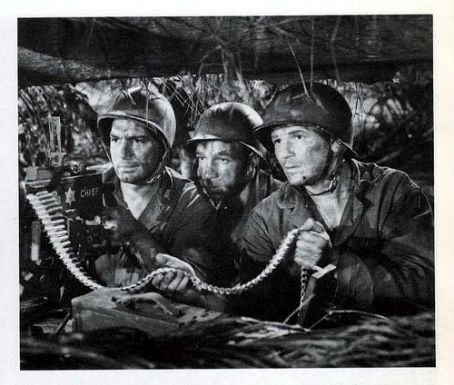
Bataan, from 1943, is a World War II drama starring Robert Taylor and Thomas Mitchell. Directed by Tay Garnett, this film features the large supporting cast of Lloyd Nolan, Robert Walker, Desi Arnaz, George Murphy, Kenneth Spencer, and Lee Bowman. Included as part of our Memorial Day weekend viewing this year, Bataan is one of my family's favorite war movies.
The film begins after the Japanese invasion of the Philippines and the departure of American and Filipino troops from the Bataan Peninsula. With only a handful of men, Sgt. Bill Dane (Robert Taylor) is assigned the task of defending a position and destroying an important peninsular bridge. Though heavily outnumbered by the enemy, Sgt. Dane and his men are determined to fight to the death.
With a well-armed Japanese army lurking unseen in the jungle, the ever-present threat of malaria, shortage of medicine, minimal food rations, and bodily weariness, this small band of men is fighting a nearly-hopeless battle. However, in the words of Sgt. Dane, "the men who died here may have done more than we'll ever know to save this whole world."
The acting in Bataan is good, the dialogue realistic. The gun and grenade scenes are extremely authentic, as is the fact that the soldiers represent people of all races. The ending scene is powerful and quite haunting...one of the best endings I have ever seen in a war film. All in all, I think this film provides an amazingly realistic account of what happened on the Bataan Peninsula.
Bataan really is a must-see film...especially on Memorial Day. While horribly depressing because nearly all the defenders die, the film serves as a vehicle to honor those who made the ultimate sacrifice. We all should watch this (and other films like it) and then give thanks for the men who gave everything so that we might live in freedom. Out on DVD, it should be fairly easy to track this one down.
Very inspiring and incredibly moving, The Fighting Sullivans, from 1944, is a Memorial Day tradition in our home. Last year, though, because I was out of town until June 10th, we didn't end up watching it (and we missed it tremendously); this year, my daughter will be gone over Memorial Day, and since she loves this film, she has requested that we wait until she returns to watch it. So, we'll be catching it a few days AFTER the holiday this year. Starring Thomas Mitchell, Selena Royle, and Anne Baxter, this film is an extreme tearjerker...you will definitely want to keep the tissues nearby.
The film is based on the true story of an Iowa family, whose five sons all enlisted in the United States Navy just after the bombing of Pearl Harbor. The boys wanted to serve their country together and were determined to be assigned to the same ship, so when their ship was attacked in the Pacific, all five boys perished.
There is very little in the way of battle scenes, as the movie focuses more on their family life when the boys were young. Though not perfect by any means, they were a functional and loving family. Thomas Mitchell portrays the boys' father, and he is alot of fun, especially when he decides that the boys' punishment for smoking is to treat them as "real men" by allowing them to smoke cigars.
The most haunting line in the movie is spoken by Ward Bond, who, as a Naval Officer, visits the Sullivan home to break the news of the deaths. When Mother Sullivan asks, "Which one?", Bond responds, "All five." Those words are haunting and devastating and serve to remind us of the truth that freedom isn't free. The Sullivan family gave so very much for the cause of freedom, as do all our veterans.
The Fighting Sullivans is a perfect Memorial Day movie, so I wanted to review it now---before Memorial Day---so as to give a heads-up about it. See if you can find it in time for the holiday, and if you can obtain a copy with bonus features, be sure to watch them. You'll have a chance to meet a descendant of one of the Sullivan brothers.
The Key, a 1958 romantic wartime drama directed by Carol Reed and starring William Holden, Sophia Loren, and Trevor Howard, is one of those films which upon first viewing, I just didn't enjoy. In fact, I came away from this film giving it only 2 stars; however, as I pondered the movie the day after viewing it, it grew on me, and while it will never be one of my favorite William Holden works, I saw some merit in the story---as well as very good acting---so, in the end, I decided this was a 3-star film.
David Ross (William Holden), a sergeant in the Canadian army, has just arrived in England for his latest assignment---that of commander of a rescue tug in the North Atlantic. Since the tugs are not well-equipped weapon-wise, they are rather defenseless, making each attempted rescue rather like a suicide mission. When David reports for duty, he discovers that his old friend Chris Ford (Trevor Howard) also commands a tug.
Wanting to get reacquainted, the two men retire to Chris's flat---a flat which he shares with a rather odd woman named Stella (Sophia Loren). As Chris explains it, another tugman gave him a key to the flat just before he died, offering Chris the use of the place should anything happen to him. Stella just happened to be part of the deal.
Three men ago, Stella was engaged to be married to the man who owned the flat; the day before their wedding, he was killed in a rescue attempt, and since he had given a key to the apartment to another man---with instructions to use it should anything happen to him---that man moved in and ended up in a relationship with Stella. He, too, was killed in a rescue attempt, which led Chris to take ownership of the key and to get involved with Stella, who by this time, is grief-stricken by all the loss she has known. Just before Chris heads out on a mission which will take his life, he gives the key to David, with the same instructions---take the flat...and look out for Stella.
Although David at first thinks Stella is just a common prostitute, it soon becomes apparent that she has loved the men she's been with and that she is so paralyzed by grief, she doesn't really even know one man from another anymore.
Eventually, David falls in love with Stella, and, loving him in return, she seems to withdraw from her grief for a time; however, before they can be married, David feels that his time is up and, so, passes the key on to another tugman. How everything plays out is the balance of the movie.
The acting in The Key is fantastic! Sophia Loren is completely sensational as Stella, a woman so scarred by loss and hurt that she is barely able to function. Really, her portrayal of such a complex woman was simply amazing. To me, she wasn't her usual beautiful self for most of the movie; however, that would be in keeping with a woman who has "shut down" due to depression. William Holden---in the most gorgeous years of his career---is beyond handsome in the role. I love him in his military uniform, and even when the jacket is off and it's just a white shirt and tie, oh, my, is he beautiful!! Looks aside, though, he was wonderful in his role. He brought such life and charisma to the character he was portraying. I felt every emotion he exuded. Trevor Howard also was really great in his role. And, finally, Carol Reed's unique way of filming tense scenes at a bit of a diagonal made for an interesting way of looking at things.
Interestingly, if you read the TCM synopsis of this film, you will find that there were two endings made. The ending on the version I watched was the one required by the Production Code. Since immoral sexual relationships were not to be rewarded, the original ending (which TCM has in their synopsis) was changed, and the version I saw reflected that change.
This film may be a difficult one to track down. While I do believe it is available on VHS, it is not out on DVD. Additionally, I haven't seen it on the TCM schedule very often---I've been looking for it for about three years now, and this past month was the first time they aired it (that I noticed anyway). However, the film is available in its entirety on YouTube (HERE). It hasn't been there for the three years I've been looking for it, but while I was putting this post together, I discovered that it has recently been uploaded. If you are able to track it down or watch it through YouTube, I'd love to know what you think of it.
Last week's big-screen experience of the masterpiece, Casablanca, was amazing. Truly, that film---and all classic films---were meant to be seen that way! Humphrey Bogart was made for the big screen!! Oh, I'm thankful for the opportunity to buy DVD's which can be watched on my television and/or computer, but, oh, how incredibly thrilling it was to experience a classic film (and the classic movie stars!) the way audiences of decades past did.
Given that Casablanca is such an iconic film---and one which I have assumed nearly everyone has seen or at least knows about---I have never reviewed it on here. (In the same way, I've never written about Gone withthe Wind, as it is so famous it needs no introduction.) However, I've come to realize that everyone has NOT seen Casablanca. While it may be a "famous" film, that doesn't mean it's been seen by all. Just as there are several "famous" films I've not yet seen (Citizen Kane, The Quiet Man, and Vertigo to name just a few), Casablanca may be one of those films on any number of people's "gotta watch it" list. With that in mind, I decided that a brief review of this beloved movie is in order.
With the Nazi army conquering Europe, terrified people are fleeing from their countries, and a stopping point for many is Casablanca, French Morocco, where they wait endlessly for exit visas so as to travel further. With so many visas in demand and so few given, naturally, corruption follows, with those who can pay the highest price receiving the coveted "freedom ticket." One man with riches on his mind is Ugarte (Peter Lorre), who intends to sell two stolen visas, pocket the money, and hightail it out of Casablanca.
Knowing the Nazi officials are hot on his trail, however, he pleads with American expatriate and cafe owner, Rick Blaine (Humphrey Bogart), to safeguard the in-demand documents. Shortly after entrusting them to Rick, Ugarte is apprehended by Nazi officials and never seen again.
In Casablanca with hopes of acquiring an exit visa for himself and his lady companion is Nazi resistance fighter, Victor Lazlo (Paul Henreid).
A thorn in the side of the Nazis, Lazlo had long been imprisoned in a concentration camp, and now that he is free and is continuing his resistance work, he desperately needs to obtain the transit papers Ugarte has entrusted to Rick. Rick, who has said he "sticks his neck out for nobody" isn't keen on providing the documents to Lazlo, especially when he discovers that Victor's companion is none other than Ilsa Lund (Ingrid Bergman, who is beyond gorgeous in this film), a woman with whom he has some sort of troubled history. (I won't disclose the nature of relationships, as I don't want to give too much away.)
All the while Mr. Lazlo is seeking to obtain the necessary exit papers from Casablanca, Nazi officials (one of which is wonderfully played by Conrad Veidt) are determined to keep him there. Knowing Lazlo would continue his resistance efforts if he is able to make his way to parts West, they seek to detain him and get him back into captivity...or to gather from him the names of other resistance members. Ilsa, meanwhile, calling upon her former relationship with Rick, hopes to obtain the papers as well; in the midst of it all, the local Prefecture of Police (fabulously played by Claude Rains), is loyal to neither side. How it all works out is the balance of the film.
Casablanca, which won the Academy Awards for best picture, best director, and best writing, is a totally brilliant film in every aspect. Michael Curtiz's direction was sensational, the casting was completely perfect, and the acting was beyond wonderful. Next to Treasure of the Sierra Madre, a film for which Humphrey Bogart did not even receive an Academy Award nomination, I think Casablanca is his absolute finest hour! He is totally fantastic in the role of Rick Blaine---definitely Oscar worthy!! I need to do a re-watch of Watchon the Rhine to see how in the world Paul Lukas snagged the win that year. Ingrid Bergman was more beautiful than I've ever seen her, and she was perfect in her role as well. Already nominated that year for her role in For Whom the Bell Tolls, she did not receive any Academy recognition for her work in Casablanca. Paul Henreid was wonderful as well. He was the perfect Victor Lazlo; especially because he hailed from Europe and spoke with a beautiful European accent, he was completely believeable in the role. Claude Rains did receive a Best Supporting Actor nomination, but he lost out to Charles Coburn for his work in The More the Merrier. (I do think Coburn was terrific in that role, but Mr. Rains was also completely stellar in his, so he was definitely win-worthy.)
Several famous movie quotes were given to us by Casablanca. Here are just a few:
"Play it, Sam." (Ingrid Bergman to Dooley Wilson, as she asks him to play "As Time Goes By" on the piano.)
"Here's looking at you, kid." (Humphrey Bogart to Ingrid Bergman)
"We'll always have Paris." (Humphrey Bogart to Ingrid Bergman...one of my favorite movie quotes)
"Of all the gin joints, in all the towns, in all the world, she walks into mine." (Humphrey Bogart about Ingrid Bergman)
I first saw Casablanca when I was 19 years old (way back in the early 1980's). At that time, I hated the film...and I hated the ending. Now, as a more mature adult, I completely love it and count it as my #2 movie of all time. Add to that, I love the ending...I think it's the right ending. Seeing this beloved film on the big screen has only increased my love for it. It was an experience I will long remember...and one which I could enjoy on a regular basis. (HINT: Let's bring a beloved classic to the big screen every single month!!)
There is one aspect of the big-screen showing which I was hoping for which did not pan out, however. I was hoping for a real stepping back in time. I was hoping that the attire of the movie-goers would reflect a 1940's flair. I am a dress-up person, and I love seeing people dressed up…men included. People of the 1940′s would no more have gone to the theatre in jeans and a flannel shirt than they would have flown to the moon. The men would have been in suits and ties, the women in dresses. Alas, I was the only woman (at least that I saw) wearing a dress…and I saw no men in suits. To me, dressing the part was an essential part of the experience, so in that aspect, I was disappointed. (However, the magic of the film itself far outweighed that disappointment!)
While my review of this incredible film and its 70th anniversary celebration really doesn't even begin to scratch the surface of it beauty, I hope that for anyone who has not yet seen this film, you have been intrigued enough to seek it out. Casablanca is, without question, a must-see film!


_02.jpg)




_01.jpg)


_01.jpg)

