Classic movies are not just antiquated films from a bygone era...rather, they are beautiful, well-acted, well-written gems that ought not to fade into obscurity. Truly, Hollywood just doesn't make 'em like they used to!!! I hope you'll discover some must-sees by your visit here.
Sadie McKee, from 1934, is a romantic drama starring Joan Crawford, Gene Raymond, Franchot Tone, and Edward Arnold. The third of seven films pairing Crawford and Tone (who would marry in 1935), this sweet little pre-code story, which chronicles the loves of working class-girl, Sadie McKee, is one I enjoyed as part of my Joan Crawford birthday month celebration.
With her mother a cook at the home of the wealthy Aldersons, Sadie McKee (Joan Crawford) has long enjoyed a friendship with the family's son, Michael (Franchot Tone). Their relationship is strictly platonic, though, as Sadie has a boyfriend...Tommy Wallace (Gene Raymond), a man who has recently lost his job due to his crooked ways. Sadie, who trusts Tommy completely, doesn't believe he has done anything wrong and runs off to New York with him.
After making plans to meet Tommy at City Hall, where they will be married, Sadie hits the New York streets, leaving Tommy behind at a cheap boarding house. When another tenant in the house flirts with him, Tommy flirts right back and ends up not only standing Sadie up, but abandoning her as well. Brokenhearted, yet determined to succeed, Sadie takes a job as a dancer in a club, where she meets drunken millionaire Jack Brennan (Edward Arnold).
Completely smitten with Sadie, the wealthy Mr. Brennan asks her to marry him. However, his good friend and lawyer is none other than Michael Alderson---and he no longer trusts Sadie. Insisting that she's nothing more than a chiseler, who will take the kindhearted man for everything he's got, Michael warns Sadie to stay away.
Will Sadie take Brennan for everything? Does she care about him? And what happens when Tommy, for whom Sadie still carries a torch, comes back into her life? And what exactly are Michael's feelings toward his childhood friend? These are the questions which play out in this sweet little film.
Sadie McKee is an interesting, enjoyable film, and although Joan Crawford gets top billing and does a great job in her role, the absolute star of the show is Edward Arnold. He is beyond fabulous as the drunken millionaire. The way he played every scene was completely perfect!! Joan is quite lovely at this point in her career, and her portrayal of Sadie was extremely heartwarming. I really came to care about Sadie. Franchot Tone was solid...and dashing as always. Gene Raymond, whose character is hardly likeable, strums a ukulele and sings "All I Do Is Dream of You," a song written specifically for this film.
Initially, I was going to go with 4 stars on this; however, the ending was rather abrupt and didn't seem to flow right, so I went with 3. Even so, though, this is a good, solid film, which I recommend---especially to Joan Crawford fans.
The film is out on DVD so it ought to be fairly easy to track down. Happy viewing!!
The Prowler, from 1951, is a mildly suspenseful film noir starring Van Heflin and Evelyn Keyes. Though I am not overly familiar with Miss Keyes, I was quite interested in this film because of Van Heflin. Since I've developed an appreciation for him, I've been trying to catch as many of his films as possible. He definitely had a vast range of ability, as this film finds him playing what I would say is against type.
When Susan Gilvray (Evelyn Keyes) discovers a man peering in her window while she is taking a bath, she puts in a call to the police. Two officers, one of which is Webb Garwood (Van Heflin), answer the call, but after looking around a bit and finding no evidence of a prowler, they take their leave. Soon though, Officer Garwood, who had been instantly attracted to the beautiful, wealthy woman, is back again. Telling Susan that it is routine to make a follow-up visit, he manages to get invited into the house, where he has a glass of milk and a bit of conversation.
Since Mrs. Gilvray's husband works nights, Officer Garwood tells her that he will make it a point to stop by regularly to check on her, just to be sure that there aren't any prowlers hanging around. Eventually---though Susan is at first reluctant---the two of them fall into a passionate affair. Wanting not only Susan, but her husband's life insurance money, Webb jumps to the other side of his badge and kills Mr. Gilvray. Claiming he shot at a prowler while keeping watch on the home, Webb is cleared of any wrongdoing...but can he really get away with murder? Can he and Susan have any kind of a future together when their being together was accomplished through such devious means? Will Susan, who has come to see Webb's wickedness, even want to stick by him? These are the questions which play out in this exciting little film.
The Prowler is definitely an interesting, enjoyable movie. Quite honestly, I was going to go with 4 stars, except that the last 20 minutes (the ghost town scene) were too far-fetched for me. (Maybe because I'm not a lonely, desolate place kind of gal, so settings like that just seem bizarre.) Anyhow, this is really more like 3.5 stars. I am only just now getting into Van Heflin, so I haven't seen a whole lot of his work; however, of the films I've seen, with the exception of They Came to Cordura, he has always been a solid, upstanding, very likeable kind of man. This role definitely showed another side to him, and I think he played the part very well. Evelyn Keyes was good and believable in her role as well, and she and Mr. Heflin worked well together.
This film is out on DVD, and it is also available in its entirety on YouTube, so you shouldn't have any problem tracking it down.
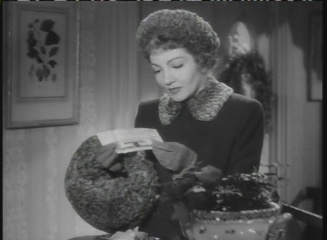
Tomorrow Is Forever is a tender, heart-tugging 1946 drama starring Claudette Colbert, Orson Welles, and George Brent, with Lucile Watson, Richard Long, and a very young Natalie Wood taking on supporting roles. I caught the last half of this film about three years ago when a local station aired it. I totally loved what I saw and definitely wanted a chance to watch the whole movie; however, at that time, it wasn't out on DVD, so I patiently waited about a year for it to get on the TCM schedule, at which time I was able to view the entire film AND record my own copy on disc. (Good things come to those who wait!!) This is easily my second favorite George Brent film (just behind Dark Victory), and in celebration of his birthday month, I have recently enjoyed a re-watch.
Claudette Colbert is Elizabeth MacDonald, a recently married woman, whose husband, John (Orson Welles), enlists in the Army and departs for Europe in the final months of World War I.
John is horribly disfigured by a bomb and spends many months in a European hospital.
However, word is sent to Elizabeth that her husband has died.
When it is discovered that Elizabeth is pregnant, Larry Hamilton, the man Elizabeth works for (played by the the VERY dashing George Brent), invites her to come live at his home, where his aunt (Lucile Watson) will be able to care for her.
Eventually, Larry falls in love with Elizabeth and marries her, raising her child as his own. The child isn't aware that his mother had been married before or that Larry is not his real father.
Fast-forward twenty years, to the beginnings of the second world war. Elizabeth and Larry's son (named John Andrew after his biological father) is all grown-up and wants to join the war effort in Europe. Elizabeth cannot bear the thought of her son going off to war----to lose him would be like losing John all over again.
Meanwhile, Larry's company has hired a new consultant, a newly-arrived European refugee with a young daughter (Natalie Wood, in her first credited role). This man, known as Erich Kessler , is none other than John MacDonald, and he, of course, recognizes Elizabeth immediately.
Will recognition dawn for Elizabeth? What will happen to her marriage to Larry? Will her obsession with the past and her fear of the past repeating itself tie her son to her apronstrings forever? Will Eric/John tell Drew that he is his father? All these questions will be answered by the end of this very touching film.
George Brent is completely wonderful in this film---he's the proverbial knight in shining armor. And I love that little bit of gray which was added at the temples in order to age him 20 years.
Claudette Colbert is her usual elegant, classy-looking self. Orson Welles, who I'm not overly familiar with, was very good in this role. His chemistry with the young Natalie Wood was terrific. And speaking of Natalie Wood, Robert Osborne said that Irving Pichel, director of this film, had seen her in an earlier uncredited role and when he needed a little girl for Tomorrow Is Forever, he remembered "the little girl with the big eyes" and sought her out. Although her first screen test didn't "wow" him, at her mother's request, he gave her another test, and "voila!" a star was born.
Tomorrow Is Forever is a very heart-tugging movie. Though it doesn't bring sobs, it definitely gets me misty-eyed a few times. The film is now out on DVD (having been released last summer), so you ought to be able to track it down. It is also available in its entirety on YouTube (HERE). Definitely see it if you can---I think it's a beautiful film.
The passing of our favorite stars is always a sad event, yet it becomes even more sad, when the death is sudden and takes us by surprise...or when the passing star is young and still in what we think is the prime of their life. It is in memory of those stars---the ones gone far too soon---that Comet Over Hollywood is hosting the "Gone Too Soon" blogathon.
One such star who left this world much too soon is Montgomery Clift, who passed away at the age of 45. (October 17, 1920 - July 23, 1966). The fabulous Mr. Clift is not just on my favorite actor list---he is near the very top. In fact, he has the honor of being one of my "beloveds." I am quite wild about him, so I was thrilled to have the opportunity to "sing his praises" during this blogathon.
Though Montgomery "Monty" Clift's death date is officially listed as July 23, 1966, in many ways, he died ten years earlier in May of 1956, when he was involved in a car crash. The single-car accident, which occurred after a party at his good friend Elizabeth Taylor's house, not only left his face partially paralyzed (and so dramatically altered that he took down most of the mirrors in his home), but it left him in so much pain that he lived his remaining years addicted to drugs and alcohol. (Though he had problems with alcohol and drugs prior to that night, afterwards his use grew ever more intense.) According to Mr. Clift's biographer, Patricia Bosworth, "he survived (the crash)...and lived for ten more years, but his real death occurred as he lay bleeding in Elizabeth Taylor's arms. Nothing would ever be the same for him after that night." Others have called Monty's death, "the longest suicide in Hollywood," because although the official cause of death was a heart attack, the reality is that years of alcohol and drug use had taken their toll on this amazingly talented man.
Prior to beginning his film career, Monty was a stage actor. After taking part in an amateur production at the age of 12, his sights were set on Broadway, and from the time he was 14 until well into the 1940's, he performed on the stage, working with such greats as Dame May Whitty, Tallulah Bankhead, Sydney Greenstreet, Mr. and Mrs. Fredric March, and even a young Elia Kazan. His acting was always praised---even if the play itself was a flop, most critics had positive words for Mr. Clift's performance.
One of the most incredibly gorgeous men I have ever seen, Mr. Clift was indeed a truly brilliant actor. What the critics saw in him during his years on the stage, they would continue to see as he moved to the screen. In a film career of 17 films, he received three Best Actor Academy Award nominations and one Best Supporting Actor nomination; sadly, though, he didn't come away with any. (For the record, I think he was definitely robbed in 1951. My apologies to all you Humphrey Bogart/African Queen fans, but I think that year belonged to Monty for A Place in the Sun.) Of his 17 films, I have seen 14, and I think he was totally stellar in every single one of them. I will highlight a few of my favorites.
A Place in the Sun (5 stars), which I just reviewed yesterday (HERE), is one of my top 3 movies of all-time. I absolutely love this movie. It is one of those films which I always wish had a different ending than the one it has. For this role, which saw Monty and director George Stevens arguing incessantly about the the final scene, the very diligent actor spent the night in the San Quentin death house. Doing that was his way of preparing emotionally for the rigors of portraying a condemned man.
The chemistry between Mr. Clift and co-star Elizabeth Taylor was completely incredible in this film. Though Hedda Hopper predicted marriage for the two of them, they were, in fact, only friends---very dear friends---for the remainder of Monty's life.
I Confesss (5 stars) has the distinction of being my all-time favorite Hitchcock film, and, again, Monty was completely fantastic in his role. Incidentally, his character in I Confess, Father Michael Logan, is one of my all-time favorite film characters...a man of honor and integrity, no matter the cost. This role greatly excited Monty, because his character was one who was "faced with a terrible crisis." In preparation for this role, Mr. Clift spent a week at a monastery in Quebec, memorizing the entire Latin mass and learning how to say the rosary and the Stations of the Cross. Karl Malden, one of Clift's co-stars in this film, said of him, "Monty was marvelous in I Confess. His ability to project mood and a held-back strength is quite extraordinary---it's a high point in the film."
I also totally love From Here to Eternity (5 stars---reviewed HERE), the film for which he received his third Best Actor Academy Award nomination. His role of Robert E. Lee "Prew" Prewitt was another of those which, like Father Logan in I Confess, intrigued him because of the "terrible crisis" his character endured. Fred Zinnemann, who had directed him in The Search, had long wanted Monty for this role; however, Columbia Pictures president, Harry Cohn, wanted Aldo Ray, and it wasn't until Zinnemann threatened to drop the project that Cohn agreed to Clift in the role. Deeply immersed in the role of Prewitt, Monty carried a copy of the novel around and referred to it constantly, and the book grew tattered from its continual use. For this film, Monty---who always set out to master something new for each of his roles---learned to play the bugle.
Although he made no sound on film, he wanted his mouth and throat movements to be as authentic as possible. Also, in preparation for this role, he spent weeks boxing. In the end, those things made his portrayal of Prew completely perfect---it was a performance of which he was proud, and for the first time, he was upset about not winning the Academy Award. (William Holden won for Stalag 17 that year.)
Judgment at Nuremberg (5 stars) is the film for which he received his final Academy Award nomination, for that of Best Supporting Actor. Originally he was asked to consider the part which ultimately went to Richard Widmark, but in the end he chose the bit part of the mentally-challenged Jew, because he felt the role had something important to say. His seven-minute performance in that film---for which he took no salary, only expenses---was totally brilliant...and heart-rending. Without a doubt, I think he was Oscar-worthy there.
The Search, (4 stars---reviewed HERE), which was Monty's second film appearance, was considered by him to be "the most fulfilling artistic experience of his life." Wanting to be completely prepared for his role, which garnered him his first Best Actor Academy Award nomination, Mr. Clift lived for a time in an army engineer's unit, dressed in army fatigues, and toured U.N. Relief and Rehabilitation camps in Germany. He was totally driven to make his character and the film authentic, which resulted in numerous improvisations of the script and endless battles with the film's producer. In the end, though, the film received unanimous acclaim and Monty, who was pleased with his performance, became one of Hollywood's hottest stars.
.
Now a "hot commodity," Monty was soon approached by director Billy Wilder, who had written the script for Sunset Boulevard (my #4 movie of all-time), with Monty specifically in mind. Originally excited about the project, Monty committed to it; however, while in Germany shooting The Big Lift, he received the final script, and he backed out, which then provided William Holden with the role. Mr. Clift's biography states that he never regretted the decision to not do the film. It was surmised by his agent that the decision to bow out was because the scenario too closely resembled the ("closely guarded at the time") relationship he had with the much-older-than-himself stage actress, Libby Holman. While I completely adore William Holden and consider Sunset Boulevard to be his most brilliant work (and my favorite of his films), I can very easily see Montgomery Clift in that role.
Much of Monty's tortured, troubled soul was the result of his sexuality. While some have said he was gay, his brother, Brooks, maintains that he was, in fact, bi-sexual. He had relationships with women---many of them---including a long relationship with the years-older Libby Holman. Regardless of whether he was bi-sexual or fully gay, Monty was in deep agony for years about his sexual preference, and the guilt he carried consumed him. Deborah Kerr, who starred with him in From Here to Eternity, said "He wanted to love women but he was attracted to men, and he crucified himself for it." The agony of conscience, combined with his alcoholism, drug addiction, constant pain, chronic health problems, and extreme insecurity took their toll, and two months after completion of The Defector (one of his films I have not yet seen), at the age of 45, Mr. Clift departed this world. His final resting place is in a small Quaker cemetery in Brooklyn, New York.
In preparation for this post, I read the book Montgomery Clift, a Biography, by Patricia Bosworth, (all quoted material is from that book, which was published in 1978). This biography, which the author researched with help, in part, from Mr. Clift's brother, Brooks, is a fascinating---yet heartbreaking---read. Troubled nearly all of his life, Monty doesn't appear to have ever really known happiness, and that breaks my heart. (Though there are more recently-published Clift biographies on the market, to be quite honest, this one was graphic and heartbreaking enough. I have no need or desire to read more current works, which most probably contain much greater ugliness.)
So, Mr. Montgomery Clift, as we remember the beloved stars who left this world much too soon, I can't help but remember you. You were an amazingly fantastic actor---one of my absolute favorites---and you provided the world with many wonderful films. Thank you for bringing such fabulous and powerful films to life!!
For the next two days, the "Gone Too Soon" blogathon will be taking place here in blogland. A way of remembering the many stars who left this world much too soon, this great event is being hosted by Comet over Hollywood. Since the star I am remembering during the blogathon is the fabulous Montgomery Clift, I decided now was the perfect time to re-work one of my very earliest posts (which I did before I had even one blog reader). So, in honor of Mr. Clift...
A Place in the Sun, from 1951, is a powerful romantic drama starring Montgomery Clift, Elizabeth Taylor, and Shelley Winters. Winner of six Academy Awards and nominated for three more, this fabulous film is high on my list of all-time favorites. In fact, it's very near the top, coming in anywhere from #1 to #3 (depending on my mood). I absolutely love this movie and could watch it every couple of months. It's one of those films which I always hope has a different ending than the one it has.
Montgomery Clift is George Eastman, a rather down on his luck young man from the wrong side of the tracks. He arrives in town and at the home of his wealthy uncle, who owns a factory. Though the uncle had told George to look him up if he ever came to town, it is quite obvious that the older man never really expected George to do that. Feeling obligated, though, he gives his nephew a job at his factory---with the strict instruction to not fraternize with the employees. Not really accepted by his wealthy relatives, though, George is lonely and soon finds himself spending time with factory worker Alice Tripp (Shelley Winters).
In short time, George and Alice have begun having a physical relationship, which results in pregnancy. Although Alice hopes to have an abortion, her doctor will not perform one. (Although the actual word "abortion" is not used, you know that's what she is after.) George is extremely distraught at the news of Alice's pregnancy...not only because he doesn't love her...but because he has fallen in love with wealthy socialite, Angela Vickers (played by an amazingly beautiful, 19 year-old Elizabeth Taylor).
After all the loneliness and rejection he's known, George has finally found love and acceptance. But his happiness is quelled by Alice's insistence that he marry her...something he does not want to do. So he begins to ponder a way of getting Alice out of the picture.
Does anything happen to Alice? Does George marry her? What happens to the baby? And what about Angela and George's love for each other? These are the questions which play out in the balance of this incredible film.
As I said, this is not a feel-good movie at all . In fact, I find it haunting...not in a scary sense, but in the fact that every time I see it, it stays in my mind for days. It is also a great "discussion piece" kind of film. I've discussed it with other classic movie fans (including my 20-ish daughter), and it is amazing how two people can look at the same thing and see things completely differently from one another. While some people look at George as a "scum bag" who used Alice and then wanted to drop her when something better came along, I don't see him that way at all. Instead, I see him in a sympathetic light. (And you won't hurt my feelings if you disagree with me.) Also, despite the snobbiness of her upper class friends and family, Angela possessed a real inner beauty, as she exhibited completely unconditional love for George. Since real and true love isn't based upon the perfect behavior of the recipient and is offered even when the recipient screws up, Angela's love for George was real and very beautiful.
The acting in this film is brilliant! Montgomery Clift's performance was beyond fantastic---the way the emotions played across his face and in his eyes as he struggled with his conscience was incredibly vivid. Truly, I think this was the best performance of a career in which all the performances were spectacular. He received a Best Actor Academy Award nomination for his work here, and I, for one, think he deserved the win that year. (Sorry to you Humphrey Bogart/African Queen fans.) Shelley Winters, who received a Best Actress Academy Award nomination, was amazing in her role too. Elizabeth Taylor was perfect as well. Not one of them could have been improved upon.
Just as an aside, I think Montgomery Clift is one of the most beautiful men I have ever seen---at least prior to his May, 1956, car accident. (After his accident, which left his face partly paralyzed, his looks were dramatically different.) He is fabulously good-looking in this movie. And while I'm not an Elizabeth Taylor fan, I think she is stunningly beautiful here. It's easy to see how she became the major star that she did. The two of them, who were very dear friends off camera, have incredible chemistry with one another in this film. Their passion is real and believable...and extremely sensual.
This incredibly moving drama is out on DVD, so it should be quite easy to track down. If you like mature, meaty, thought-provoking dramas, definitely make it a point to see A Place in the Sun.


_03.jpg)




_04.jpg)


_NRFPT_03.jpg)


_NRFPT_01.jpg)